The Kemper Art Museum (1 Brookings) is delving deep into the work of the Argentine modernists living in Buenos Aires throughout the mid-20th century in its new exhibition Buenos Aires Modern, on display September 9—January 4, 2027. The exhibition focuses on artistic duo Horacio Coppola and Grete Stern, as well as the artistic community that surrounded them.
The three-room exhibition, curated by Dana Ostrander, travels between different time periods in Coppola and Stern’s lives, starting in the 1930s with the mass European migration to Argentina spurred by the rise of fascism and anti-semitism in post-World War I Europe. Jewish immigration in particular was at an all-time high, such that Buenos Aires’ Jewish population rivaled that of New York’s, says Maria Calsyn, Coppola’s stepdaughter and St. Louis resident. Ostrander notes that, as a result, cultural exchange is incredibly prevalent in the work.
Stay up-to-date with the local arts scene
Subscribe to the weekly St. Louis Arts+Culture newsletter to discover must-attend art exhibits, performances, festivals, and more.
“[Stern] started out working in a very German, Bauhaus mode,” she says. “People didn’t necessarily understand her photographs when she got to Argentina, so she shifted into a different vernacular. She adapted her practice to suit the desires of her Argentine clientele, but she still retained some of the traits of Bauhaus photography: stark scenes, she’s not retouching things, she’s portraying people in pensive modes. It’s not necessarily very flattering portraiture, but it’s portraiture that shows the soul of the individual more than how they might wish to look…it’s a blend of her training in Germany and what people anticipated a portrait would look like.”
A broader goal of the exhibition, Ostrander says, is to debunk the common myth that Latin American artists with avant-garde leanings, such as Coppola, were solely inspired by European artists.
“Coppola was influenced by Europe, but I think he maintained that this was his own vision,” Ostrander says. “It was rooted in the city of Buenos Aires, which makes it its own unique thing.”
On display in the exhibition is Coppola’s landmark photograph “Esto es Buenos Aires” (This is Buenos Aires), named for Argentine short story author Jorge Luis Borges’ reaction upon seeing the work. The photograph, which shows a building reflected in a puddle on the side of a city street, is an example of Coppola’s boundary-pushing modernism.
“[Coppola] had this style which was quite modern for Argentines at the time,” Ostrander says. “People had no sense that [the style] would be a beautiful fine art photograph.”
As the exhibition shifts into the 1940s, the presence of the artistic community forming around Coppola and Stern begins to take shape. Architectural plans for the couple’s home in Buenos Aires are on display, as well as Gyula Kosice’s “La Ciudad Hidroespacial” (The Hydrospacial City), a model of a futuristic flying city in which each room in a citizen’s house was modular (the flight, for curious parties, was powered through hydropower, at least in Kosice’s conceptions). Coppola and Stern’s home was often a gathering place for young Argentine avant-garde artists, even after the couple’s divorce.
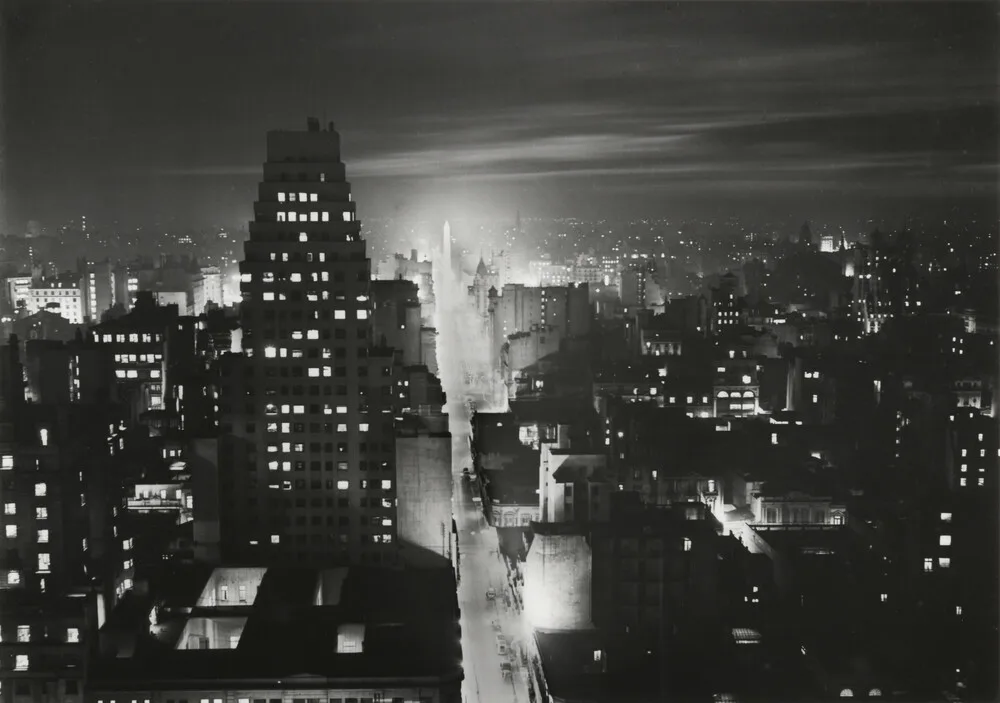
The final room of the exhibition displays large, boundary-pushing sculptural works of Kosice, as well as a large cityscape taken by Stern.
Sole Van Emden, Calsyn’s daughter, emphasizes that, above all, Coppola and the Argentine modernists lived their art. Rather than the work being a mere expression of their creativity, they continued to push the boundaries of what was possible through everyday innovations. Calsyn recalls that an elaborate pulley system ran through Coppola’s house, and her stepfather was “always fiddling” with something.
“It’s the mentality of Kosice as well,” Van Emden adds. “Always searching, and inventing, and living with your inventiveness.”
The artists, Ostrander says, believed that their artworks would change the world. Nearly a century later, it’s not difficult to see why.
Buenos Aires Modern is on display September 9—January 4, 2027. Admission is free to the public.