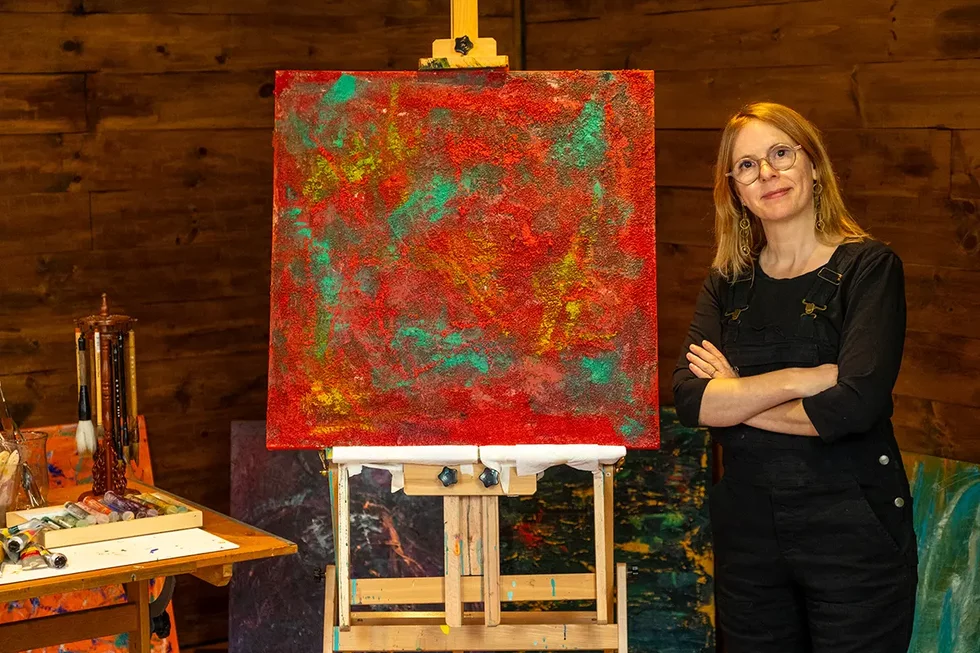
By the time composer Anna Clyne steps onto the stage at Touhill Performing Arts Center on Valentine’s Day, St. Louis audiences will have already heard plenty about her adventurous new work: PALETTE, a Concerto for Augmented Orchestra. Synesthetic by design, this multisensory event melds orchestral sound, lighting design, real-time electronic processing, and seven original paintings that Clyne herself created to complement the music.
“I love to express myself, be it through music or poetry or art,” Clyne says. “Music is something I’ve dedicated more time to, but I do love painting. And with this piece, I really wanted to explore incorporating painting into the creative process.”
Stay up-to-date with the local arts scene
Subscribe to the weekly St. Louis Arts+Culture newsletter to discover must-attend art exhibits, performances, festivals, and more.
The fusion of media is, of course, familiar to Clyne, a London-born composer now living in New York’s Hudson Valley. Clyne often draws inspiration from painting, poetry, and dance. When composing Night Ferry (whose title comes from a line in Seamus Heaney’s poem “Elegy” for Robert Lowell) more than a decade ago, she painted a long mural and translated its turbulent imagery into music. But PALETTE dives much deeper into combining disciplines.
“It’s the first time that I’ve really been this ambitious, to create seven cohesive, connected pieces of art,” Clyne says.
PALETTE will have its world premiere with the Saint Louis Symphony Orchestra and music director Stéphane Denève during the orchestra’s Valentine’s Day weekend program on February 14 and 15 at the University of Missouri-St. Louis’ Touhill Performing Arts Center. It’s a concerto for orchestra in the spirit of Bartók, only Clyne’s version introduces a new twist. She calls it the “Augmented Orchestra”—an innovative technique developed with Grammy Award–winning audio engineer Jody Elff that applies real-time electronic processing to the ensemble’s sound.
“New audience members hearing the Augmented Orchestra for the first time probably—and hopefully—won’t be able to discern sometimes what’s the acoustic orchestra and what’s the augmented sound,” Clyne explains. “The processed sound is responding to the hall, to the dynamics of the instruments, to the conductor’s tempo, to all those very organic elements. It’s responding in the same way that the acoustic orchestra is.”
The sonic transformations are subtle and integrated. There’s no canned audio, no prerecorded samples. Instead, the electronics stretch, bend, and enrich the live instrumental voices.
“Audience members will be hearing this sort of kaleidoscopic color, in a way, but hearing the orchestra through a new lens,” Clyne says.
Color is an essential element of PALETTE. The title itself is an acronym for seven striking hues: plum, amber, lava, ebony, teal, tangerine, and emerald. These colors correspond to seven movements, each paired with one of Clyne’s paintings. Lighting designer Luke Kritzeck will further immerse the audience by bathing the hall in these shifting shades as PALETTE progresses through its movements.
“We’re also collaborating with [Kritzeck] to expand the experience so that the audience is enveloped in these hues of color that morph and shift as the piece evolves,” Clyne says. “It’s really creating an immersive experience for the audience, and hopefully a new angle on the orchestral experience.”
Clyne has worked with the Saint Louis Symphony Orchestra and Denève before, most notably on the U.S. premiere of her 2021 piece PIVOT. She has since developed a close rapport with both the orchestra and its music director.
“Relationships are at the heart of any community, but especially in an artistic community,” Clyne says. “It’s made the process of writing much more personal to know the musicians I’m writing for. Stéphane has programmed several of my works with the orchestra, so he knows my music very well. It’s great to have that foundation going into a piece like PALETTE, which is taking a lot of risks. I couldn’t imagine a stronger team to be trying this out with.”
PALETTE shares the Valentine’s Day weekend program with two beloved masterworks from Russian greats—Sergei Rachmaninoff’s Piano Concerto No. 2, featuring pianist Nikolai Lugansky, and Pyotr Ilyich Tchaikovsky’s Romeo and Juliet.
“It’s a really interesting program,” Clyne says. “They’re very emotionally driven pieces. They’re also very melodically driven pieces. I love Rachmaninoff’s piano concertos for that—he just spins. And, of course, Tchaikovsky was a great melodist. Melody is very much at the heart of my music, and especially for PALETTE.”
Much like Bartók’s Concerto for Orchestra, PALETTE spotlights different sections of the ensemble, giving the orchestra itself a soloistic role.
“Different movements focus on different groups of instruments,” says Clyne. “The opening movement, ‘Plum,’ features the harp and the piano. The second movement, ‘Amber,’ features the woodwinds. The third movement, ‘Lava,’ features the strings. ‘Ebony’ features percussion, ‘Tangerine’ features brass, and so forth. So it’s highlighting the colors and personalities of the orchestra. Within those constructs, melody—or sometimes just snippets of melody—drives the music.”
Clyne—who, as a young pianist and cellist, started composing short pieces to play with friends—didn’t receive formal composition instruction until her twenties, when she worked closely with influential mentors such as Georgian composer Marina Adamia and composer and New York University professor Julia Wolfe.
“The most important thing [Wolfe] taught me was to trust my intuition,” Clyne recalls, “which sounds obvious, but it’s one of the hardest things to do when you’re finding your own voice as a composer—or as any kind of artist.”
As the musicians and creative team for PALETTE prepare for its debut, Clyne is already looking toward its future. How can the Augmented Orchestra endure beyond its creators’ direct involvement?
“As a composer, you want a piece to have a robust life,” Clyne says. “For the world premiere and most performances of PALETTE, Jody [Elff] will be there in person, operating the electronics. The next stage is having it all pre-programmed, so a musician from within the orchestra can simply press a MIDI [Musical Instrument Digital Interface] keyboard and trigger the processes, making it more nimble. I think pushing boundaries and experimenting is the key to progress.”