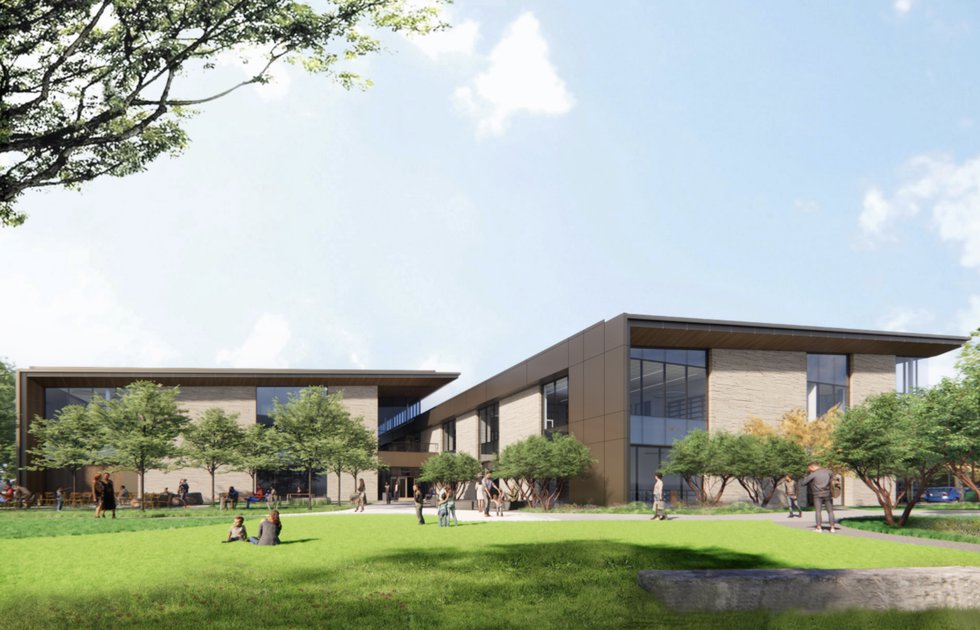
After a decade of renovations, revamps, and new construction, the St. Louis County Library has reached the end of its 10-year “Your Library Renewed” campaign. The final two projects on the slate will see the current headquarters branch, which also houses SLCL’s administrative offices, replaced with a new Ladue Branch, while administrative operations move to the new Lynn Beckwith, Jr. Administrative Building. We recently caught up with Amy Luchun and Ellen Eckert of Lamar Johnson Collaborative to discuss plans for Ladue’s forthcoming library.
Tell us a bit about why the current HQ branch is being replaced.
Stay up-to-date with the local arts scene
Subscribe to the weekly St. Louis Arts+Culture newsletter to discover must-attend art exhibits, performances, festivals, and more.
Amy Luchun: There was a 10-year master plan for the entire district. And this project is the final project of the 20 branches of that plan. We were awarded the project back in early 2018 and began working on programming the building. The current facility in Ladue is one of [SLCL’s] busiest. You can go to their website and actually see the stats on how many visitors they have and how much circulation goes through that main branch. They waited to do this until the end because it’s the busiest branch of all their branches. Thinking about how to navigate that and keep the district operational throughout the whole process was a really difficult task. The existing building has two things mashed together, and part of that difficulty of thinking about shutting down one is the operations portion. Operations are what circulates collections through the entire district. The other part of the building is the library branch, where you go and visit and see the authors and check out a book or talk to small businesses. So, the first step was programming and figuring out how to make this branch more successful for the future, because it has some conflicts in how it’s currently laid out. That was a product of the building being 60 years old and just kind of outdated. It’s leaking, it needs a lot of repairs, and it’s just past time for it to be revamped.
Ellen Eckert: I think a lot of patrons probably noticed that a lot of their branches have been renovated. Unfortunately, this building was not a good candidate for a renovation in that the existing building’s structure is unique. The bookshelves on the operations side are actually holding the building up as part of the structure. I wish every patron could go and see how this library is functioning right now. It is unbelievable what their staff is doing to get this county and patrons our books. They have ramps and elevators that are not in great working condition, just things that are keeping them from serving the public more efficiently. So that’ll be so much better when they move to their new Branch. But for the existing Ladue Branch, like Amy said, it’s set up like a ’60s library, and they’re trying to make it into a 2022 library, which is doing way more than it did back in the 1960s.
How is this new building going to support programming?
EE: I think we all know that [the library] provides technology and really focuses on children and teens, but they also support authors who come to their building, and they don’t really have a dedicated space for that right now. Right now they have to shut down their library. They have to move all the books just to host an author event. The new building will offer more flexibility for more author events, and more use for the public for other library events as well. So I think that’s the cool part. They will have more spaces that are supporting all those different groups versus always having to adapt their current space, which is the best they can do right now. And now it’ll be the best that it can be.
What were some of the key goals in mind when designing the new space?
EE: If anybody has driven into the library’s parking lot, it is like going onto a rollercoaster. As you enter the site, you kind of go down a hill. There’s a lot of cars because it’s a busy location, and that was something from day one that we knew we were going to have to improve and make safer and more efficient. There [are] a lot of unique programs for this building. We have the event space. We also have a teen space that includes a creative lab, like a maker space. And then children’s programs. So many patrons bring their kids to the library so their kids can play and read books, and they always do something special for children. And we are doing that here too with a little cityscape, where they will have storefronts, a restaurant, a grocery store, and things like that. So they can go in and play, as well as having little spaces for them to read as well.
AL: I don’t think I even knew this before I started working on this project, but their history and genealogy collection is one of the largest in the country. People from all across the country come to this library because it has such an extensive resource of books that other libraries don’t have. So that’s something else that’s been kind of an interesting challenge. How do you showcase all these different programs?
EE: There’s also a small business component to this that they really want to give space for, almost like a co-working space where people can go for help with how to start a business, how to do their taxes, all those things the library system offers. They wanted a space for that, too. So I think from the beginning, we knew we had our work cut out for us to get all of these programs into the space.
AL: The overarching theme that the library director gave us from the beginning to keep in our heads is that libraries are not just for books anymore. That’s really important, because the current facility was designed all around books and book storage. And this is really more about all the other services out there that a library can offer its a community.
What has it been like working with the library system, and how did you get from their goals to these plans for Ladue?
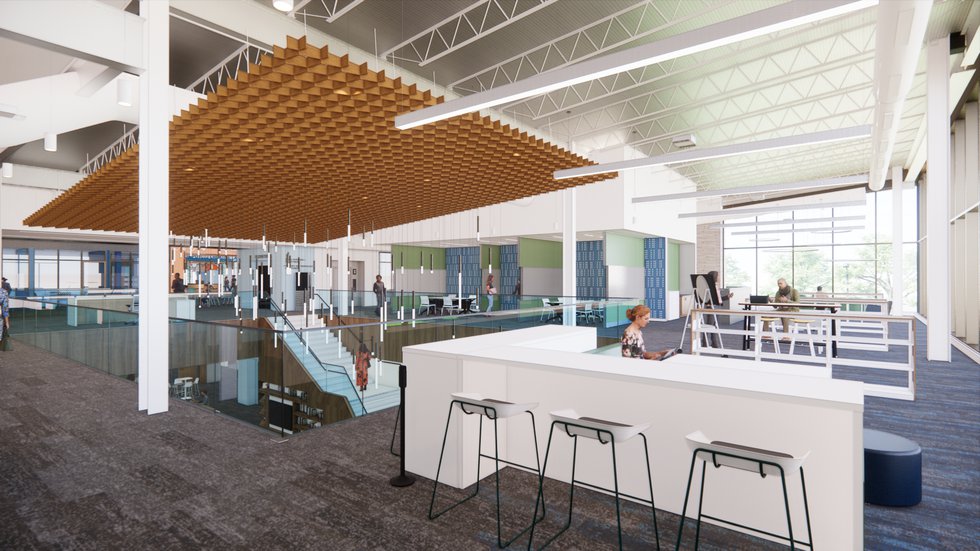
EE: A lot of meetings. Like Amy was saying, it’s not just about books. We visited all of the libraries and branches to kind of see what works and what doesn’t. That’s always so valuable. I think going into the Ladue Branch now, you can see what’s not working. It’s so set in the past, but I think they have so many great success stories from their current branches. We definitely did lots of site visits. [SLCL has] been such a great partner in going through the design process. We’re very hands-on with them…it’s really a process that we did with them and just brought them along. That way they felt like they were part of the design process, because they’re the most important part, making sure we get it right for them. From the early stages, we did more diagrammatic planning of bubbles and shapes and things like that, and then, as we have developed it, we’ve always been showing them everything in 3D. Every time we meet with them, we walk through the building in 3D, and that has been so valuable to them. I think that has been probably one of our most successful tools in helping them understand what it will feel like.
With this being the last branch, how much did the previous projects factor into this one?
AL: All different architectural teams have worked on those, and they’ve done amazing jobs. We kind of played off of that and took the best elements of all the branches to make this building just fit in with the 19 other branches that have been renovated or added onto or made brand new. Then it becomes a very cohesive district. So the architecture was really important for us to get right. There are some similarities. There are certain things that are going to be similar to all branches. For example, the employee circulation workrooms are slightly different at every branch because they’re bigger or smaller, but they all kind of function in the same way. So there are certain things at the heart of each branch that are very similar. The architecture speaks to the area and to the patrons, but it works together as a district. Now they all work together. And I think that was really important to say as a district, that it’s all one.
EE: I was just so pleasantly surprised at how I started to have my own favorites. It’s fun to talk with the librarians and just understand some of the nuances and small things that we could change and make better for the branches. I like seeing the evolution of [the various branches], and even the other architecture firms. Obviously, we haven’t been involved in every single one, but it’s fun to see their growth over the years. They’ve learned a lot.
What elements of this new space are you most excited for people to see?
EE: I really am just excited that there’s just going to be this really warm sense of home and place. We are incorporating small features that are really making it feel so welcoming to all the patrons. So I think giving all these different places for people to sit and read and interact with other individuals…I’m excited to see all of that come together. We’ve given so much variety in the space. I’m just excited to see the interaction that happens in the library in the future.
AL: There’s definitely a sense of pride in every single branch, so we’re trying to bring that forward but in a new way for Ladue. We worked really, really hard on the architecture on the site. It’s currently a building just surrounded by asphalt. The new setting will have really pretty landscaping. It’ll have outdoor choices for people to enjoy. It’ll just speak architecturally a little bit better to how you enter the site, and it’s safer. It’s just bringing forth what Ladue has now, but in a much better way.
What does the timeline for the project look like right now?
AL: The drawings will go out for bids in late spring, and then there’s usually a six-to-eight-week timeline for bidding. Then the award will happen in the Summer of 2022. Once that happens, that kicks off the construction process, and it’ll be probably a year and a half to two years of construction to remove the building, then get the site prepared, then to start building the building.
What do you most want people to know about this project?
AL: I want people to realize that it took a very large team and that the library did everything to be inclusive of their staff and of the patrons as well. I think the library and the larger team in general did such a good job of just being inclusive to the patrons and the staff.
EE: I would say that patrons need to go check out their libraries. If they haven’t checked it out, they need to really see. I mean it’s just mind-blowing the number of services that they offer. I really had no idea how much they did for this community. And I think that people would be blown away at what is being offered to them. I would say throw your 1960s, whatever your last library experience was, out the window. Go check out your library. They’re doing great stuff. It’s amazing.