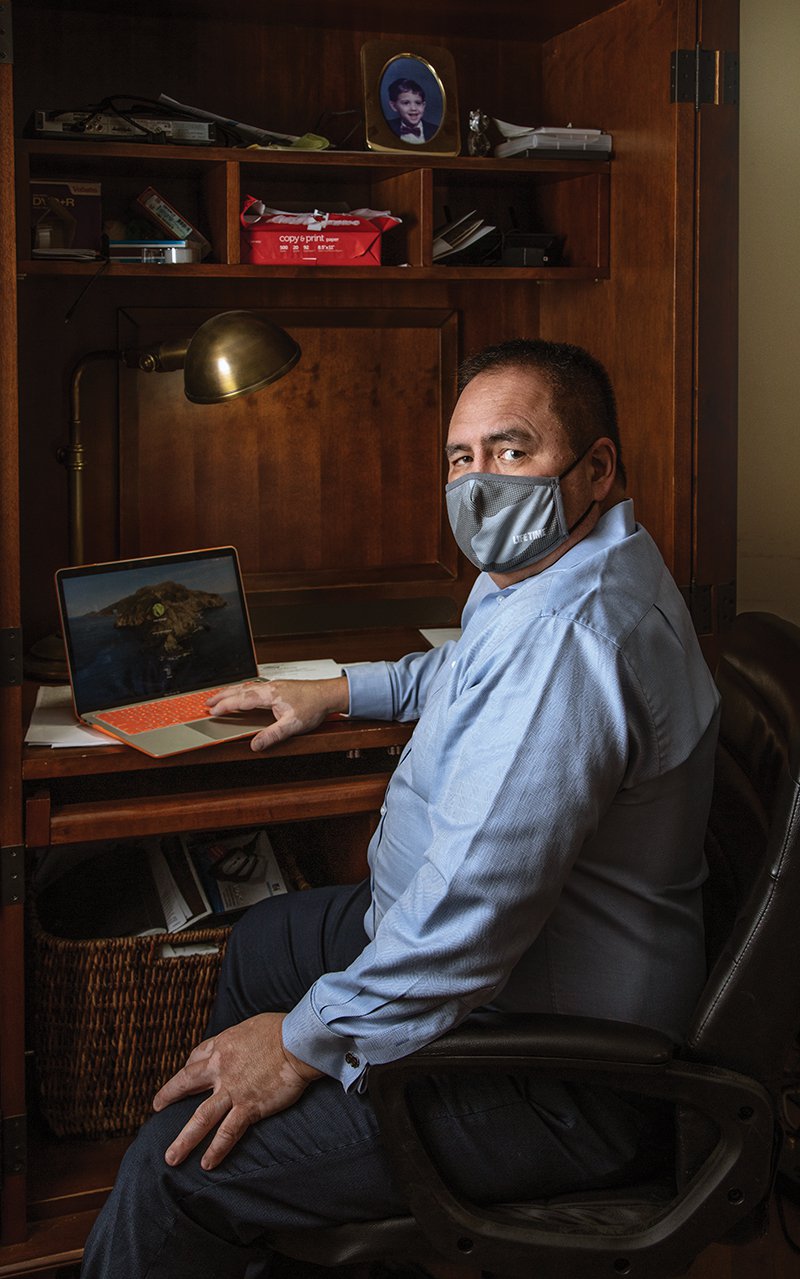
Just before the United States began shutting down to help prevent the spread of COVID-19 in the spring, emergency physician Dr. Larry Prablek visited New York City. While watching a Broadway musical with her father, his daughter noted that his hands looked discolored. It was odd, but he didn’t give it much thought. After returning to St. Louis, the 58-year-old worked his normal shift and returned home. But the steps between his car and house felt heavy, and he began gasping for breath. Panicked, he drove to nearby Mercy Hospital St. Louis. “The minute they shot my chest X-ray, I knew I had COVID,” he says. Within 10 hours of being admitted to the hospital’s COVID-19 floor, he was put into a medically induced coma on a ventilator. He awoke 22 days later.
On his recovery: If you look at the statistics—people at that time during the pandemic who are intubated for three weeks—it’s a 95 percent mortality rate. People expected me to die. As I woke up, it was a dark ICU. I knew I was in a hospital, but then I had this complete sense of being disoriented. Someone tells me, “Oh, by the way, it’s April the 10th.” I thought to myself, Oh, my God. I came here in the middle of March. The first thing I did was look at the monitor to see my heart rate. It was fast, so I’m, like, “I am still not out of the woods.” You’re coming off medication. The next thing is, they want you to totally wake up. They want to see what you can do, activity-wise. That’s the scary part, because I could not stand on my own. With assistance, three or four steps wiped me out. [I had a] 160 heart rate on the monitor and was very short of breath. I realized how weak I was.
Your guide to a healthier, happier you
Sign up for the St. Louis Wellness newsletter and get practical tips for a balanced, healthy life in St. Louis.
On how a doctor’s insight can be a curse: Knowledge, as good as it is, terrifies you. I knew all of the things that could be wrong. I thought, I am literally going to be bedridden and incapacitated if I don’t get stronger.
On contracting the virus so early in the pandemic: Remember when E.T. was sick and they wore hazmat suits? Not that I equate myself to an extraterrestrial, but that’s the example. I work a lot out of Franklin County, and several people out there have referred to me as Patient Zero. I was one of the first to be infected. I worked at Mercy Hospital Lincoln the day I got sick, and they shut down the emergency department for 24 hours to disinfect it from top to bottom. It reminded me of what happened when HIV broke out, in the ’80s: the total and absolute fear. When I needed to go to a rehabilitation center, there were very few places that would take recovered COVID-19 patients at that time, because of the fear. That added to the whole recovery process. You feel, like, What did I do wrong? That’s a horrible way to feel. You didn’t know how people were going to react after you recovered… We were in uncharted waters.
On the shame of contracting COVID-19: [When] people say, “Well, all of the people who got COVID have health issues or don’t take care of themselves,” I get a little angry. I tell them to look at me. I didn’t have terrible habits. I didn’t have a lot of underlying health conditions: I have mild asthma and take an inhaler? People in their twenties get sick. The other misconception is that only strangers spread it. It’s not a good idea to have only your loved ones but 50 of them in a gathering.
On COVID-19’s lasting damage: I went back to work on June 4. Before I went back, I tried working with my trainer, Dominic Mena, at Life Time Fitness in Frontenac, and it wasn’t easy. I was so deconditioned because I didn’t move for three weeks—I was on my stomach. I think that’s what contributes to the weakness. I lost 45 pounds, and a lot of that was muscle. Think about it: I just lay there. Your muscles atrophy. I didn’t feel like eating. I tried to build my core, then slowly get into cardiovascular stuff. That’s the hardest thing to get back. COVID scars your lungs, and a lot of people have problems with their respiratory capacity after. The only residual I have from all of this is that I have a little bit of neuropathy in my left foot; it feels a little numb. My trainer helped me tremendously, because he has a set program I did once a week. I now make it to the gym three to four times a week. In between, I’ll go on a walk. For me, it’s a privilege, because I couldn’t even do that for a while.
On the prevalence of COVID-19 deniers, even in health care: This is not, “Oh, it’s just the news.” I have had literally people who’ve said—to me, of all people—that this whole thing a hoax. There are health care professionals who have said to me, “Oh, it’s just like the flu.” I am, like, “Are you kidding?” I’m going to tell you: It’s much worse than the flu. People with the flu don’t end up on ventilators for three weeks.
On braving the return to work: I had to have a full neuropsychological evaluation to make sure [I was] with it, competent, to practice medicine. When you’re under that long, you’re not getting enough oxygen. You can have brain damage. People kept asking, “Well, are you going to go back [to work]?” I was, like, “Of course I’m going to go back.” Is it scary? Yeah. The reality is, your immunity only lasts a while.
On how contracting the virus has affected his bedside manner: I tell them my story. It made me—not just with COVID patients—but so much more empathic about what a patient goes through. For COVID patients, I share that we know so much more now and that most people can do OK. Yes, there are people who die from this, but we know more ways to treat it. But this virus is also not just going to go away.
On how other people recovering from COVID-19 should exercise: You have to get a trainer and individualize that program to do what you can tolerate; everyone’s a little different. I brought the small exercise I was doing in the rehabilitation center to my trainer, showing him where to start. The question is: What was your exercise capacity beforehand? You have to have one person who really understands where your strengths and weaknesses lie.
On the state of St. Louis’ health care system as of winter: These numbers are real; this is a real threat. If you look at the [November and December] numbers, this is worse than March and April. We can’t just keep saying, We all need to get it. No, we don’t. I do not wish this on anybody.