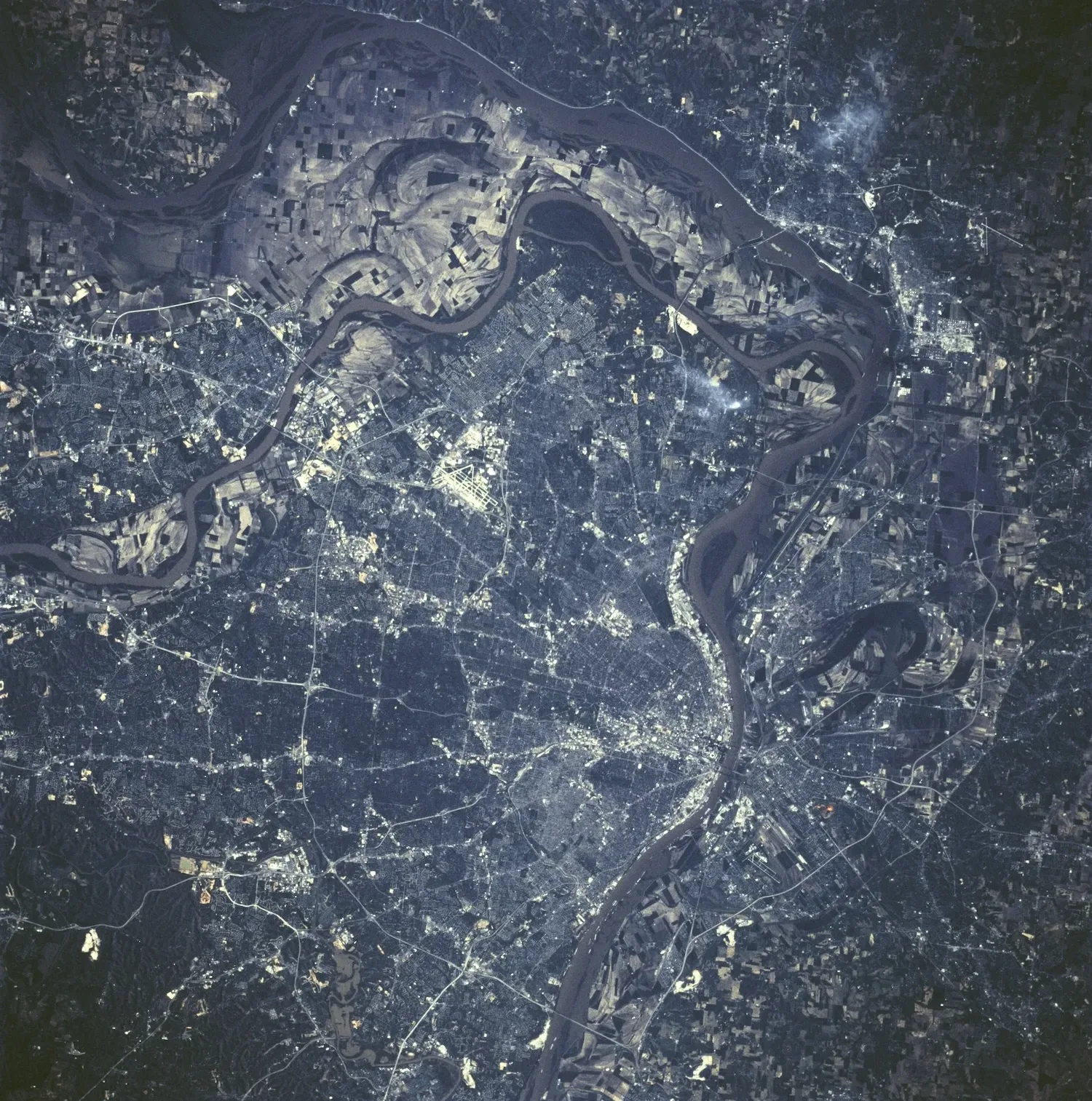
Leaders in St. Louis’ geospatial landscape are moving to refine and enhance the ecosystem’s offerings in an effort to drive more job creation and retention, as well as spur innovation locally.
Those efforts are punctuated by this month’s consolidation of the Taylor Geospatial Institute and Engine into a single nonprofit, known as Taylor Geospatial, as well as the ramp up of GeoSTL, a new standalone nonprofit focused on leveraging geospatial innovation into local economic and job growth.
Keep up with local business news and trends
Subscribe to the St. Louis Business newsletter to get the latest insights sent to your inbox every morning.
GeoSTL executive director Mark Munsell describes the nonprofit’s role as “a backbone organization” leading the strategic direction for St. Louis’ geospatial ecosystem. It’s also positioned as a “front door,” a first point of contact for entities interested in the local sector that’s capable of facilitating connections, he adds.
“Any given individual organization might not see the gaps. Any given individual organization might have their own agenda to achieve their own goals,” Munsell says. “Our opportunity as a backbone organization is to see everyone’s goals [and] agendas, and be able to combine those where it makes sense to lift up the entire region.”
In practice, Munsell says that will involve inventorying the organizations already pursuing innovative tools or developing the workforce around new geospatial technology and organizing them around a common goal. He says this is essential both to avoid duplicating resources as well as building a broad coalition that highlights the breadth of geospatial expertise and activity in St. Louis.
GeoSTL represents an evolution of the strategy around developing a geospatial industry first put forward by the regional business advocacy nonprofit Greater St. Louis Inc. at the beginning of the decade. The most recent update of that strategic vision, released last year, called for a standalone organization.
Munsell brings weight and credibility to GeoSTL, having worked for more than two decades with the National Geospatial-Intelligence Agency, most recently as agency’s chief artificial intelligence officer and director of digital innovation. To that end, he’s focused on evolving the way the region markets itself to potential companies or researchers, emphasizing specific geospatial resources they can tap into, versus touting general touchpoints such as frozen custard or great beer.
“The cultural items do endear themselves to people that move here,” Munsell says. “But what we haven’t seen when we go to these national and international conferences are statistics [or] data as to why you would move to St. Louis. We’re going to convince way more people with actual data.”
And that positioning is part of the organization’s core focus on growing the number of geospatial businesses with a local footprint, and by extension the number of geospatial jobs created and retained in St. Louis, he says. Munsell adds the market for global geospatial artificial intelligence is valued around $45 billion and is set to grow to $125 billion between 2030 and 2035.
“We have to get a piece of that,” he says.
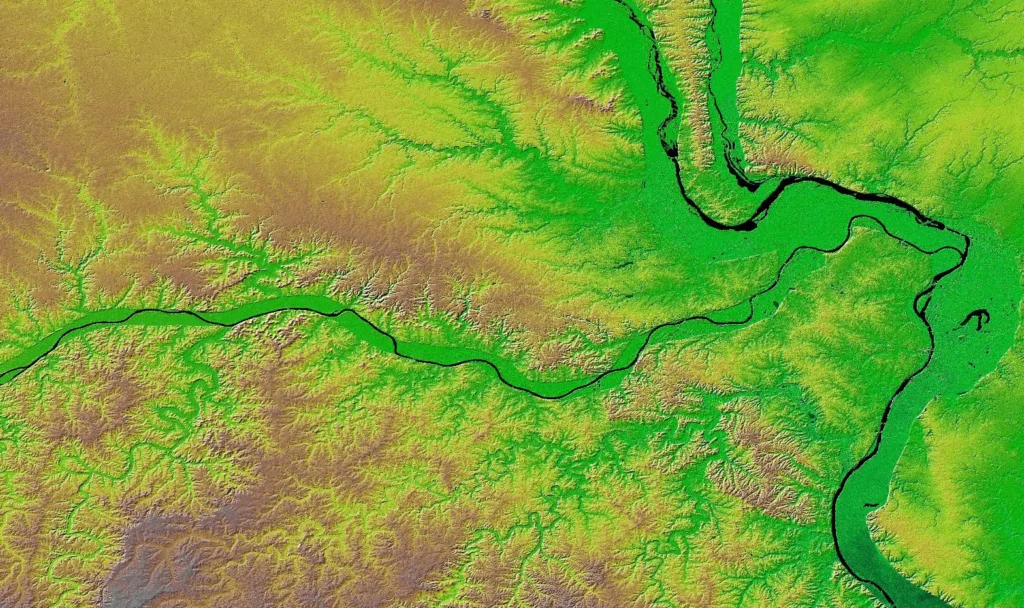
Elliott Kellner, Taylor Geospatial’s president, says a key to achieving that goal is developing new technologies that can bridge the gap that’s persisted between actionable insights and the raw data captured by satellite imagery.
“Twenty years ago, we promised people meaning, and we delivered data,” he says. “Really what everybody needs are those analytical resources that can bridge that gap, and that’s where we can play as an ecosystem.”
He sees GeoSTL’s focus on economic development as a good fit with his nonprofit, which is focused on research, development, and commercialization.
“They can take the lead on coordinating workforce development and all of these additional critical needs for the ecosystem that, frankly, a research institute maybe wasn’t the best organization to provide,” he says. “We are finally observing a maturation of the geospatial ecosystem here in St. Louis.”
Kellner and Munsell agree their organizations will collaborate, with each describing a vision of replicating what has worked with similarly positioned entities in agtech with the 39 North AgTech Innovation District and the Danforth Plant Science Center, or biosciences with BioSTL.
“I would love to see the geospatial ecosystem in St Louis mature in the same way that the ag tech ecosystem has, with the one caveat being that the way that the work is done is different,” says Kellner. “The paradox of geospatial technology is that the work is location-agnostic, so it begs the question, then: How do we build a durable, robust, vibrant geospatial ecosystem in St Louis?”
He argues the answer to that comes through physical spaces where people working in the geospatial sector can “work, collide and collaborate together to see what comes out of the mix.”
Beyond attracting new companies, jobs, or researchers to the region, Munsell contends a concentrated effort on refining and developing the local geospatial sector will drive important civic returns. He points to the history since The Great Divorce, which has yielded a heavily fractured region.
Munsell says this has left St. Louis in a weaker position than Midwestern peers such as Kansas City or Indianapolis, which have grown through annexing land where “growth turned into economic power.” Calls to reunify the city and county have gained more momentum recently, but the details will rely on geospatial knowledge.
“Some people have said, ‘Well, it’s just as easy as maybe getting rid of the line between the city and the county.’ And, you know, logically it is,” Munsell says. “Obviously the regional leaders need more data than that to make these decisions. But until someone shines the light on our geographical problem with geospatial technology, we can’t make those decisions.”