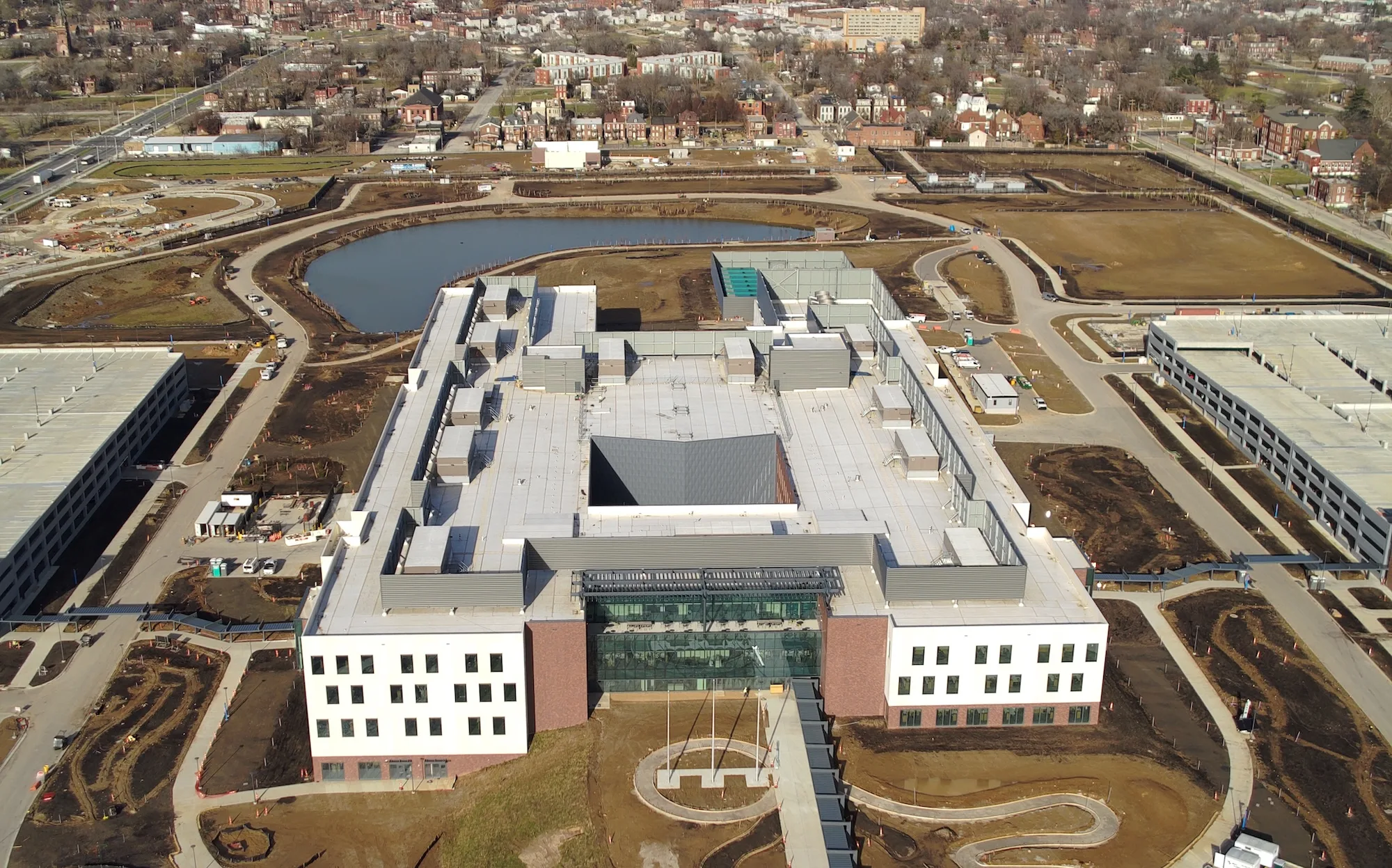
With the National Geospatial Intelligence Agency’s new headquarters in north St. Louis now officially open and set to be fully occupied by early next year, local business leaders are thinking harder about how to best position the region as a global hub for geospatial technology and innovation.
A lot of this is laid out in a revamped strategic roadmap implementation plan for the GeoFutures initiative released late last week by Greater St. Louis Inc., the region’s largest business promoting organization. The first such roadmap was released in 2020.
Keep up with local business news and trends
Subscribe to the St. Louis Business newsletter to get the latest insights sent to your inbox every morning.
The new plan’s core priorities focus on growing local talent for the geospatial workforce, fostering innovation around this type of technology, and helping startups and entrepreneurs grow new businesses, all while highlighting St. Louis’ central role. One of its major recommendations is the creation of a dedicated organization focused on developing the region’s geospatial ecosystem.
“To date, the GeoFutures Initiative housed within GSL has had a broad mandate and limited resources and staffing and served as a backbone for the ecosystem,” the report notes. “Five years into the Roadmap, the maturing ecosystem requires a backbone with dedicated resourcing and subject matter expertise.”
Mark Munsell, who currently leads the GeoFutures initiative, notes the people they surveyed said a more focused organization was necessary for the sector’s continued growth.
“We envision creating something similar to 39North or BioSTL, which work to grow St. Louis’ agetch and life science clusters, respectively,” he says. “A lot of people know that something is happening here in St Louis, but there [is more] opportunity to really showcase the new developments [and] opportunities for moving here, setting up shop here, for employees to have a better standard of living here, for them to work with some of the top minds in the world.”
The report says that a standalone organization could serve as a “front door” for the local sector, helping to attract business and talent while also compiling information on what resources and opportunities exist in the St. Louis region into one place. GeoFutures, it notes, “has been led by a part-time consultant and fractional GSL staff with no ecosystem governance” making it hard to scale the initiative and leaving unclear accountability.
The comparison to 39North is apt, as the idea for an agtech innovation district has been around for years, yet a stand-alone nonprofit was only set up two years ago. Now though, the results are starting to speak for themselves, with 39North playing a key role in attracting multiple new agtech companies to St. Louis.
Munsell says he expects to see more regional initiatives to attract talent and link in with existing university programs, as well as programming centered around startup accelerators, incubators, and networking for smaller companies looking to get a leg up.
In some ways this isn’t uncharted territory; the NGA in partnership with the MIssouri Technology Corporation ran an accelerator program between 2020 and 2022, and earned recognition for its success.
“That was our first foray into that [and] a field we had not been involved in before,” says current NGA West executive Bill Caniano. “It was from that accelerator program that we had the idea to stand up what you see at Moonshot Labs in TREX.”
Today, Caninano says Moonshot Labs continues to serve as a gathering place for the NGA to run tech challenges, hackathons, and otherwise engage with relevant companies and technology without the hassle of accessing a classified facility. And he notes the major geospatial companies in Maxar, Esri, T-Kartor, and Scale AI that all have some local presence in St. Louis because of the proximity to the NGA.
These assets exist today in large part because the NGA chose to stay located in St. Louis a decade ago, says Andy Dearing, executive vice president and regional manager for Bowman, a geospatial company that provides mapping for local and state governments, utilities, and other private and commercial customers. Dearing also preceded Munsell as the leader of GeoFutures.
“All of these things really spawned off that single decision of NGA saying we’re going to stay here,” Dearing says.
Munsell sees real opportunity for the ecosystem to significantly develop, especially around applications that can work beyond defense and intelligence.
“Do new things with agriculture technology, fintech, transportation, or advanced manufacturing,” he says. “That’s the real opportunity here for us to take advantage of this platform that is the NGA economy and take it up a notch.”
Munsell says he sees the biggest market opportunity in geospatial AI, which he says is now a $25 billion industry but could grow by as much as $12 billion over the next five years. Part of this is because the technology applies beyond intelligence uses, which Munsel says was evident in some of the presentations at the recent Plant Science Family Reunion, like the high-level analysis of satellite or drone imagery. An intelligence context might be looking for enemy adversaries, while a plant science use would be around detecting unhealthy crops, he explained.
“Same technology, same type of research, same platform, same software, just different use cases,” he says.
Dearing agrees, noting the seeds for a successful geospatial venture are already sewn in the region with organizations like the Taylor Geospatial Institute leading the way. He argues there needs to be a concerted focus on growing companies around them.
“If they’re commercially viable, how do you do the company formation around that and see and feed them?” he says. “We’ve got some of the ingredients around there, but it’s really focusing in on the horsepower to really build and grow that.”
Dearing notes some of the technological challenges the NGA faces aren’t necessarily unique and bringing together other large stakeholders in private or public companies, such as Ameren or Bayer, or local governments with the same challenges, can demonstrate a deeper customer base for a new company seeking feedback on what it’s developing.
“The hardest part about running a technology innovation company is getting good feedback,” Dearing says. “It’s getting that direct market feedback from key stakeholders to help shape the product. Can we make the NGA one of several that can be part of that?”