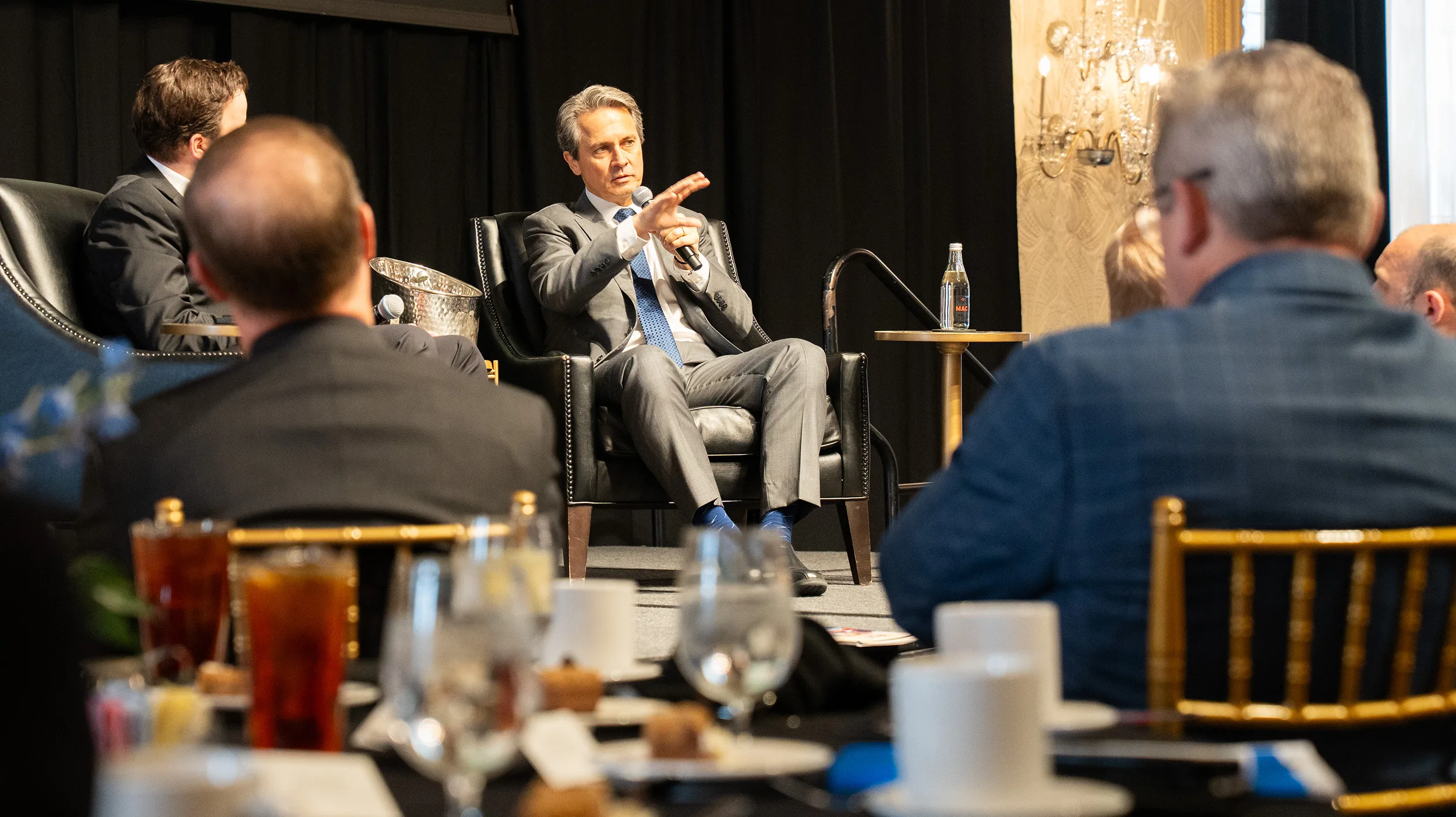
In the eyes of Alberto Musalem, the president and CEO of the Federal Reserve Bank of St. Louis, the overall economy is teed up for a good rest of the year. During a lunch question-and-answer session at the Missouri Athletic Club downtown on Wednesday, he said he sees the economy growing “at or above potential,” which is around two percent.
“There are a lot of tailwinds that are going to propel the economy forward,” Musalem said, aided by three quarter-point cuts to overall interest rates made in the last half of 2025 and some deregulation in the financial system.
Keep up with local business news and trends
Subscribe to the St. Louis Business newsletter to get the latest insights sent to your inbox every morning.
Even with inflation remaining above the Fed’s goal of two percent, Musalem sees it finally drifting down this year. The most recent reading on the personal consumption expenditures index, which is the Fed’s preferred read on inflation, pegged year-over-year increases at three percent.
“Half of that excess inflation comes from tariffs, as best we can measure it,” Musalem said. “I expect the part that is attributable to tariffs to fade as the year progresses and inflation to then resume a trajectory towards our 2 percent target.”
Musalem acknowledged inflation is still a big challenge for people around the Federal Reserve District that encompasses Arkansas and parts of Illinois, Indiana, Kentucky, Mississippi, Tennessee, and Missouri.
“When I travel around the district, I hear from folks, consumers, households, that they are challenged in consuming because the real incomes are stretched. If inflation continues to run above our target, that’s going to add to those challenges, and it’s really important that we finish the job and bring inflation back towards a two percent target.”
And, he said, there’s a risk that inflation will be more stubborn than he expects, especially given last year’s government shutdown and the way it forced statistical agencies to estimate Consumer Price Index data for October and some of November.
“That may have biased the inflation data downward for a few months,” he said. “And those biases could be with us all the way through April, just how things are calculated.”
Another risk is the labor market. While Musalem sees it stabilizing, he explained job creation is essentially limited to the sectors of health care and education.
“Because it’s a narrow job creation environment, the job market is vulnerable to an increase in layoffs. If there were increasing layoffs, with low job creation, you could risk labor market deterioration further,” he said.
When it comes to more of a local read, Musalem pointed to stagnant population growth as an enduring challenge, but said businesses and households are cautiously optimistic about the labor market in the near-term.
“We hear that it’s easier for people to fill vacancies, [that they have] more applicants for [each] vacancy,” he said. “When we survey firms, the majority are thinking they’re going to keep their labor force constant—they’re not going to hire, they’re not going to fire.”
And he notes a growing number of firms (though not in the majority) have an eye toward increasing payroll expenditures. Musalem said many companies are reporting higher non-labor costs for items such as insurance and are looking to drive efficiencies in their operations to counter these increases and still hold onto profit margins.
As far as how different local sectors are doing, Musalem noted that manufacturing is “surprisingly doing well,” along with strong indications from banking and the tourism sector. Musalem added things are more stagnant for retail, business services, and professional professional services, while agriculture remains “challenged just because of a rising input costs and weaker output costs.”