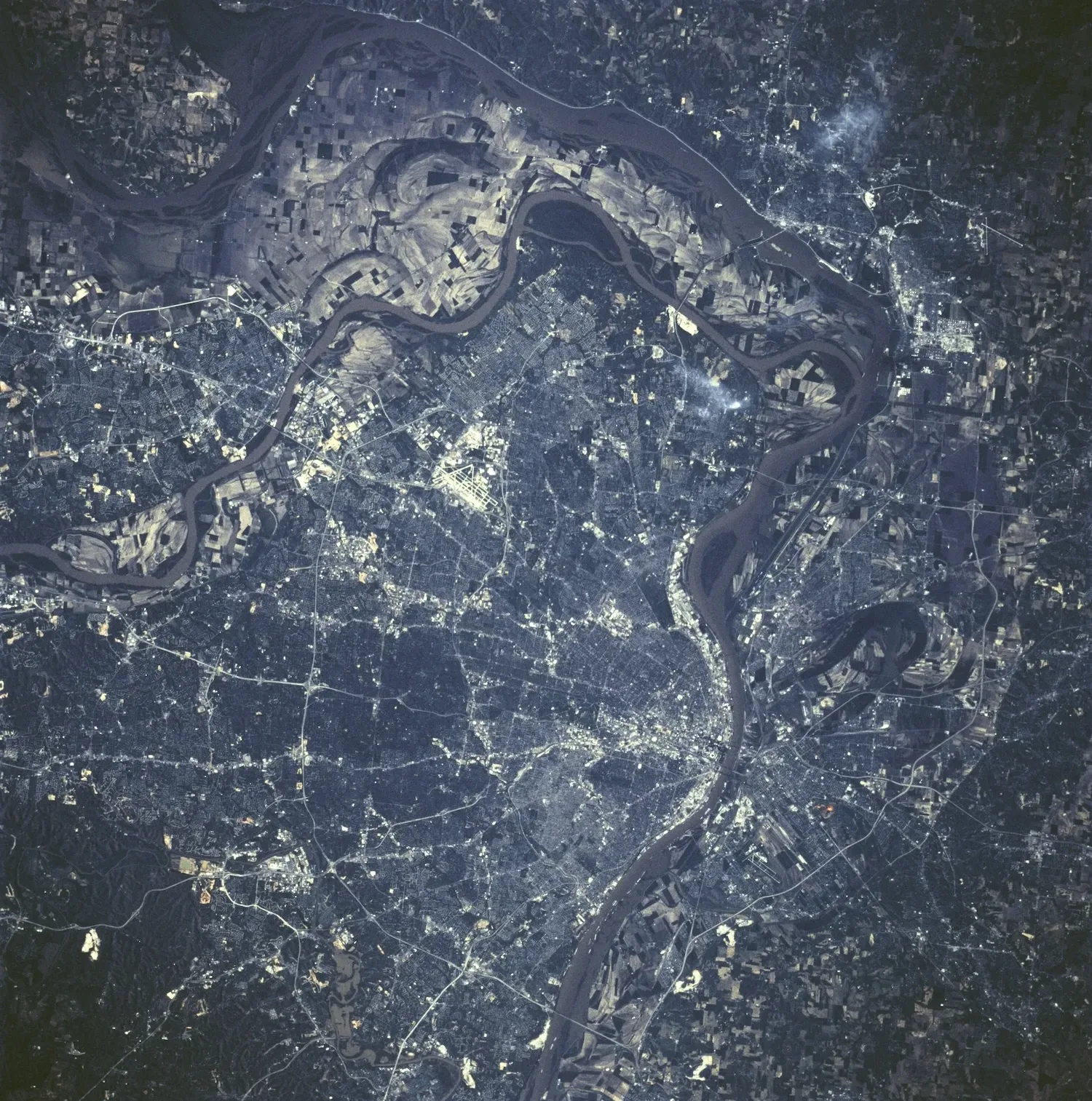
St. Louis is set to house a new innovation center dedicated to using geospatial and artificial intelligence breakthroughs to foster solutions to major national and global challenges.
The local nonprofit GeoSTL made the announcement Wednesday morning, sharing that it, along with a collection of tech behemoths, have come together to establish the Spirit of St. Louis AI Innovation Center, a nod to the aircraft that Charles Lindbergh flew from New York to Paris to capture the Orteig Prize in 1927. NVIDIA, Amazon Web Services, Google, WEKA, Overture Maps Foundation, and World Wide Technology are all listed as founding members of the center.
Keep up with local business news and trends
Subscribe to the St. Louis Business newsletter to get the latest insights sent to your inbox every morning.
The goal is to surmount the constraints being felt by younger firms developing new AI-driven tools, where they may not have the resources to fully develop or scale what they’re working on, says GeoSTL director of strategy and operations Peter Tchoukaleff.
“These companies are increasingly in need of high-performance compute, not necessarily capital,” he says. The “major hurdle” is finding computing environments where they can test and fine-tune a potential solution on a much larger scale, Tchoukaleff explains.
The Spirit of St. Louis AI Innovation Center, which will be administered by GeoSTL, intends to address the current gaps by establishing a high-performance computing environment with the expertise of its founding Big Tech members. It will be rooted in the St. Louis region but globally accessible. Tchoukaleff describes the center as a “digital utility” and says GeoSTL plans to showcase its capabilities by issuing themed challenges or competitions oriented around using high-powered AI and geospatial techniques to solve thorny problems.
He says it builds off of the “Generative AI for Geospatial Challenge,” which AWS teamed up with Taylor Geospatial on in 2024 and offered an award of $1 million in cloud credits.
“They deployed 12 [minimum viable products] out of that,” Tchoukaleff says. “AWS looked at that as a positive and high return on investment initiative for them.”
He envisions GeoSTL will run dedicated challenges focused on agtech, advanced manufacturing, bio and health sciences, national security, supply chain logistics, and others. The first one GeoSTL intends to unveil later this year will be focused on improving humanitarian efforts.
“For the next three to five years, we would pitch these competitions, and we would not prescribe what problems we want to solve,” Tchoukaleff says. Instead, GeoSTL is leaning on local organizations, such as the Danforth Plant Science Center, BioSTL, 39 North Agtech Innovation District, Taylor Geospatial, TechSTL, the Advanced Manufacturing Innovation Center, or the Yield Lab Institute, to help develop how specific challenges are framed.
“The value here to these framers is that it fosters a connection back to St. Louis,” Tchoukaleff says. “There’s expertise, knowledge that’s based here, and utilizing this shared innovation resource, we can deem what is most worthy to be solved in these respective industries.”
What companies, researchers, and others submitting proposals to the innovation center’s challenges get is access to expertise or resources from the likes of NVIDIA, WWT, AWS and the other big companies signed on with the innovation center.
GeoSTL executive director Munsell says each of the large tech companies involved will evaluate proposals submitted for the individual challenges and decide if and how they wish to support them, depending on how the project aligns their overall goals. He says that could look like providing access to high-powered AI models for testing, awarding credits for cloud computing, offering their expertise, or other kinds of support.
“Some problems will be more suitable for certain companies with certain products and techniques than others,” Munsell says.
He gives the hypothetical example of a small company that has enough resources to develop an AI model that works well to solve a problem on the scale of a small region or city.
“For them to go nationally, they would basically need hundreds of thousands of dollars in compute that [they] can’t afford,” Munsell says. “Or maybe they can’t get investors for the company until they can demonstrate that it can be scaled to a national solution.”
But NVIDIA, for example, could pledge some of its high-powered GPUs to test whether that idea works at a larger scale.
“Then that company can go back and say, ‘Look, this is our product. We’ve been able to scale it. All we need now is investors,’” Munsell explains.
And the larger tech firms get a more direct path to acquiring, purchasing, or procuring something that’s incubating in the innovation center, he adds.
Munsell says one of the goals with this innovation center is to demonstrate how AI can play a positive role in solving big, hairy problems.
“The only way for us to do that is to ask the world what their problems are,” he says. “I know from working in national security for the last 30 years that this technology absolutely impacts world problems.”
The Spirit of St. Louis AI Innovation Center doesn’t yet have a physical location, though Munsell says that’s in the works as a way to showcase the progress that comes from the challenges once they’re up and running.
The idea for the innovation center began growing last year, when many NVIDIA representatives were in town for SC25, the annual international conference for high performance computing, network, storage, and analysis that brought tens of thousands of people to downtown St. Louis.
“I had contacts at NVIDIA that asked for a meeting to sit down and talk, and they basically said, ‘Look, we’re doing all this geospatial AI global model development, we would really like to do something in St. Louis for St. Louis,” Munsell recalls.
Even though it wasn’t obvious at the time what a collaboration could look like, “the goodwill was there between me and that company,” he says. And with NVIDIA on board, Munsell says it was easier to get other Big Tech firms to sign on as well. He says, “Anytime that they have a chance to work with NVIDIA they’re on board to do it.”
Tchoukaleff and Munsell were adamant about St. Louis staying at the forefront of anything that unfolded, eventually earmarking a fifth of the computing capacity created by the Spirit of St. Louis Innovation Center for projects that are locally focused. Tchoukaleff explains they plan to meet this quota in two ways, by reserving a specific set-aside for proposals that benefit the broader St. Louis region and running a competition focused on civic use cases shaped by direct input from local leaders.
“As we’ve drafted [memoranda of understanding] with these technology partners, we said that this is a priority of this center, that it helps St. Louis operate more effectively, helps encourage St. Louis to be a more vibrant, thriving, safer region,” Tchoukaleff says.
And by positioning and demonstrating St. Louis as a leading region using geospatial techniques and AI to solve big problems—something the National Science Foundation is interested in funding—the region could end up attracting more companies that align with that mission, Munsell says. “That changes their attitude about St. Louis, the region.”