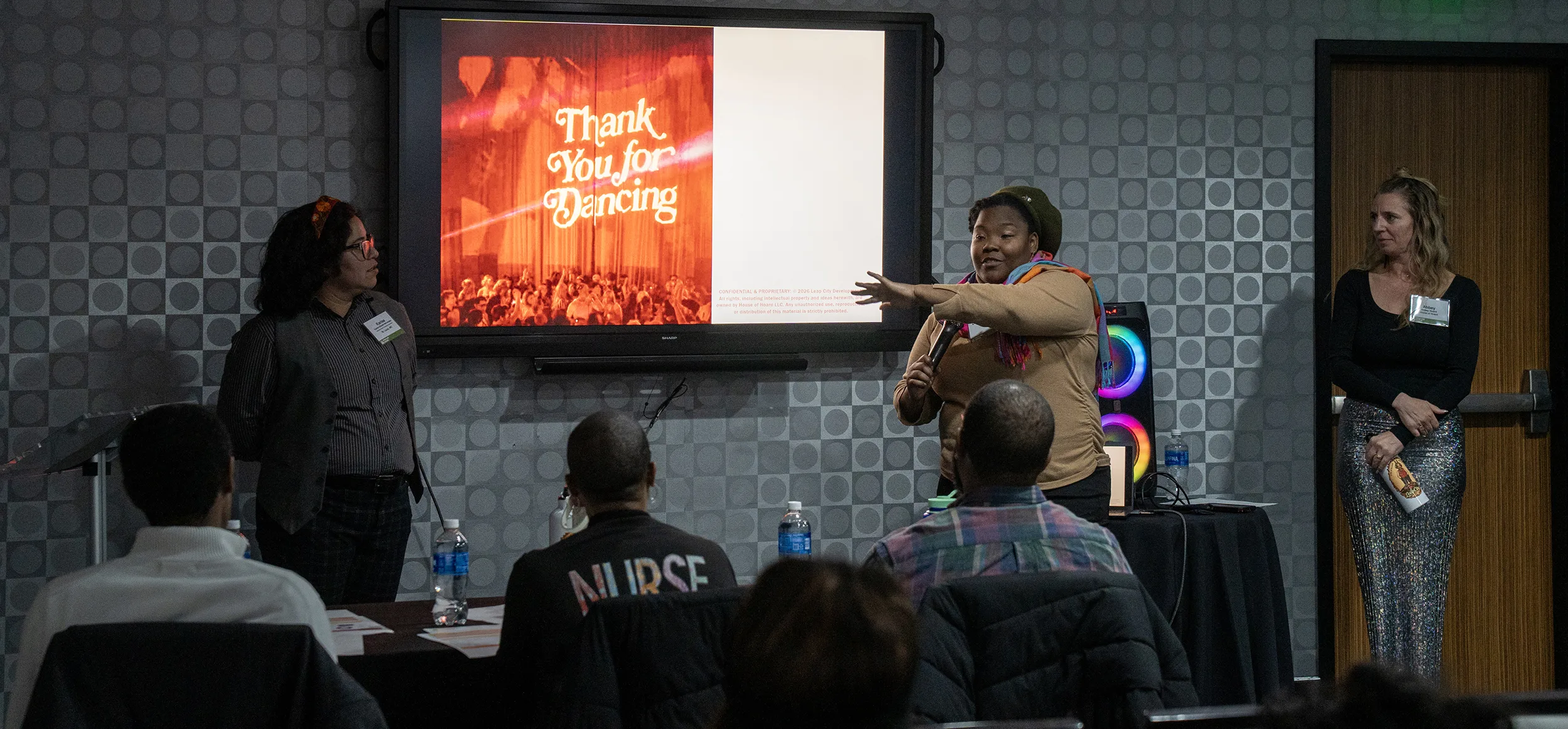
On a recent Monday evening, one of the cozier ballrooms inside the Moonrise Hotel buzzed as the 25 members of the Urban Land Institute’s most recent Real Estate Diversity Initiative cohort geared up for the conclusion of the 14-week program.
The program, abbreviated as REDI, teaches the nuances of commercial real estate development to people whose backgrounds are practically nonexistent in the development sector. Local experts in design, architecture, construction, financing and others essential to the field lend their expertise, with participants then working in teams to create and present a full development plan, including marketing, financing, construction costs, timelines, and other essential components, for an actual site in St. Louis.
Keep up with local business news and trends
Subscribe to the St. Louis Business newsletter to get the latest insights sent to your inbox every morning.
This year’s cohort in St. Louis focused on creating redevelopment proposals for the vacant buildings and lots on the block bounded by Martin Luther King Drive, Delmar Boulevard and N. 19th and N. 20th streets. The five teams each made a pitch for what the site could be, complete with financial and market analysis. Some opted for new housing; others for an entertainment venue or mixed-use retail and residential development.
The teams excitedly presented their ideas, looking to out duel each other and win over the crowd in the ballroom, as well as a panel of local experts that would eventually crown the best proposal, a phased mixed-use development featuring new housing, retail space and a roller skating rink.
Participant Danielle Bowles-Martin (whose team had the winning proposal) says the “hands-on” nature of REDI made it invaluable.
“You can’t teach what’s so abstract about development,” she says. “There’s so many aspects to it that if you didn’t start with a real property, it would be hard to visualize how to actually put all the pieces together.”
An engineer, Bowles-Martin grew up in the city’s Walnut Park West neighborhood and wanted to do her part in revitalizing it. Before REDI, she wasn’t sure how to get started.
“I submitted some proposals for renovating some of the space, some of the homes over there, and it was rejected,” she says. “I was just like, ‘I have to figure out what I did wrong and connect to people and learn more about what it takes to be able to get into this.’”
REDI helped Bowles-Martin build more of an understanding of what she calls “novice errors that I absolutely made”—and how to prevent them next time.
Others in this year’s cohort say the program opened their eyes to the types of development projects that are possible for a beginner to take on. Jordan McCain, a realtor with Focus Realty Group who focuses on residential and commercial assets, says REDI gave him insight into low-income housing tax credits, which he had been unfamiliar with before.
“That really helped me shift my focus,” he says. “Shift what I was thinking about and focus less on the profit side of things, so to speak, but more so on how I can help the community.”
Now McCain says he feels equipped with the knowledge of how to properly execute an affordable housing project and understand the costs involved.
The program, which expanded to St. Louis in 2019, already has strong examples of people who’ve put the knowledge and connections it affords to use.

Notable alumni include Pastor Alexander Andre, whose Tabernacle Community Development Corporation is behind the new construction and rehabs revitalizing north St. Louis’ blocks near Fairground Park, and Ono Ikanone, who owns and runs Levels Nigerian Cuisine and the four-story downtown St. Louis building it’s housed in.
“The thing that attracted me to this building was the third and fourth floor not being completed,” Ikanone says. “I figured that we can run the restaurant in the first and second floor, and the third and fourth floor is where the meat really is. That’s where the investment is. And once we’re done with that, then the building will have its real value.”
For Ikanone, REDI and the experts it connected him to through the 2023 cohort helped him feel confident in the decision to purchase the commercial property downtown. Before that, he’d only worked with residential properties.
“When you’re investing so much into a space, sometimes you worry: Did I pay too much? Was it worth it? Is this area downtown worth it?” he says. “Hearing these professionals talk about how to carry out real estate projects, it was good to have some positive reinforcement from professionals that are in the industry. [It] was reassuring to hear that we didn’t pay too much. We were in the range of what we should have paid for the upgrades that we did.”
REDI helped Ikanone prepare for the project he ended up taking on: The third and fourth floors of Ikanone’s downtown building were the case study that his cohort studied and presented project plans for.
“That was very, very insightful, because I was not only part of the cohort, but my building was also the case study, so we had five different groups put together a best use scenario for the third and fourth floor,” he says.
Different groups in the cohort proposed filling the space with a cooking studio (playing off the restaurant below), photo studios, residential space, and even an exclusive cigar bar, he says. Each presentation also came complete with an estimate of development costs, operating expenses, and rough designs.
“With that, I actually married a few of those ideas together,” Ikonone says. Drawing on the suggestion of a cigar lounge, he plans to outfit the third floor as an upscale speakeasy that has “that secret feel,” while the fourth floor will be more of a media center, complete with a photo studio, podcast studio, and boardroom that are all available for members of the public to book time within.
“The idea there is that I wanted to have youth between the ages of 16 and 25 that were interested in media to come up there,” Ikanone says. “We’ll have courses with the photo studio, with the podcast studio, just things of that nature so they can learn. And then we’ll put the spaces where people can just rent it out.”
He says he’s steadily working on the buildout, using profits from the restaurant “to build slowly” and targeting a completion next spring, though he’s exploring ways to work with the St. Louis Development Corporation to speed things up.
“It’s taken longer than we expected, but construction projects oftentimes do,” he says. “It costs a lot and we don’t want to overcommit.”

Other alumni credit REDI with helping them expand their holdings, including Sabrina Jones-Williams, a real estate broker with a personal portfolio of properties, as well as hundreds more that she manages for other investors.
Jones-Williams explains she started in real estate and property management with a single rental property eight years ago and has seen her personal portfolio grow after replicating what worked with her first property. Being a part of the 2024 REDI cohort was instrumental in helping her refine and “level up” her real estate business from the six properties she had before joining it to the nearly 25 she owns today.
“I don’t know that without taking that class if I would have scaled as fast as I’ve scaled with it being [sustainable],” Jones-Williams says. “I wouldn’t have known how I should go for funding if I hadn’t attended REDI because all of my properties that I have now [are] single family, so they were smaller to obtain and rehab.”
Today, she says she’s able to take on larger redevelopment projects, such as an entire apartment building, because of how REDI taught her how to structure financing, cost estimates, scopes of work and other essential details to bring lenders or investors on board.
“When you’re trying to level up for development, I don’t care how many properties you have, you don’t have that liquid[ity] to be able to finish those projects that are phased out,” Jones-Williams says.
As much as she learned about the nuts and bolts of getting development projects approved and finished, she says the pivotal value of REDI came from the network it connected her to with “people that will help you get closer to whatever goal that you’re trying to accomplish.”


