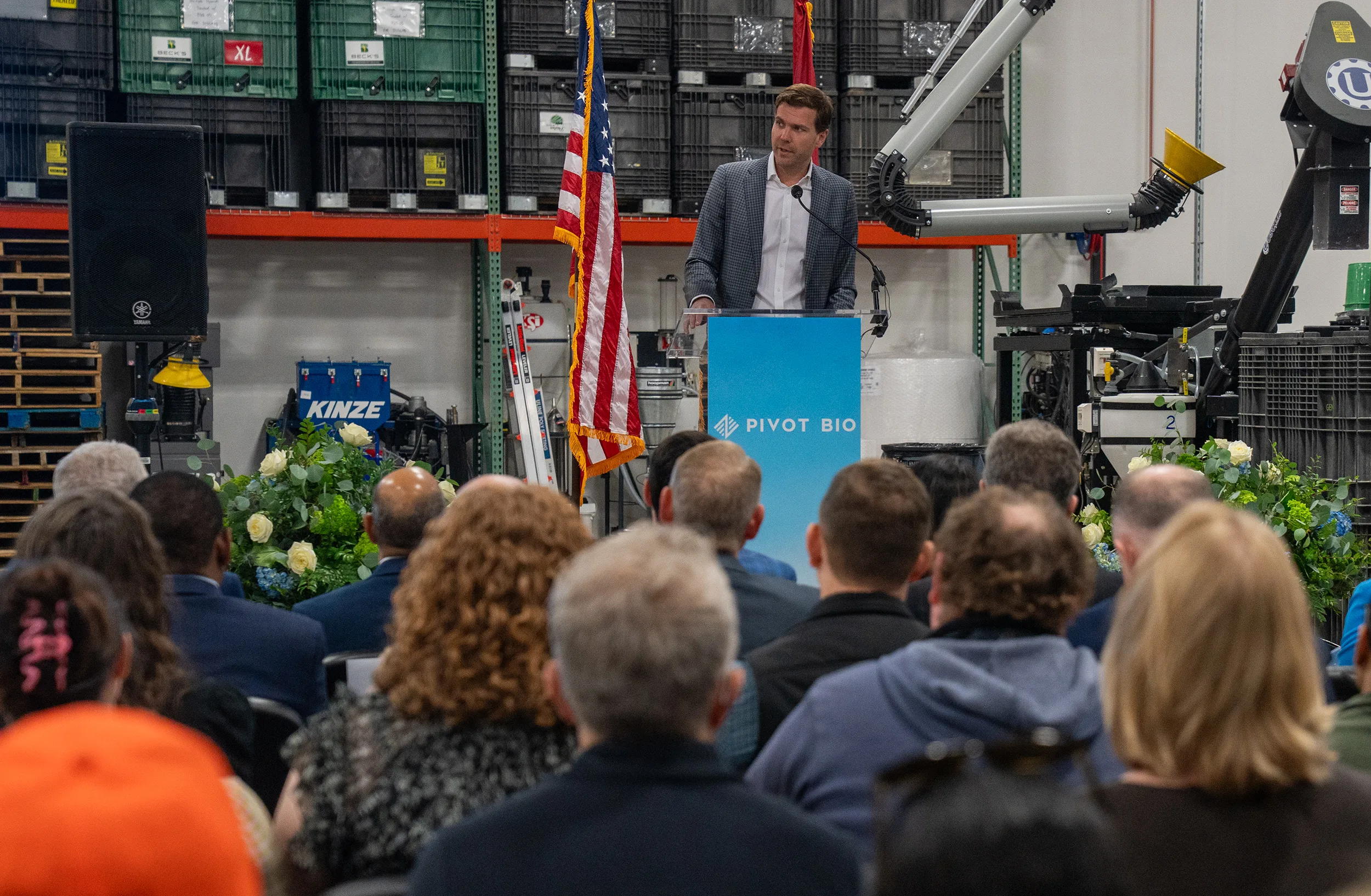
Pivot Bio, a multi-billion dollar agtech company with origins in Berkeley, California, is continuing to uproot itself from the West Coast, with an announcement Tuesday morning that it’s expanding its footprint in St. Louis.
The company’s $7 million incremental investment into two new “Centers of Excellence” in the St. Louis region will focus on innovation and manufacturing, and create at least 40 new local jobs.
Keep up with local business news and trends
Subscribe to the St. Louis Business newsletter to get the latest insights sent to your inbox every morning.
Pivot Bio CEO Chris Abbott described the decision to expand in the St. Louis region as a “no-brainer,” given the location of company partners in Bayer and Bunge, established plant science research prowess anchored by the Danforth Center, and a concentration of talented professionals.
“Our partners are here, our co-investors, new investors that want to join the Pivot Bio story are here,” he says. “You get all three legs of that stool. You get the business and commercial partnership angle, you get the talent piece, and then you [have] capital.”
The company is valued at $2 billion and has raised some $600 million, including investments from Bayer and Bunge, according to reporting from the Minnesota Star Tribune.
Pivot Bio’s expanding local presence comes at two facilities located about 10 miles from one another—the company’s existing manufacturing presence in Hazelwood and its newly minted research and development space in the EDGE@BRDG building (the same one that previously housed Benson Hill) in the 39 North AgTech Innovation District just across from the Danforth Plant Science Center in Creve Coeur.
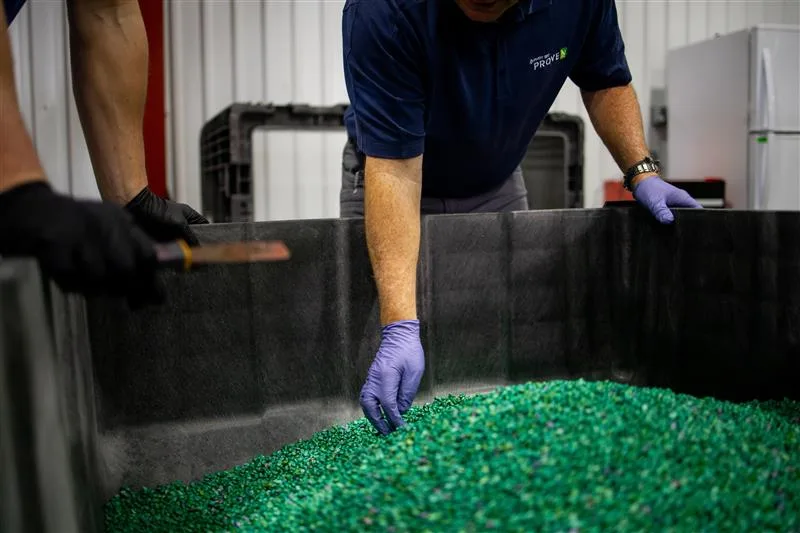
The investment into St. Louis will allow Pivot Bio to scale up its pioneering technology that allows farmers to use less synthetic fertilizer, Abbott explains. The company is behind a genetically modified bacteria that can convert nitrogen from the atmosphere into the soil-based nitrogen that plants (such as corn, wheat, cotton, or sorghum) need to grow.
The bacteria are directly coated onto seeds and then live in the root system of the plants after they’ve germinated and started growing in fields. Pivot Bio sees this as a key innovation to help farmers use less synthetic fertilizer, which is simultaneously an increasing cost burden for farmers and causing vast environmental damage when it runs off from the farm fields where it’s applied.
“You have weather events, right? We had one here [on Monday]. Tons of rain, tons of storms, that just leaches a bunch of nitrogen,” Abbott says. “Breakthrough technology is really what we’re going to need to fix this nitrogen conundrum.”
He contends that concentrating facilities focused on research and development and manufacturing (what the company refers to as its “Customer and Operations Success Center”) will help Pivot Bio rapidly scale the fertilizer product it can deliver to farmers. And those goals are lofty, going from the 35 million acres the Hazelwood facility can support now to the 150 million domestic acres of the staple crops of corn, wheat, and cotton that Pivot Bio has products for.
“Our goal is to be able to satisfy that in a year or less,” Abbott says, adding that it’s especially critical now that prices for synthetic fertilizers have jumped in the wake of the U.S. and Israel’s military action in Iran. Pivot Bio’s fertilizer is now about 65 percent less expensive than synthetic fertilizers, he says, and was already 20 to 25 percent cheaper than it before the military conflict started.
St. Louis’ central location will help with distribution, Abbott adds. “We need 24 hours [to get from] here to any acre in the United States,” he says. “Think about what that means. So when you have a shortage, when you have a supply chain disruption, when you have a price spike, we can deploy that nitrogen readily, in an instant.”
To that end, the company has committed to keeping its prices for farmers flat through the 2028 growing season.
“We’re gonna put our money where our mouth is [and] help reduce the volatility of input spiking,” he says. “We want] to prove to farmers that we can lock in that low price and give them some certainty for their input costs through the 2028 season.”
The company’s news in St. Louis Tuesday follows an announcement the company made in March to relocate its global headquarters to a suburb of the Twin Cities in Minnesota. These moves aren’t exactly sudden, though, as the company telegraphed it would be moving more of its operations to the Midwest last May. The news site Berkeleyside even hinted that the company’s research operations were consolidating into the St. Louis region last June, noting Pivot Bio already had a manufacturing facility in Hazelwood.
Local and state leaders cheered the announcement by the company. Hazelwood city manager David Leezer says Tuesday’s $7 million commitment from Pivot Bio follows the $22 million it invested three years ago to establish the current manufacturing facility there.
“They have created a credibility for Hazelwood and North County for an agtech forum, for an agtech location,” Leezer says. “We appreciate that, because of their work, we are benefiting from it as a city, as a region, and as the whole metropolitan area.”
Other elected officials say the company’s move is a clear indication of St. Louis’ continued dominance in the ag sector.
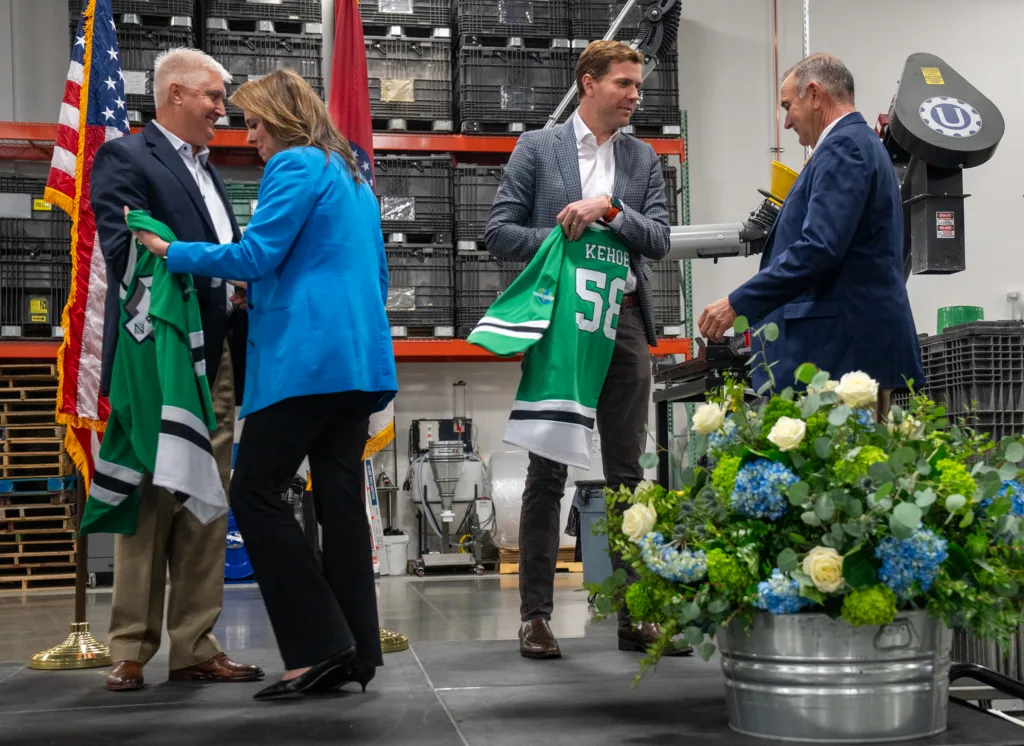
“[With] the whole plant science corridor [here], the plant science world is coming to us,” says Missouri Gov. Mike Kehoe. “What St. Louis and the region has done in economic development and showing the world that we have the best place to live, to grow a family, and to grow a business is indisputable with announcements like Pivot Bio.”
Kehoe adds that the company’s expanded local presence “puts the icing on the cake” for the local research institutions that serve to support local farmers and the state’s economy.

39 North executive director Emily Lohse-Busch adds that it’s no accident St. Louis is managing to lure companies from outside the region given the “strategic growth” that has been stewarded for decades.
“Which means for companies like Pivot, they can be confident they’ll have access to the talent they need as they continue to grow and scale,” she says. “What we see today with this announcement is yet another example of how this agtech community wraps its arms around innovators and the companies that they are building.”
It’s something Abbott says his employees have felt since relocating here.
“Once they were here, it’s an easy sell, right? You look at the ease of doing business, the cost and standard of living here, access to world-class universities, to private institutions. We’re lucky the agtech community here is a very tight-knit community, and so people come in feeling that sense of community.”