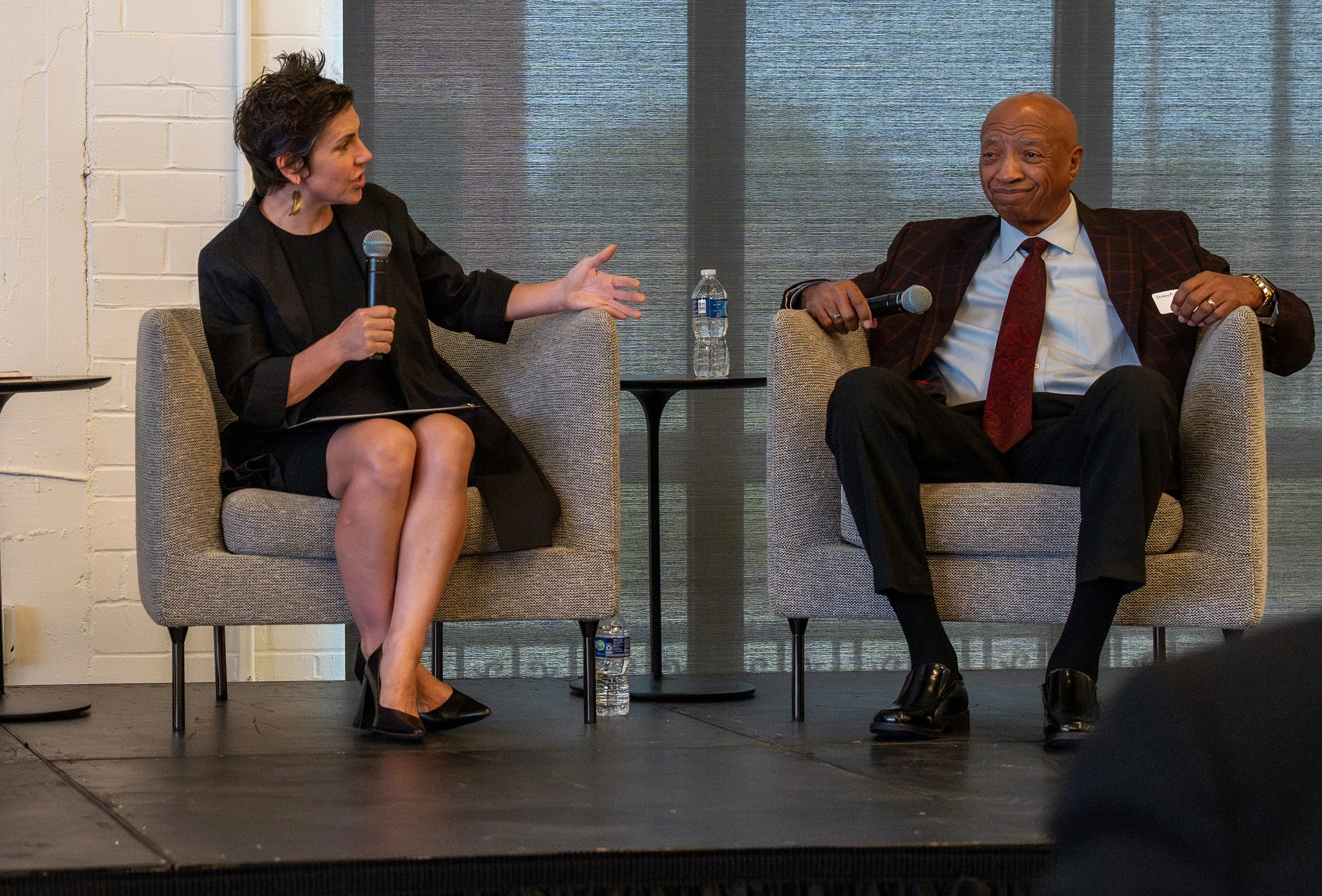
When Otis Williams was first tapped to come out of retirement and again lead the St. Louis Development Corporation, he thought he’d be back for maybe six months.
Now, almost a year later, Williams, 78, is once again set to retire from the city agency that he’s dedicated more than two decades of his life to. Nearly a decade of that time has been as SLDC’s top leader—eight years from 2013 to 2021, plus the nearly year-long interim stint that wraps up when new president and CEO Stephen Westbrooks takes over on Monday.
Keep up with local business news and trends
Subscribe to the St. Louis Business newsletter to get the latest insights sent to your inbox every morning.
“It’s been a good time working with very good staff,” Williams says. “And the political environment has been good for us to be able to get a few things done.”
Despite the development agency having only a few dozen familiar faces remaining from when he first retired, Williams says it wasn’t too challenging to step back into the role he had once occupied, likening it to riding a bicycle.
“I had just been away from it and I needed to get back on,” he says. “I probably can’t ride as fast and as long, but I knew how to ride it.”
And, Williams adds, he hasn’t felt held back by the temporary nature of his role this time around.
“From day one, I’ve been at full throttle,” he says. “The mayor has been very supportive. I have not been limited in any degree. I’ve probably said and done a lot of things that maybe she wished I hadn’t said.”
This doesn’t mean the ride this time around has been easy. “In this job there are always surprises,” he chuckles. “I can’t say every day, but many weeks, there are things that come up that you didn’t expect.”
Front of mind being the ongoing recovery from last May’s powerful tornado that struck St. Louis, just weeks after Williams came back to SLDC. He also points to some of the broader and enduring challenges in securing large- and small-scale redevelopment projects across the city.
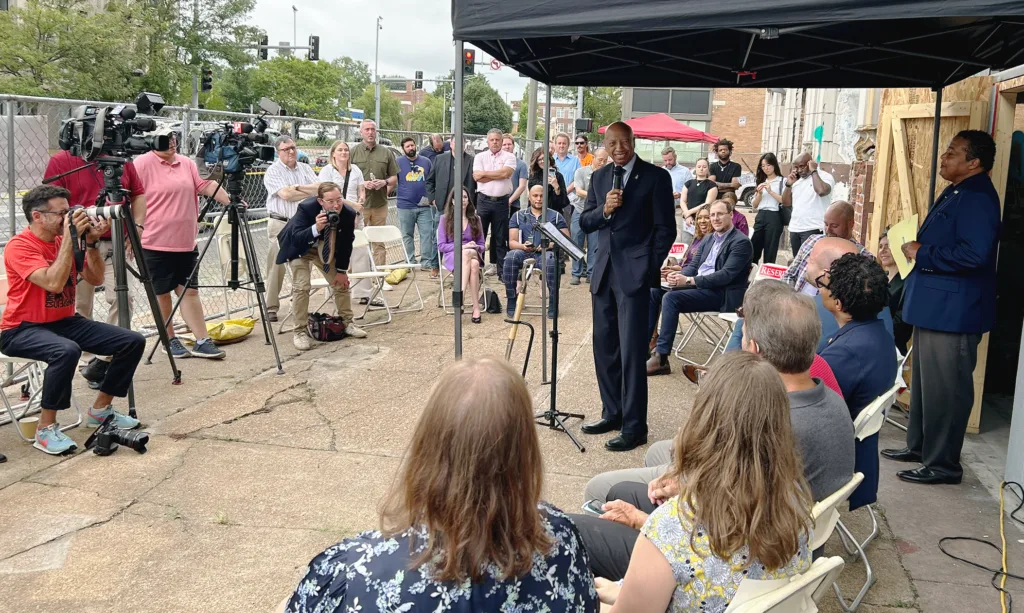
“One of the great challenges is just finding resources, and being able to get projects funded,” Williams says. “I think it would make it easier if the local banks really came back to the table and were able to work with developers to get things financed. That would be a real home run.”
It’s something Williams says he diagnosed back in 2021, while preparing to leave SLDC the first time. In his estimation, the city’s current process around development projects presents too much uncertainty and perceived risk for local financiers to feel comfortable committing resources.
During his time as SLDC’s interim leader, Williams consistently advocated for the city to make use of the incentive tools at its disposal to help with the financial side of development. Construction costs don’t vary that much for similar-sized projects in different parts of the region, he argues, but market conditions increase the rent a developer can charge after the fact in Clayton (for example) versus Downtown St. Louis.
“The incentive is to help fill that gap between the ability to get the same rents,” he says. “I think those who say that we don’t need to use incentives, and that [development] will happen, you know, that’s not really understanding where we are as far as financing projects or the risk that developers and financiers are looking at.”
Part of the fix Williams sees is creating a local climate that is reliable and predictable for those pursuing projects.
“We need to build that confidence, not just on the front end where I’ve been talking about, but also on the back end,” he says. “That if you negotiate a deal, the deal remains the [same] through the process. I think that’s one of the key concerns [for developers].”
He adds that he believes SLDC’s new president and CEO Stephen Westbrooks is well-equipped to affect that change, especially given the support Williams says he sees from the mayor’s office for redevelopment efforts. As for any advice for Westbrooks, “the most important thing I can tell him is to be himself,” Williams says. “The reason he was selected is because of who he is and the talent that he has.”
As Williams’ time with SLDC winds down, he finds one of the things he’s most grateful for is having the opportunity to attend last year’s ceremonial opening of the new National Geospatial-Intelligence Agency campus in north St. Louis, which the agency expects to fully occupy the building this spring.
“I didn’t think I was going to be around for that,” he says. “To tell you about how redevelopment is, I started talking about the NGA in 2012, 2013, and it opens in 2026.”
Williams adds he’s keen to watch how development activities unfold downtown with demolition underway at the former Millennium Hotel site, the plans for AT&T Tower, and a potential third development phase with Ballpark Village. He’s also eager to see plans shape up for Dr. Martin Luther King Drive in north St. Louis, given SLDC’s recent purchase of Marshall School and pursuit of federal opportunities to help redesign and rebuild the road.
“If that happens, that will just give a different view, look, and feel for that whole corridor,” he says. “We’re working with some small developers who have ideas on MLK, as well as Natural Bridge. I think all of those will be transformational.”
But all that will be viewed from the comfort of his “retirement routine,” which resumes next Monday.
“I’m not going to get up early,” Williams says. “Just get a cup of coffee and listen to the news comfortably and not worry about the challenges.”