
Amid the chaos of the Missouri legislature’s budget process and the hang-wringing over Gov. Mike Kehoe’s subsequent vetoes earlier this year, the elimination of state funding for one organization easily slipped under the radar.
The Missouri Technology Corporation, a public-private partnership to support innovation and high-growth entrepreneurship in Missouri, saw the legislative body that created it (and allocated $8.5 million to it last year) zero out its state support.
Keep up with local business news and trends
Subscribe to the St. Louis Business newsletter to get the latest insights sent to your inbox every morning.
That decision seems to have flown below the radar of the journalists who cover the capitol, and the lawmakers who successfully slashed MTC’s funding haven’t gone on the record with their reasons. But the fallout is now becoming more clear. MTC executive director Jack Scatizzi previewed the implications in May, and on Thursday morning offered a detailed analysis of what the organization will be able to do over the next fiscal year without any state support.
“We’re able to Band-Aid, duct tape, bubble gum, bailing wire. Use whatever term you want to use for this year,” Scatizzi says. “But if we use all of our duct tape, bubble gum, Band-Aids, baling wire this year, there isn’t any for next year.”
Thanks to previously allocated federal and state dollars, many core MTC programs remain entirely funded, such as the state-sponsored venture capital IDEA Fund, grants to enhance entrepreneurial capacity and educate investors, a program to help businesses become ready to seek venture capital, and Missouri’s manufacturing extension partnership program. But among the cuts were grant programs to create physical spaces to help launch and grow new businesses and ones to encourage communities to better organize and coalesce their innovation resources.
The lack of state support means MTC will focus more intently on building a pipeline of venture-viable companies to unlock more federal dollars from Missouri’s allocation of $95 million from the State Small Business Credit Initiative, a $10 billion national program funded by the American Rescue Plan Act designed to support small businesses and entrepreneurship. Congress would have to authorize more funding once the current allocation is fully distributed.
MTC managed to convince then Missouri Gov. Parson to dedicate the vast majority of the state’s allocation to direct state-sponsored venture capital. But Scatizzi says funding through the initiative isn’t a lump sum, but instead distributed in three tranches. Missouri, and other states, must expend at least 80 percent of the first tranche to get the second, and for access to the third, the state has to expend all of the first tranche and 80 percent of the second.
This becomes a critical distinction for Missouri. Scatizzi explains the U.S. Treasury only counts money as “expended” once a check is cut for a specific company, which makes it harder to move the money and access the next tranches.
“In our mind, we’re obligating them, and this money is set aside,” he says. “Treasury says, ‘No, we only count it when you write a check.’”
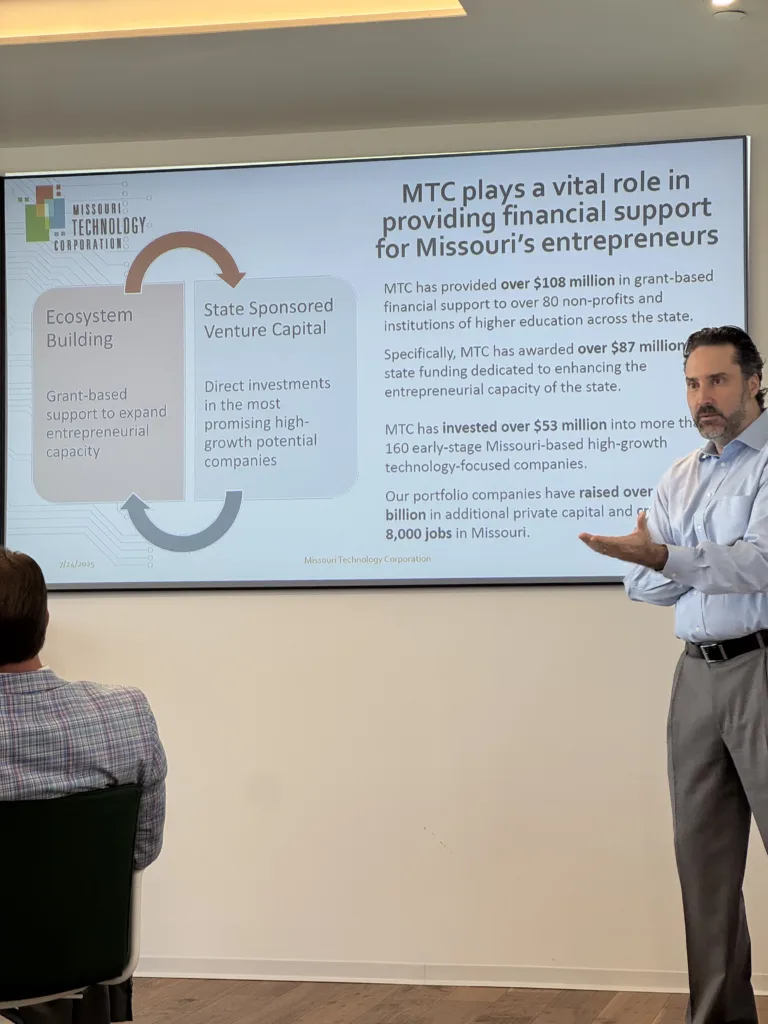
MTC has steadily increased the amount of funds it’s awarded and, importantly, expended over the past three fiscal years. Since fiscal year 2023, the organization has awarded $68.9 million to venture-ready startups, with about $38.9 million of that money out the door. The organization has expended 63 percent of its first tranche of federal funding and awarded up to 85 percent, according to documents presented at last month’s MTC board meeting.
“Without getting new funding from the state and having to reallocate the funding we already have from the state, we’re putting it into the programs that are going to create the best pipeline for us to get into the third tranche of [federal] funding, because that’s what we believe has the largest impact on the organization,” Scatizzi says. The third tranche of federal funding could bring in another $27–35 million to the state, he adds.
Familiar territory
This isn’t the first time state support for MTC has yo-yoed. The organization saw robust appropriations (above $10 million annually) from the legislature in some years last decade. Then support dropped below that for fiscal years 2021 and 2022 before jumping to $16 million for both 2023 and 2024 and down to $8.5 million in 2025.
“We’re constantly in a boom-or-bust cycle,” Scatizzi says. He points out the average annual support is around $8 million, but when lawmakers treat financial support for innovation and entrepreneurship like a faucet, it makes long-term growth of the state-wide innovation ecosystem more difficult.
The grant programs for entrepreneurial support organizations MTC has sponsored in the past are a good example. Scatizzi explains consistent state support means his organization can award multi-year grants versus ones that only last one year.
“It actually makes the entire system more stable,” he says. “[instead of] every year the [entrepreneurial support organizations] coming back [and] saying, ‘Well, I don’t know if MTC is going to fund us. We can’t be doing long-term planning.’”
Quentin Ortega, who runs Venture Ready Missouri, agrees. His program is part of what MTC is still funding this year, with a grant term for the next two. “Giving a one-year lifespan of funding and then having to continue to find funding immediately the next year is always going to be a challenge,” he says. “As soon as you’ve got the funding for the first year, you’re starting to think about, ‘How do I fund it for the next year?’”
The program Ortega leads teaches founders or business owners about how to effectively seek venture capital, in the hopes that providing people a road map means more success for local companies, he says. Having been involved in the Missouri innovation landscape for nearly a decade and a half (he was one of the first recipients of an Arch Grant), Ortega says consistent support for entrepreneurs is vital to maintain positive momentum.
Before Venture Ready Missouri was funded, he says an entrepreneur reached out to him asking for advice and Ortega couldn’t exactly help. “[They] said, ‘I’ve been building this business in my basement, and I need to know what the next steps are, and I see your name on a lot of websites and stuff for all these programs.’ I really didn’t have a resource to point them to,” he explains.
Consistent support can help entrepreneurs feel more comfortable starting something new in Missouri and staying here for the long-term, Ortega says.
“When I first moved to St. Louis with one of my companies in 2012, the amount of people who were knocking on the door saying, ‘How can we help you? What connections do you need?’ That’s what allowed us to grow,” he says. “That’s what kept me here. That’s what brought me into the innovation community.”

Slow and steady work
Building a robust and state-wide innovation ecosystem in Missouri is a long-term play that requires both direct investment into new companies that are ready for it and the programming that prepares them for it, too. MTC is one of the only organizations in the country doing both sides of that work, Scatizzi says.
“It takes a lot to get a company venture-ready,” he says. “So it makes a lot of sense that there’s one organization that is looking at the broader perspective of how the state is ensuring all of these resources are available.”
These shared roles—two sides of the same coin—also couldn’t be more different, says Emily Hemingway, executive director of TechSTL, a tech council composed of St. Louis tech entrepreneurs, companies, universities, and nonprofits.
“They’re both long games, but in very different ways,” she says. “Those two pieces are so intertwined you cannot have one without the other.”
Hemingway describes ecosystem-building as “inch-wide, mile-deep,” wherein MTC (or any other organization) must deeply engage within a community to build up resources, while direct investment in individual companies is “inch-deep, mile-wide.” There the emphasis is on clearing a broad path to support the rapid growth of many different startups.
“We’re asking this one organization with a very small team to manage two completely different models that have different cultures, timelines, and funding streams,” she says. “And when you factor in inconsistent investment from the state, it makes it almost impossible to juggle both.”
With more state support, Scatizzi contends MTC can support more things outside of direct investment into companies, fulfilling its mission of supporting high-growth potential entrepreneurship. But without funding from the state, those extra programs are the first to get cut. The parts of the state that really lose out, he says, are not the major metro areas, but places like Joplin, Kirksville or St. Joseph.
Those are the places where MTC can have outsized impact versus somewhere like St. Louis with a more developed innovation apparatus, Hemingway says.
“In the more nascent rural communities we’re hearing the frustration from elected officials that there’s not enough investment capital being deployed to startups within their region,” she says. “What we know is that their ecosystem is also very young. There aren’t the support mechanisms in place to get those startups to where they are competitive to secure that kind of investment.”
What’s next
A silver lining in all of this is that the programs already funded by MTC will continue to have that funding, including physical infrastructure grants to the 39North AgTech Innovation District and the St. Louis Economic Partnership. Scatizzi says these grants are funded for two or three years.
“The real negative is, if we don’t run this program next year, it’s not that any one of those won’t have funding, [but that] there won’t be any opportunity for new people to apply,” he says.
Given the finagling MTC has done for its fiscal year 2026 budget, the organization can weather a single year of being left out of appropriations, Ortega observes.
“The people who benefit from these programs and this funding won’t feel it right away, because there’s this buffer space,” he says. “The goal would be, and the hope would be, that we can get funding back in the budget for MTC in time that they never know.”
But going without would likely hobble the organization and Missouri’s innovation ecosystem in the long-term, Scatizzi says.
“MTC can probably always cover some level of core services, but that’s going to just keep shrinking and shrinking until [we] can’t support the entire state’s ecosystem,” he says.
Correction: A previous version of this article misstated figures of the amount of money awarded and expended over fiscal years 2023 to 2025.