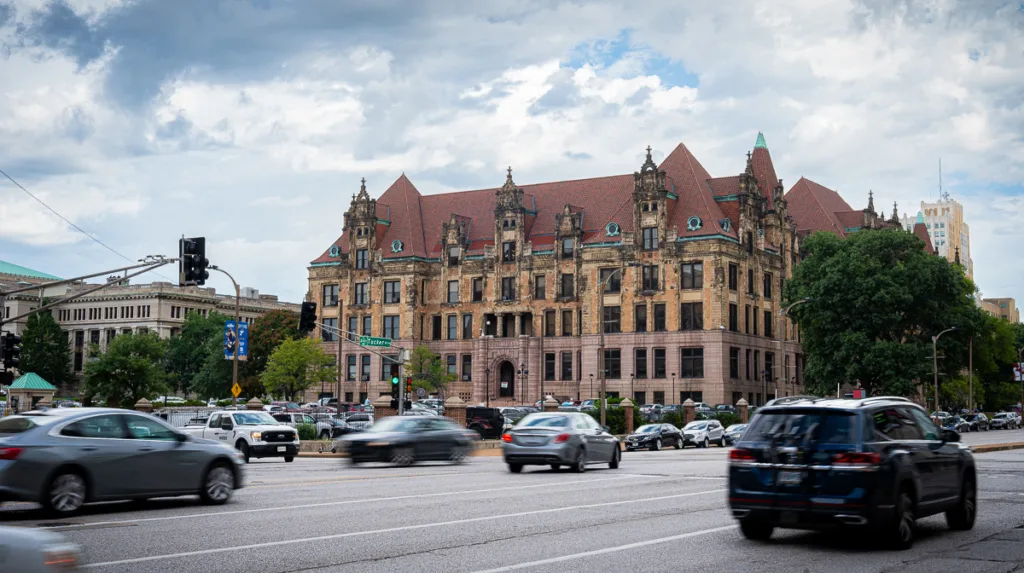
In the early 20th century, spurred by the civic excitement surrounding the 1904 World’s Fair, boosters and businesspeople wanted to continue transforming St. Louis. They formed committees and task forces to promote the city as a great place to live and work, aiming to double the population to 1 million residents. But the effort stalled: St. Louis’ population peaked at around 850,000 after World War II, and it’s been on a steady decline ever since. The latest Census estimates reveal that fewer than 300,000 people call the city home. Karlos Ramirez believes he has a plan to reverse the trend.
Hired in September as the International Institute of St. Louis’ vice president of Latino outreach, Ramirez is promoting the city as a welcoming place for Latino immigrants. Ramirez already visited Chicago and El Paso, Texas, and met with representatives from Boston. Soon, he’ll make similar trips to New York City and Denver. Ramirez’s goals for the Latino Outreach Program are, perhaps, much more realistic than those of the city boosters from more than a century ago.
Keep up with local business news and trends
Subscribe to the St. Louis Business newsletter to get the latest insights sent to your inbox every morning.
He hopes these efforts will bring at least 500 Latino immigrants to St. Louis in 2024, continuing a trend of Latino population growth in the city. Ramirez also wants to make something clear: “It’s not just a feel-good story or what’s humanitarianly right. It’s what makes economic sense for the region.”
Arch Grants founder Jerry Schlichter designed the Latino Outreach Program in response to new immigration pathways recently established by the U.S. Citizenship and Immigration Service. The program is targeting humanitarian parolees from such countries as Venezuela, Cuba, and Nicaragua—in other words, folks who aren’t technically classified as refugees though they hail from places experiencing profound economic and political crises. Every immigrant who is resettled in St. Louis will arrive with the proper legal clearances to live and work in the United States.
Even so, Ramirez is fighting against misconceptions that the program will bring scores of illegal immigrants to the region. “We’re only getting people who legally have the right to work in the country,” Ramirez says. “We’re being strategic and intentional to make sure that we’re not bringing more people than we have beds.”
Learn More
For more information on how the International Institute of St. Louis is resettling refugees and immigrants in the city, visit iistl.org
The International Institute’s resettlement programs for Bosnians and Afghans, among others, provide a blueprint for how to proceed. Like Ramirez, Moji Sidiqi, the International Institute’s director of multicultural affairs and Afghan outreach, has been traveling the nation to meet with local officials and tout St. Louis’ ability to support significant numbers of refugees. Sidiqi has learned many lessons since joining the organization in early 2022, including how to set realistic expectations for families interested in making St. Louis their home. She tries to explain to Afghan immigrants that while there are welcoming support systems ready to help newcomers, it’s crucial that they arrive ready to work.
“Our biggest issue is housing,” Sidiqi says. “We want landlords and leasing offices to connect with us so that we can collaborate. If we truly want St. Louis’ population to increase to the numbers we’re aiming for, we need to look at housing through a whole other lens.”
The majority of the housing for Latino immigrants will be within walking distance of the Institute’s headquarters in Tower Grove East, as well as in areas with bus routes that could get them to headquarters. The program also has job placement partnerships with local building and manufacturing trade unions.
“One of the things St. Louis always gets dinged on is that we don’t have a big enough workforce,” Ramirez says. “If people really consider the economic development of this program—not the politics of it, not the race of it—I think they’ll realize that this really is what’s best for the region.”
MORE TO KNOW
DEMOGRAPHIC SHIFT
THE RISE OF ST. LOUIS’ HISPANIC AND LATINO POPULATIONS
All you need to do is walk along Cherokee Street to see the influence of St. Louis’ burgeoning Hispanic and Latino population. From grocery stores to restaurants to bakeries, a community has sprouted to support the growing number of people with Hispanic and Latino backgrounds who have made the region their home in recent years. As the city’s overall population has dropped, the proportion of Hispanic and Latino residents has more than doubled over the past two decades.
2020: 301,578 total population / 15,405 Hispanic or Latino residents
2010: 319,294 total population / 11,130 Hispanic or Latinoresidents
2000: 348,189 total population / 7,022 Hispanic or Latino residents