While the lettuce-driven cyclospora outbreak has generally been bad for businesses across the nation—including some St. Louis chefs who’ve been forced to take extra precautions—the outbreak has come with an upside for one St. Louis-area startup.
Vertigreens, which Tova Feinberg founded in 2021, has received an influx of inquiries from restaurants and grocery stores looking to switch from national suppliers to locally grown lettuce. “Since they know it’s coming local from us here, then they feel a little bit more secure because we’re not part of the recall,” Feinberg says.
Keep up with local business news and trends
Subscribe to the St. Louis Business newsletter to get the latest insights sent to your inbox every morning.
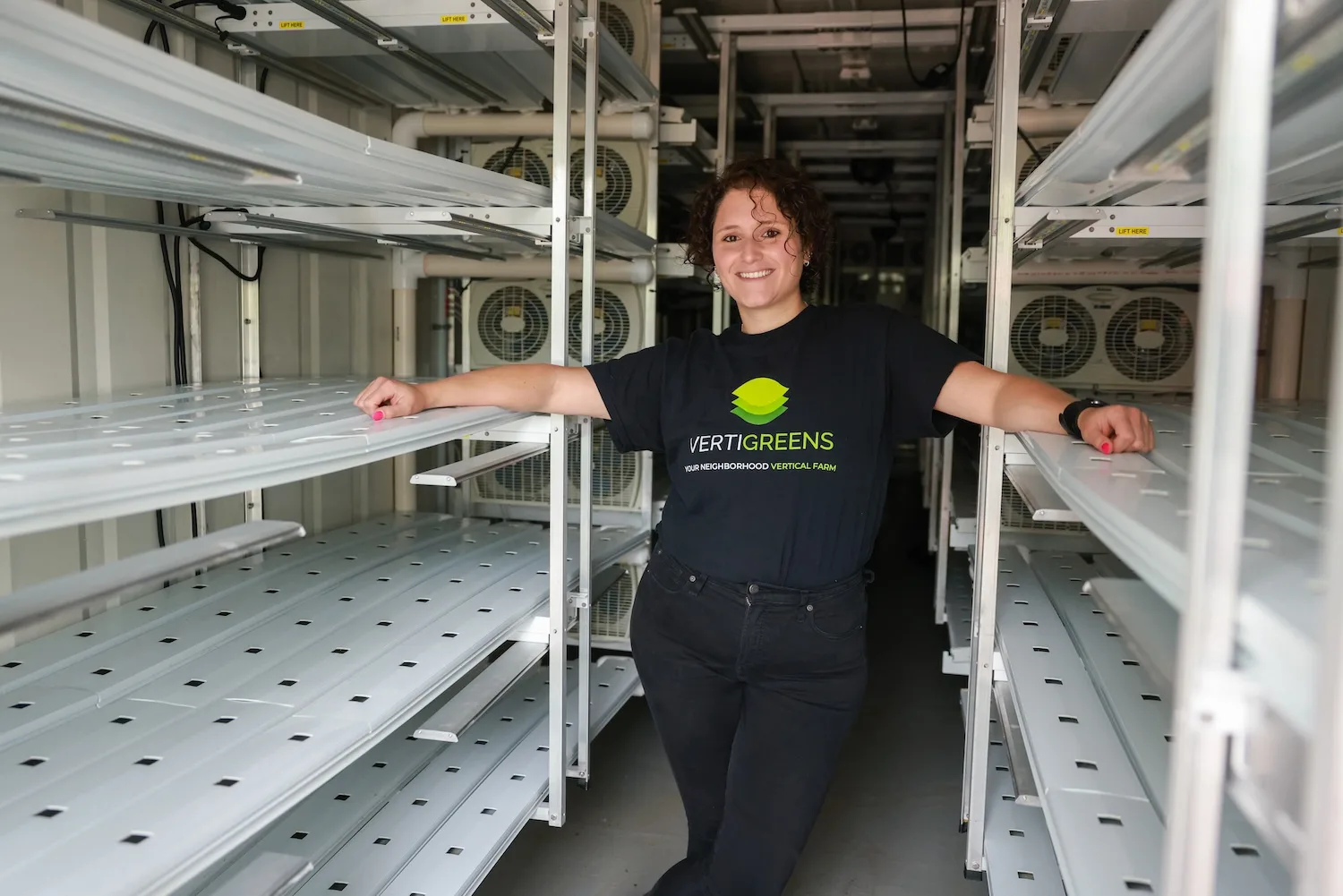
Vertigreens employs hydroponic cultivation methods, meaning that the roots of the plant are immersed in nutrient-dense water rather than soil. With hydroponics, the plants can be stacked floor to ceiling in open-air boxes stored in shipping containers, hence the name Vertigreens.
Feinberg says that hydroponic cultivation gives restaurant owners greater peace of mind since the possibility of the lettuce being grown in contaminated soil is eliminated. (Cyclospora outbreaks arise from growing lettuce in soil or water contaminated with human fecal matter.)
Aside from helping to alleviate contamination concerns, hydroponic cultivation also saves space, as quantities that would normally take up three acres of land now take 325 square feet. “As long as you have access to power and water, you can really place these things anywhere,” Feinberg says of the shipping containers.
However, Feinberg hesitates to boast about her company’s total environmental footprint. “The electric load is high to the point that I don’t say we’re fully sustainable. But that’s where we’re entering research to see if we can be more energy efficient.”
The company’s limited water demands, however, are enviable. Due to using a closed-loop system, one shipping container uses just five gallons of water per day.
This past March, Feinberg was presented with the opportunity to acquire 21 shipping containers, a rapid expansion from the small farm she had been operating since 2021. Nineteen of those containers could be outfitted as vertical hydroponic farms, along with a sanitation and an administrative container. She says, “I had two months to find a lot of money.” Ultimately, she was able to acquire all 21 containers with help from a line of credit from Carrollton Bank.
The Jackie Joyner-Kersee Foundation also helped, stepping up to partner with Feinberg by purchasing and hosting four of the farms. The foundation recently established a Food, Agriculture and Nutrition Center in East St. Louis, where Feinberg is currently storing the other containers as she looks for additional partner sites.
Before, with just one farm, Feinberg found it “tight” to break even.
“But now with the 19, especially with the partnership we have with Jackie Joyner,” she says, “it tends to be a lot simpler. The projections are looking great now. We just need to execute.”
With the new four farms, Feinberg adds, she can use crop rotation to produce up to 3,600 heads of lettuce a week by harvesting one farm every week—a 400 percent increase to her total output.
With the expanded output, Feinberg hopes she can branch out from supplying restaurants—which she originally started working with because they require fewer certifications—to larger institutions. “There’s food hubs,” she says as one possibility. “We’re going for zoos, which is exciting. Potentially hospitals, schools, universities, anyone that really wants some fresh produce, and grocery stores will be next.”
A St. Louis native, Feinberg works part-time for Washington University’s Skandalaris Center for Interdisciplinary Innovation and Entrepreneurship as a startup associate, a job in which she helps WashU students launch new businesses. She says she tells them to prioritize their network. “It feels like it’s a lonely journey, but really build out that network, and you never know who’s going to help you along the way,” she says.
“Two—equity is your power. Don’t just give it away,” she adds. “Be really strategic when you’re raising money, and it shouldn’t just be about money. It should be what can they contribute to the table.”
Feinberg puts her startup advice and experience to use in local competitions such as Arch Grants, which gives winning founders capital without them having to exchange equity. At the beginning of August, she pitched for the fourth year in a row at the founder competition and made it to the finals for the third time in a row.
“Each pitch just seems stronger, just because I see the progress that I’ve done year over year. A lot of people resonate with what I do, which is always nice. And there are actually a lot of people that I’ve mentored that I was competing against, which is always super fun,” Feinberg says.
Through her partnership with the Jackie Joyner-Kersee Foundation, Feinberg will donate 10 percent of the lettuce grown in the four farms on site to address food insecurity in East St. Louis, a documented food desert. “A big thing for me is that healthy food should not have to be at a costly price point. Everyone deserves healthy food, so this is one way of being able to give back,” she says.