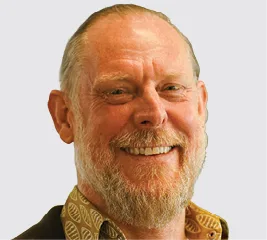
Originally from West Yorkshire, England, Oldroyd became the Danforth Center’s new president in 2025. He’s been impressed with the organization’s work, particularly its successful launch of pest-resistant cowpea in Nigeria, which gives farmers a vital tool to increase productivity and food security, as well as the development of new cover crop mixes that have the potential to improve soil health and long-term sustainability in the United States. “I’ve been inspired by the remarkable impact of our work,” Oldroyd says.
Keep up with local business news and trends
Subscribe to the St. Louis Business newsletter to get the latest insights sent to your inbox every morning.
2026 QUESTIONNAIRE
PROFESSIONAL ACCOMPLISHMENTS & OPPORTUNITIES
What has been your/your company’s most significant success over the past 12 months? Since joining the Danforth Plant Science Center on October 1, 2025, I’ve been inspired by the remarkable impact of our work. In my view, the Center’s greatest recent successes include the release of pest-resistant cowpea in Nigeria—providing smallholder farmers with a vital tool to increase productivity and food security—and the development of new cover crop mixes that has the potential to offer US farmers powerful solutions to improve soil health and long-term sustainability. These achievements reflect the Danforth Center’s continued role as a global leader in plant science with real-world benefits both locally and internationally.
What has you most excited about the future of your company or industry? Knowledge in plant science has expanded immensely over the last three decades and we are in an incredibly exciting time, where I believe we can use the knowledge generated through plant science to deliver transformative change in the resilience, sustainability and security of our global food production systems.
If you could change one thing about your industry, what would it be and why? If I could change one thing about the plant science industry, it would be to make it easier to translate discoveries into real-world agricultural impact. Compared to pharmaceuticals, bringing innovations to agriculture is far more challenging—largely because there’s significantly less capital available for agtech entrepreneurship. To be viable, new agricultural products must reach a large share of crop production, which requires substantial investment and time. Removing these barriers would allow more breakthroughs in plant science to benefit farmers and communities worldwide. There has been a big push over the last few years in St Louis at the 39 North Agtech Innovation District, that supports startup/scaleup of agtech companies. I am extremely happy to see this development in St Louis, and I would like to see it scaled further.
What’s the toughest business challenge you’ve had to overcome? I think the hardest challenges we face in agriculture is finding effective ways to drive sustainability while also ensuring that innovations reach the world’s poorest farmers. A profit-based approach is a well-traveled route and proven path to impact, which we need to maximize here in St. Louis, but it can’t be the only route. To truly address agricultural sustainability and support low-income farmers in some of the most vulnerable regions, we must explore alternative models that maximize impact, even when profitability is not the primary driver. The real challenge lies in balancing these paths to ensure the greatest possible benefit.
What’s a risk you took in business that didn’t pan out—but taught you something valuable? Although my career so far has been in academia, I’ve learned that taking risks is essential to progress. In scientific research, we push the boundaries of understanding by asking bold questions—knowing that sometimes the answer may be failure. Those experiences have taught me that failure isn’t wasted; it’s part of the process that paves the way for breakthroughs. I believe transformational change rarely happens without the courage to take risks.
What advice would you give to the next generation of St. Louis entrepreneurs or leaders? Hold onto your passion, and believe that transformational change is possible.
MENTORS & PEERS
What is a key strength of the St. Louis metro area business environment? The St. Louis area is a powerhouse for plant science, both in the public and private sectors. We have a strong community, with world-class institutions. Since I accepted the position of president in January 2025, I have received an overwhelmingly positive response and welcome from the business community. That includes, not only people in the agtech innovation ecosystem, but business leaders like our board president, Penny Pennington, and influencers like Ruth Kim. The St. Louis business environment is very collaborative—driven by talented generous people, dedicated to driving progress across industries. I think it’s the commitment and generosity of the community that is St. Louis’ greatest asset.
What is one thing you would change about the St. Louis metro area business environment? I would increase the amount of venture capital available in plant science to increase our pace of impact and the investment in local businesses associated with agriculture.
What’s a local organization, nonprofit, or initiative that more people should know about—and why? I am not sure many people in the region fully appreciate what a powerhouse St. Louis is in agricultural innovation. Much of that stems from the vision of Bill Danforth and the internationally renowned Donald Danforth Plant Science Center, which has attracted some of the brightest minds from around the world to address challenges we face, and advance secure and sustainable food production.
BACKGROUND
Where were you born? I was born in West Yorkshire, UK. Specifically in Dewsbury, an old industrial revolution city that was rather down at heel when I was young.
What educational degrees do you hold, and where were they earned? BSc Honours in Biological Sciences, from the University of East Anglia, UK PhD in Plant Science, from the University of California, Berkeley.
What was your first job, and what did you learn from it? My first paid job was cleaning dishes in a kitchen at a hotel, which I did during my summers while a student at university. I learned resilience and humbleness from this role. But perhaps most relevant was my second job, working as an undergraduate in a plant genetics laboratory at the University of California, Berkeley. This job inspired me in plant science and especially plant genetics. I started working in a lab at an incredibly exciting time, as we were just starting to be able to identify plant genes. I knew then I wanted to work in plant science, and I have never looked back.
HOBBIES & INTERESTS
What’s your hobby/passion? I have applied my principles to my garden: creating a space for nature and people. I have really enjoyed thinking about the entire lifecycle of insects and creating space in my garden where biodiversity can thrive.
What is one book you think everyone should read (or podcast everyone should listen to) and why? Wilding by Isabella Tree. This book tells the story of converting unproductive farmland into a thriving space for wildlife. I think one of the greatest challenges we currently face as a society is how we balance food production, urban development and space for biodiversity. We need out of the box thinking, and I find this thesis from Isabella Tree an inspiring use of unproductive land.
What do you do when you’re feeling stuck or uninspired? When I’m feeling stuck or uninspired, I find the best solution is to step away and clear my head outdoors. Spending time in wild spaces—whether hiking or biking—helps me reset, gain perspective, and return with fresh energy and ideas. Being in nature is a powerful way for me to reconnect and recharge.
What would people be surprised to learn about you (fun fact)? I spent the early part of my life in Zambia. My earliest memories are from there. Growing up in Zambia meant that I did not have access as a child to television or the toys that most British/American kids took for granted at the time. It meant I had to be very creative in my play as a child, and I think I have benefited immensely from that background. Exploring the national parks in Africa and their amazing wildlife instilled a lifelong love of the natural world.