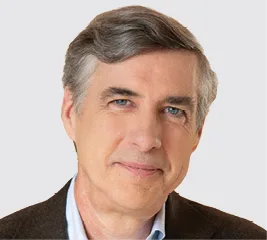
Mc Laughlin’s team played a leading role in rebuilding Mastercard’s global payments network to be faster, smarter, and ready for the future. He has also been instrumental in advancing Mastercard’s fraud prevention programs, while driving advancements that help the company process more transactions securely and expand its reach across the world. “Revolutionizing Mastercard’s core payments network, transitioning from legacy systems to an integrated, agile transaction stream, enabling diverse and future payment technologies, crucial for the company’s growth and innovation in the digital payment landscape has been a challenging yet rewarding journey,” he says.
Keep up with local business news and trends
Subscribe to the St. Louis Business newsletter to get the latest insights sent to your inbox every morning.
2026 QUESTIONNAIRE
PROFESSIONAL ACCOMPLISHMENTS & OPPORTUNITIES
What has been your/your company’s most significant success over the past 12 months? My team have led the design, development, and delivery of the most significant technological transformation in over thirty years to Mastercard’s core global payments network—the heart of a nearly $500 billion company—transforming it from multiple legacy fixed payment rails into an integrated, real-time, event-based Transaction Stream. The new platform enables full backwards compatibility for current customer interfaces, payment types, and services, while unlocking the potential to seamlessly incorporate new flows, interfaces, and business capabilities. Deployable in both public and private cloud environments and connected through a new global network backbone, the Transaction Stream is designed to meet emerging regulatory and data handling requirements, while operating with 30-plus percent reduced cost and delivering a 20 percent increased transaction performance. It is crucial for Mastercard’s long-term technological resilience and competitiveness, enabling a future where anyone can transact anywhere, any way they want. Under my leadership, Mastercard has continued to evolve one of the world’s largest and most sophisticated payment fraud detection and prevention systems, the Decision Management Platform (DMP), which currently stops billions of dollars in fraud attempts per month for our customers and creates a major new revenue stream for Mastercard. Moving from traditional rules-based systems to a real-time AI-based system, leveraging 13 different sophisticated AI techniques and over a trillion in-memory parameters, the system operates with five-nines reliability and sub-50ms response times, interacting in real time with all Mastercard transactions. Not only has the platform reduced fraud by a factor of 3 times over traditional methods, but the DMP has also enabled a 6 times reduction in ‘false positives,’ allowing many more valid transactions to flow through the network, driving revenues and greatly strengthening the consumer experience. My team has also played a key role in expanding Mastercard’s processing footprint globally, particularly in Japan, Mexico, India, Indonesia, Vietnam, and other regions. The expansion involved setting up cost-effective local operations and enabling domestic processing, significantly enhancing Mastercard’s network penetration in local transaction flows and enabling a 24 percent increase in transactions reaching the network and services.
What has you most excited about the future of your company or industry? I am excited about the future of the financial services industry and how companies transition to more of a contextual payments system. No longer will we discuss payments as a distinct action; no, that will become a thing of the past. Along with my colleagues at Mastercard, we are working and thinking about how to make payments richer, more seamless, and more secure experience. Whether it’s when you get out of your Uber, walk into the grocery store, go to the movies, or make an in – game purchase, how can companies similar to ours enrich every transaction, and provide the customer with more experiences, all while continuing to maintain control.
What’s the toughest business challenge you’ve had to overcome? Revolutionizing Mastercard’s core payments network, transitioning from legacy systems to an integrated, agile transaction stream, enabling diverse and future payment technologies, crucial for the company’s growth and innovation in the digital payment landscape has been a challenging yet rewarding journey. I’ve helped evolve Mastercard’s digital payments network, establishing global industry standards for mobile payments. Modernizing the core payments networks is groundbreaking because it enables instant digital credential issuance and the tokenization of transactions, enabling any connected device to be used as a secure payment device, significantly enhancing security and convenience for merchants and consumers.
What advice would you give to the next generation of St. Louis entrepreneurs or leaders? I believe that we are all entrepreneurs at work at Mastercard, because we are trying to solve hard, global challenges that impact the everyday lives of consumers, businesses, and the global economy. With that context, for any entrepreneur or peer aiming to achieve their best at work, it is crucial to drive execution, remain nimble and adaptable to changing circumstances, and stay grounded in their purpose. Staying grounded will allow you to continue to relentlessly focus on the real problem and not get sidetracked with the shiny new thing. Use data and seek advice from peers and those around to ensure the task at hand is still the north star. Learn continuously, and keep expanding your knowledge. Markets will change, and technology advances at the speed of light, making what worked today potentially ineffective or irrelevant tomorrow. By consistently absorbing new information, you can stay focused on the real issues and understand when and how to pivot or adjust to unforeseen or entirely new factors. Don’t be afraid of failing, but if and when you do, do it quickly and learn from it.
MENTORS & PEERS
What is a key strength of the St. Louis metro area business environment? A key strength of the St. Louis metro area business environment is the region’s talented, resilient, and community-minded workforce. The St. Louis area benefits from a steady pipeline of graduates from respected institutions such as Washington University in St. Louis, Saint Louis University, and the University of Missouri–St. Louis, which collectively produce professionals with strong foundations across many sectors including technology, healthcare, business, and science. The local workforce reflects a strong Midwestern work ethic, paired with a growing emphasis on innovation, inclusion, and continuous learning. Many of Mastercard’s employees in St. Louis actively participate in professional development, employee resource groups, and community engagement initiatives, contributing to a workplace culture at Mastercard that values both individual growth and collective success.
What’s a local organization, nonprofit, or initiative that more people should know about—and why? LaunchCode, a St. Louis–based nonprofit that’s redefining what it means to build a career in technology. Their mission is simple but powerful: to open doors to tech careers for individuals from nontraditional backgrounds, those without four-year degrees, those making career pivots, and those who simply haven’t had access to traditional pathways. And they do it through rigorous free trainings and job placement support. At Mastercard, we’ve had the privilege of partnering with LaunchCode for more than a decade. What makes this partnership so meaningful to us is how deeply it aligns with Mastercard’s Force for Good culture. We believe that technology should be a bridge, not a barrier. And LaunchCode helps us live that belief by bringing in talent that’s not only skilled and driven, but also incredibly diverse in perspective and experience. Since 2014, we’ve welcomed more than 200 LaunchCode apprentices into our St. Louis Tech Hub. More than half have converted to full-time roles, and many are now in mission-critical positions, right from data operations to engineering. These individuals bring in fresh thinking, challenge assumptions, and enrich our teams in ways that go far beyond just code.
BACKGROUND
Where were you born? Massachusetts
What educational degrees do you hold, and where were they earned? University of Pennsylvania, Wharton School of Business