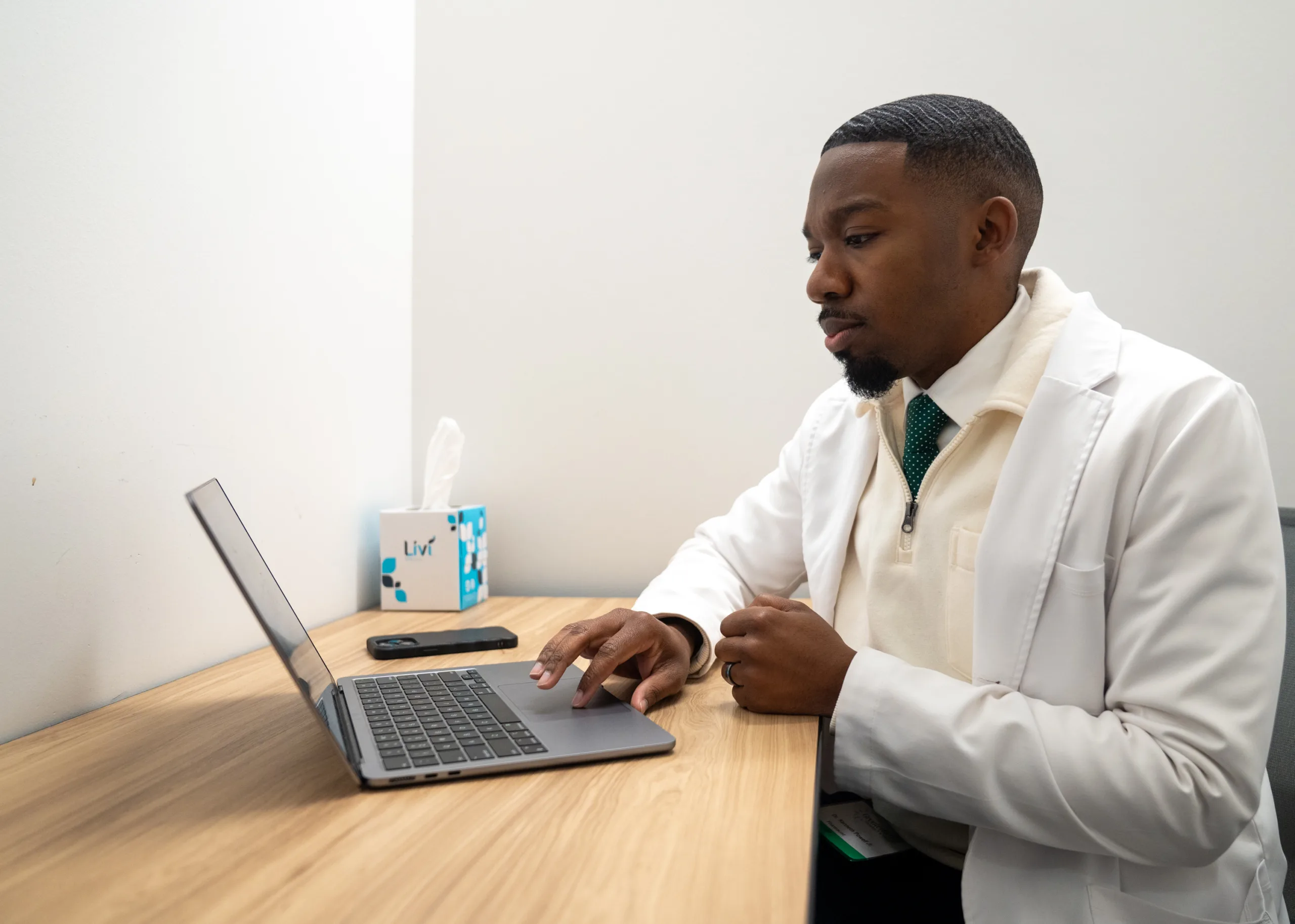
The seed of the idea for COUNSELMEDS began growing several years ago, when Marcus Howard returned to North St. Louis, where he’d grown up. Howard saw first-hand the challenge one of his parents faced living with congestive heart failure as a beneficiary of Medicaid.
“I was able to see the struggle with managing his meds, [him being] in and out of the hospital, and really struggling to become healthier,” he says. “That experience had a significant emotional and financial impact on my immediate family and sparked my interest in solving the problem.”
Keep up with local business news and trends
Subscribe to the St. Louis Business newsletter to get the latest insights sent to your inbox every morning.
Howard’s first crack at that came with GreaterHealth Pharmacy & Wellness, an independent pharmacy operating out of the Delmar DivINe building, which he founded with the intent of building trust and counseling patients on the medications they are prescribed. The new business found support from Arch Grants as a member of its 2023 cohort, and the $75,000 grant helped the pharmacy evolve into one that delivered medication to people on Medicaid.
“We increase our revenue by over 100 percent just being able to deliver medication directly to the door of the patient,” Howard says. “That allowed us to significantly increase the number of people that we would work with.”
Fast-forward to today and the company, now known as COUNSELMEDS, is building out a virtual pharmacy care service designed to “connect pharmacists virtually to Medicaid patients with chronic conditions to help them better manage their medication and their healthcare outcomes,” he explains. Howard has big plans this year to begin scaling the service with artificial intelligence tools, taking it from St. Louis to the entire state of Missouri and eventually reaching more than 100,000 Medicaid patients.
“Ultimately, our goal is to be a medication management partner for all Medicaid beneficiaries who are managing medication and have chronic conditions,” he says. “There’s a human element to it, where our pharmacists will support them. But in order to scale that one-on-one interaction more frequently, we’ll be building an AI technology that will help us more frequently reach out and help our patients manage their medications so they can get healthier faster.”

Howard explains COUNSELMEDS is a “human plus AI voice agent technology,” where a pharmacist counsels a patient virtually, talking them through their different medications, how to take it, and potentially dispelling any myths or misconceptions about health care. The artificial intelligence component handles follow-up messages in the month between vertical calls, asking and recording how a patient is feeling and if they’ve had specific side effects, such as headaches or dizziness.
Howard also says the AI can potentially help guide patients through checking indicators like blood pressure, blood sugar levels, coordinating or scheduling care with their primary care physician, facilitating non-emergency transportation or medication delivery, and other “things that are difficult for Medicaid patients to navigate the health care system.”
Maintaining closer contact with patients, without burning out pharmacists or having them manage dozens of calls or texts a month, can yield better care over the long term, he contends.
“Basically, the AI component collects that data either by voice or by phone throughout the month,” Howard says. “So by the time the next month rolls around, the pharmacist has a good amount of data to be able to assess and continue working with their patient and putting them on a health plan that actually gets them healthier.”
Howard is clear that his company isn’t about to, or even interested in, fully replacing human-to-human connections, as those interactions are paramount to building trust between the patient and service.
“If you do try to completely overhaul it with AI, there’s this trust gap that will completely obliterate the trust in that infrastructure,” he says. “What we’re doing is, we’re enhancing the pharmacist’s ability to help a patient and to be able to frequently connect with that patient.”
Crucially, COUNSELMEDS AI is designed to work as a voice and text service, which may be the only way to reach lower income patients, he explains. “These are the people who need it most, the people who have five to ten-plus medications, the people who live in communities that are under-resourced, considered pharmacy deserts so they don’t have a pharmacy within a mile,” he says. “Most new and innovative technology is not geared to those people who are furthest away from opportunity.”
This focus is encouraging for Arch Grants executive director Gabe Angieri.
“We have a bifurcation of healthcare delivery in this country, where people of means [and] privilege have access to much more tailored, personalized healthcare delivery,” he says. “And to see that start to become more available for underserved populations is where we need to go. It is not just an untapped market, but also a really positive thing for our society as well.”
To that end, Arch Grants has thrown more support for COUNSELMEDS’ evolution from a brick-and-mortar pharmacy to a virtual service. The nonprofit revealed at the end of last year COUNSELMEDS had received a $100,000 Growth Grant, funding that comes with the requirement of raising matching funds.
Of the three companies that received a Growth Grant last year, Angieri notes all of them had a focus on solving a problem in health care.
“I would not say it’s a trend line that I would expect to necessarily continue, but it does point to the fact that St. Louis has a robust medtech and health care-oriented startup infrastructure,” he says. “There’s massive waste in the system—overruns and charges—and if we can support companies that are cutting through that and making the healthcare delivery system more efficient, I expect those companies to do quite well in the market.”
Angieri describes Howard as a “dynamic entrepreneur” whose pivot he expects will take full advantage of the Growth Grant. He notes similar support has gone to 21 other companies that have gone on to create 450 jobs and raise over $100M in venture and other outside capital.
“The scalability is a lot easier to realize when you are dealing with a tech platform rather than physical locations and all the issues that come with brick and mortar expansion,” he says. “COUNSELMEDS is a company that I think is certainly easier to envision scaling successfully.”
To that end, Howard envisions scaling nationally within the next three years if the statewide rollout is successful.
“We’re very excited because we’re doing something that is going to be extremely innovative, and we get to do it starting right here in St. Louis,” he says.

Both Howard and Angieri note the potential for COUNSELMEDS’ success. Howard explains the company looks to drive revenue by dispensing medication, which is reimbursed through insurance plans, but also by helping reduce readmission rates for health systems. He says a single Medicaid patient can cost a health system over $10,000 each time they’re readmitted.
“If that person is readmitted two or three times within that year because they have serious conditions, a hospital might lose almost $30,000 to $40,000 per patient,” Howard says, adding it can easily translate to hundreds of millions of lost money a year on not being able to properly manage Medicaid patients struggling with multiple chronic conditions.
COUNSELMEDS looks to reduce that by having health systems automatically enroll patients with the company once they’ve been discharged from the hospital. Howard says COUNSELMEDS can help monitor patients’ health and manage medication to keep them from needing to be readmitted.
“We get paid a percentage of what the hospital saves from each patient that we manage,” he says.
Despite the shifting focus to virtual care, Howard says there’s no plan to shutter GreaterHealth Pharmacy & Wellness’ location in Delmar DivINe. He says he plans to open more physical locations as the company expands its operations as a way to ensure they can quickly deliver medication to people who need it.
“If somebody needs their meds and they need them tomorrow, we can get them delivered for free, at no cost, directly to their door the next day, and we don’t have to rely on another pharmacy,” he says.