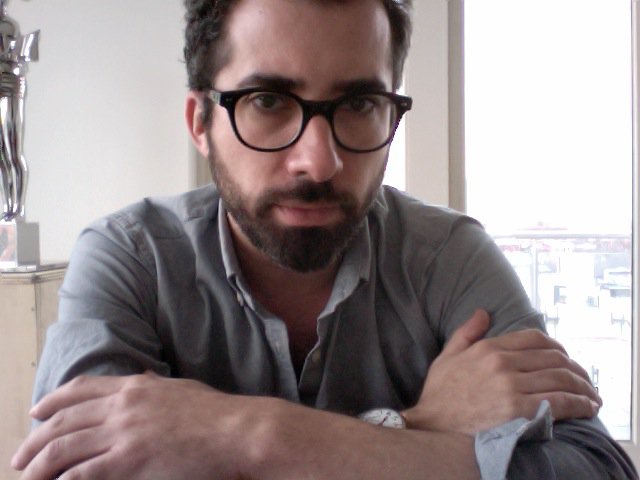
Matt Strauss is the director of White Flag Projects, St. Louis’s largest non-profit contemporary art space. As White Flag prepares to end its fifth season, Elizabeth Wolfson caught with Strauss via email to talk about the gallery’s next show, Für Elise (opening August 13th), upcoming fall shows, and five years of running the city’s most progressive and provocative arts venue.
Liz Wolfson: I thought that hell would freeze over before either a pet-themed show or a show of works solicited from the general public happened at White Flag. But low and behold, Für Elise, an exhibition of works created from pet hair, by any enthusiast, is opening on August 13th. Can you explain what strange turn of events inspired this show?
Stay up-to-date with the local arts scene
Subscribe to the weekly St. Louis Arts+Culture newsletter to discover must-attend art exhibits, performances, festivals, and more.
Matt Strauss: It’s a joke. There’s a very strange proliferation of local shows of art about dogs, and Für Elise is really aimed at that. It’s interesting, you know there are just these confluences that occasionally arise in any city I guess—in New York this summer, there are at least three big group shows focusing on ceramics, and in St. Louis this summer it’s all about dogs. After seeing announcements that the dog-themed exhibitions at Laumeier and SLUMA had spread to CityGarden and other venues it just seemed too funny that any percentage of any place’s schedule was being used this way. The thought was that if they’re doing these shows about dogs, it would be even funnier to make an exhibition literally made from dogs, and if they’re going to attempt some kind of populism, we could take that a step further as well and just let everyone into it instead of Jeff Koons or William Wegman or whoever. It’s also important to realize that summer is traditionally when a lot of less serious things go on in galleries, and that Für Elise is obviously not a serious thing within the program here. Also, we aren’t discriminating against cats.
LW: What unique curatorial challenges do you foresee arising from this exhibition?
MS: Usually the artists don’t want to eat the other artist’s work at the opening.
LW: The first show of White Flag’s sixth season, a solo show of works by St. Louis native Amy Granat, opens soon after Für Elise closes. For those not familiar with Granat’s body of work, what should people know about Granat and her work going into the show?
MS: There is very little awareness of Amy’s work in St. Louis, but she has a strong reputation elsewhere for her experimental 16mm films, and we’re very excited to be able to welcome her back for her first solo exhibition in her hometown. Throughout her career, Amy has developed her own distinct language by engaging with the tradition and technical vocabulary of earlier experimental film artists. Rather than any purely Structuralist or Materialist approach, Amy’s vision is more holistic, very lyrically activating film’s full potential as a material and a form. This is the first survey ever of her work, and we’ll be exhibiting five pieces including her most well-known “scratch” films, a film she made in St. Louis called “Lines in the Sand,” and “T.S.O.Y.W,” a collaborative film that was included in the 2008 Whitney Biennial. It’s going to be great.
LW: Can you give readers a general overview of the next season? What should people get excited about seeing soon at White Flag?
MS: Honestly, I’m not aware of anyone around here getting too excited about seeing the kinds of exhibitions White Flag produces, but internally we’re very happy with the direction of the gallery at the moment and the shows that are being scheduled—Amy Granat, as we’ve discussed, as well as a solo project by Daniel Lefcourt that really looks like it will be a breakout thing for him, and a first-time collaboration between Uri Aran and Tommy Hartung, two very quickly emerging young artists based in New York. Also, White Flag’s assistant director Jessica Baran will be organizing a group show in November, which is the first time I’ve invited a staff member to be a guest curator. We’ve really jettisoned a lot of the ideas we’d held onto about who our audience is, and we’ve reconsidered the conventional wisdom about the role of the institution within the local context, and just generally how contemporary art is best transmitted to a viewer. I think the way to put it briefly is that we’ve seen the last “idea” show at White Flag—I’m sick to death with curatorial constructs and academic exhibitions. I’m not interested in anything linear or resolvable. I want to cultivate ambiguity, and that’s really the direction things are going.
LW: In the past year or so, you’ve generally relocated to New York City. How has this impacted your work as the director of a gallery located in St. Louis? What are the benefits, what are the challenges? Do you think it’s essential for an art professional working in St. Louis (or anywhere outside of New York or L.A.) to live in between cities?
MS: I wouldn’t say I’ve relocated as much as I’m dividing my time, and really with all of the communication technologies that are available now, there’s no reason to be sitting at a computer in St. Louis if the work is better accomplished sitting at the same computer in New York, and the curatorial work is truly best accomplished when your in the same place as the art. Anyway, I’m in touch with the office in St. Louis every day, usually many times a day, no matter where I am.
The biggest challenge is the cost of trying to live in two places, and I guess there’s some sense of placelessness that’s a weird feeling sometimes. The advantages are endless… if one wants to be in touch with the art that’s being made now, there has to be that regular access to it. I don’t think you need be in New York or LA to organize exhibitions of regional interest or of dead artists, but I think it’s difficult to engage with the most current things in a timely way from too great a distance. I guess it probably depends a lot on what kind of art you want to work with—really, there’s no one way to do it. I think the way I’m trying to do this is pretty hard to swing.
LW: Looking back over the past five years at White Flag, what achievements are you most proud of? What are your regrets?
MS: Who ever achieves anything, really?
LW: How do you think the St. Louis art community has changed (or not changed) since White Flag opened?
MS: There seemed to be a real flowering of both institutions and interest that White Flag was only a very small part of, and maybe that’s peaked some time ago now. It looks to me like attendance is way down in general everywhere I go, except maybe Cherokee Street. The Post-Dispatch dropping its critic and a lot of its coverage has hurt awareness quite a bit, I think. Having said that, I feel like even if we lost half of the museums and galleries we have in St. Louis today, we’d still have a disproportionate amount of contemporary art programming relative to the size and interest level of the audience.
LW: When you first opened the gallery, you intended it (if I’m not mistaken) as an experiment, to see if St. Louis could and would support a non-profit gallery that only exhibited cutting edge, aesthetically and conceptually challenging contemporary art. Five years later, what’s your assessment of that experiment?
MS: It turns out St. Louis won’t really support it, but we go on in spite of that.
LW: Will White Flag Projects be open five years from now? How are your goals and intentions for the next five years different or similar to those you had when you first opened the gallery?
MS: The goal is to continue raising the level of the shows we produce, and in a perfect world sustainability would grow out of that. We work with relatively small budgets, and that presents a lot of obstacles to that goal. I was told it’s bad form to publish any kind of retrospective book or anything until you’ve gotten to 10 years, so I sure hope it’s around so we could do that. I’ve always wanted White Flag to have the option of being a sustainable thing, that could continue beyond my tenure, and that remains a very elusive goal.
LW: If you could travel back in time and give advice to the Matt Strauss of 2006, what would you tell him?
MS: No matter what I would have told him, he wouldn’t have listened. The things I know now had to be learned through experience.
LW: Shows at White Flag generally tend to feature American or U.S.-based artists. Any plans to expand the programming to feature a more international array of artists?
MS: I don’t know… the last group show I organized was one-third European, I think. More generally, it’s a matter of money—it costs more to work with artwork that needs to travel from overseas, and we barely scrape by the way it is. When we do work with European artists, it’s usually only feasible when they have an American gallery we can work with on shipping. If we had the resources, there are certainly a number of artists abroad I’d be very interested in bringing here. And honestly, I never thought about it that way, but I suppose we are pretty much engaged with a strain of art making that is largely Western.
LW: Those familiar with your career know you as both a curator and gallery director and as an artist, most notably as one of the winners of the Contemporary Art Museum’s Great Rivers Biennial in 2006. How has your work at White Flag, and the recent move to New York impacted your art practice? Are you currently making work, and do you have any immediate plans to exhibit?
MS: White Flag is more than a full-time job, but I’ve continued to make things when I can. I had a studio in New York for a bit, but it was too much to afford. What I’m making now is much less physical than the kinds of heavily produced paintings I used to make, and much more involved with the meaning of certain actions rather than the resulting objects. My art-making has always been a very personal activity, and exhibiting is something I give very little thought to. I’ve talked with a couple of friends about doing some group things for fun, but really I have no ambitions for that outside of my own head for now.
Liz Wolfson is Look/Listen’s visual art critic; you can also read her work under the header “Turkish and Other Delights,” at the Art21 blog.