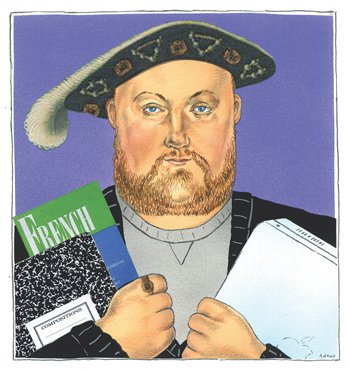
You’ll find Charles Hewitt at the St. Louis County Library’s Headquarters Branch on a school-day afternoon, one of more than a dozen brainy, patient tutors huddled with young clients, unscrambling an essay or puzzling out a calculus problem. Hewitt’s made an increasingly good living as a full-time tutor since 2000, covering all the maths and sciences, history, and English, as well as doing test prep for the make-or-break ACT and SAT college-admissions tests. Most of his students are sophomores, juniors, or seniors at St. Louis’ elite high schools; referrals come steadily by word of mouth.
Years ago, those referrals would have been whispered. These days, there’s no shame in having a tutor; everybody’s got one. Pick your reason for the trend: Colleges are more selective, parents more pushy, kids more worried about succeeding, teachers too busy coaching and serving on committees to give extra attention. Even middle-class kids headed for a state university are using tutors. And Martha Hicks, St. Louis director of Varsity Tutors, says in the company’s five years in St. Louis, it’s seen an increasing number of students in middle school and younger.
Tutoring can be a balancing act, with the tutor meting out equal measures of loyalty to the parents, the student, the school, and teachers. “Sometimes students unconsciously want you to do too much for them,” Hewitt says. “If you do, you are crippling the child, undermining her teacher, and weakening the whole tutoring profession.” A tutor “should only accept a student who has a demonstrated need that tutor can meet,” he adds.
They shouldn’t charge if their services aren’t really needed, he adds—not even if the parents are sufficiently angst-ridden to pay just for peace of mind. Nor should a tutor charge just to babysit if the student doesn’t want the help or is suffering from a deeper problem, such as depression.
Students who can benefit from tutoring may have processing or memory difficulties, an attention deficit disorder, or test anxiety. Or they may just be bubbly, overloaded kids who know they somehow have to keep their grades up. Hewitt homes in on his students’ strengths and weaknesses without judgment: “Every brain is like a tree, with neural networks that branch out in their own unique way,” he says. “There will be strong branches and weak ones.” He keeps extensive files on his students, with goals that include life skills, like organization and discipline, as well as specific content they need to master. More than anything else, what he gives his clients is full attention, asking gentle, probing questions about what something means, why it’s being done, and how it fits into a larger context.
Ultimately, that’s what the tutoring trend is about: engaging a student with extra attention, in a society that’s suffering from a deficit.