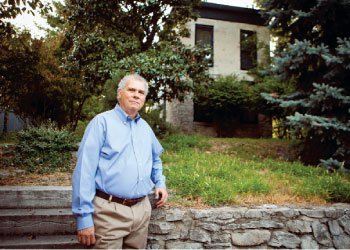
It all started with a narrow little house in Lafayette Square, as straight and simple as a child’s drawing. Thomas Danisi bought it for $500 in 1976. Curious just how old his new house was, he did a little research. Actually, he did a lot of research, for the next eight years.
A brick second story had been added in 1859, but when Danisi chipped away the concrete slathered over the first-story walls, he found the original fieldstone, quarried on-site. The lot cut across two Spanish land grants: one once owned by explorer James MacKay, the other by fur trader Joseph Motard. The house had been one of Motard’s outbuildings, put up in the late 1780s, and it just might be the only French colonial structure still standing in the city of St. Louis. “It’s an incredible survival,” notes Bob Moore, historian for the Jefferson National Expansion Memorial. “The last known colonial-era house was torn down in 1875.”
Next, Danisi learned that MacKay had mapped the Missouri River from here to North Dakota, and that it was his map that guided Meriwether Lewis and William Clark when they began their journey. Danisi, who’d majored in English at Saint Louis University before starting an audio-video design business, pored over Lewis and Clark’s journals looking for comments about MacKay. One evening, his hand slipped, and as the pages fluttered by, his eye landed on a comment that Lewis made about suffering from the ague.
At the time, “ague” was a common term for malaria. And that started Danisi thinking about Lewis’ mysterious death at age 35. The doctor who examined the body proclaimed “the work of an assassin,” and some historians still suspect a conspiracy to conceal murder. But Lewis’ colleagues felt sure he had shot himself, and for more than a century, historians have worked backward from that suicide, blaming it on depression, mental instability, moodiness, character flaws, or drunkenness.
In making their case, historians have cited Lewis’ court martial at the age of 21, for getting intoxicated and challenging a superior officer to a duel. They’ve also noted his problems finding a wife, unnecessary delays in his work, missing journal entries, and in the words of his grieving friend President Thomas Jefferson: “Governor Lewis had from early life been subject to hypochondriac affections… I observed at times sensible depressions of mind.”
So Lewis was neurotic and emotionally unstable, obsessed with unreal illnesses? Danisi wasn’t buying it. He’d taken ancient Greek in school, and he knew that in the early 1800s, the word’s definition was a lot closer to its Greek roots: hypochondriakos, meaning “of the abdomen.” Jefferson would have understood hypochondria as a chronic abdominal ailment that, although linked to melancholia, was as real as chicken pox.
Melancholia might cause abdominal distress, but so does malaria, enlarging the liver and spleen. And Danisi found evidence of recurring bouts of malaria—with fever, chills, delirium, and severe headaches—from 1803 until Lewis’ death in 1809. He believes those bouts colored Lewis’ behavior and even his observations. In September 1803, for example, instead of remarking upon the grandeur of the Ohio River scenery, he wrote, “The fever and ague and bilious fevers here commence their baneful oppression and continue through the whole course of the river with increasing violence as you approach its mouth.”
Two months later, he wrote, “I was seized with a violent ague which continued for about four hours and as usual was succeeded by a fever.” And in late September 1809, a fortnight before Lewis’ death, he stopped at Fort Pickering “in a state of mental derangement,” according to the fort’s commander, Capt. Gilbert Russell. On October 10, 1809—the night before he shot himself—a tavern-keeper’s wife recalled him as flushed, pacing madly, and muttering.
“In the end stages of malaria, you get this buzzing in the front of the head, and severe pain in the abdomen,” Danisi says. “People have said that when this buzzing occurs, you just want to shoot yourself to get rid of the pain.” When Lewis picked up his pistol, that’s where he first took aim: at the front of his skull. He shot at an angle, so the bullet sliced across his forehead and did not kill him. Then he fired again, this time aiming under his breastbone.
In 2009, Danisi co-authored a biography, Meriwether Lewis, in which he broached his malaria theory. Scholars resisted. But when he spoke at a Lewis and Clark Bicentennial conference that year, he says the audience was thunderstruck: “They came up to me afterward, saying, ‘We’ve never heard this!’”
Danisi became even more determined to redeem Lewis’ reputation. “He was brilliant—a writer, a scientist, Thomas Jefferson’s private secretary. So many historians traced his ‘mental instability’ to that early court martial, but all they were going by was the summary. So I decided I was going to find that damned case.”
It took 18 months. Danisi narrowed it down to 12 historical societies and scanned finding aids that listed millions of documents. He found a record tagged “court martials” in the papers of Gen. Anthony Wayne—who presided over Lewis’ court martial—but the archivists told him they didn’t photocopy; he’d have to travel there and see for himself.
Danisi drove to Pennsylvania and photographed the 40 handwritten pages that were, indeed, the long-lost court-martial proceedings. They contained no proof that Lewis had even been drunk. Since he’d brandished no weapon, he claimed that his demand for “satisfaction” hadn’t meant he was challenging his superior officer to a duel. “His superior officer wanted to teach him a lesson,” Danisi says, “and had a prior pattern of making such accusations.” Lewis was found innocent, and his sword was returned to him.
Once Danisi had the court martial’s back story resolved, he started documenting all the side projects Lewis was completing, at Jefferson’s request, when he wasn’t making daily journal entries. How could scholars accuse him of laziness when he was pressing and labeling plant specimens, labeling minerals and animal furs, managing tense encounters with the Lakota, measuring latitude and longitude, tracking weather and wind, and taking astronomical readings?
Danisi also worked to debunk the murder-conspiracy theory, and he found, in Sedalia, the medical ledger of Dr. Antoine Saugrain, who’d treated Lewis for malaria. He even investigated the mysterious delay of letters Lewis posted from St. Louis—was a local postmaster spying and sending the information to the British?
“It’s just amazing that no real research has been done on this guy,” Danisi says. “They assumed that everything had already been found. And nobody was going to put the time into a hero who committed suicide.”
In late October 2010, Prometheus Books accepted Danisi’s proposal for a second book: Uncovering the Truth About Meriwether Lewis. Danisi worked 16 hours a day for nine months, setting his alarm for 3 a.m.
The book came out early this year, and Publishers Weekly not only gave it a starred review, but also scolded other historians for failing to hunt down the court-martial proceedings.
“At last, the truth has surfaced thanks to the persistence and diligence of historian Thomas C. Danisi,” commented Herman Viola, curator emeritus of the Smithsonian’s National Museum of Natural History.
Jay Buckley, president of the Lewis and Clark Trail Heritage Foundation, said Danisi was emerging as “the Meriwether Lewis expert of this generation.”