As St. Louis anticipates the opening of the Stan Musial Veterans Memorial Bridge, slated for early next year, SLM examines the history of other bridges spanning the Mighty Mississippi.
Eads Bridge, 1874
He’d never built a bridge before, but he was a natural inventor, a genius. Most important, he understood the river as few did. At age 37, James Eads retired on money he’d made salvaging sunk riverboats and their cargo from the Mississippi. His secret: a diving bell he’d constructed from a 40-gallon whiskey barrel, with an air tube attached to deck of his twin-hulled boat, the Submarine. All that time spent under that opaque, ochre water inspired Eads when he designed his masterpiece. In order to attach the bridge’s piers to the bedrock, he used caissons—hollow chambers with circular staircases and air locks that allowed men to work beneath the water. He’d seen caissons used on European bridges. More than a century later, his are still the largest and deepest ever used. When excavation was finished, they were filled with concrete and served as foundations for the pier. Caisson workers made $4 a day—twice the pay of surface workers—but the chambers were an uncanny place. With the air pressure at 50 pounds per square inch, voices fragmented into pips and shrieks. The chambers were equipped with a telegraph for emergencies, but that didn’t prevent one slow-motion catastrophe: deaths from a then-obscure malady, decompression sickness, also known as “the Grecian bends.” Eads was beside himself after 15 workers died, eventually installing a slow-moving elevator to bring the men to the surface gradually.
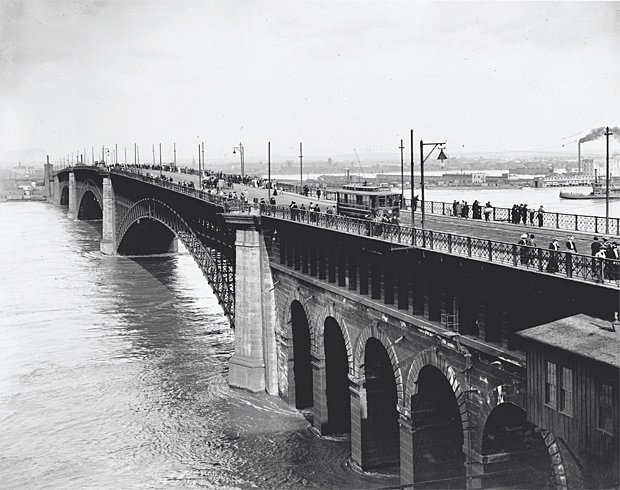
Though the bridge—one of the first to span the Mississippi River—should have been impossible for a number of political, environmental, and engineering reasons, it not only got built, but also was built magnificently. When it opened in 1874, it was the longest arch bridge in the world (6,442 feet), the first alloy-steel bridge (with 780,000 pounds of steel), and the first to use only cantilever supports. In fact, it was so avant-garde, people were a little afraid of it. A “test elephant” from a traveling circus was led across—not for his tonnage, but because Victorians believed elephants had danger instincts superior to humans’. On July 4, a little less than a month after the elephant’s triumphant pilgrimage to East St. Louis, Ill., the bridge opened. There were fireworks and a 15-mile-long parade.
Since then, the bridge has seen daredevil jumpers, like vaudeville high-diver Paul Tustin, who did a somersault off of it in 1895; suicides and attempted suicides, like C.H. Frazer, who leapt from the middle pier in 1915, only to hit a wire cable, get bounced onto the rail deck, and watch his bowler drift off on an ice floe; lots of last requests to have ashes flung into the Mississippi, including those of undertaker William Degen, who also stipulated the presence of his three ex-wives; and lots and lots of traffic, including from MetroLink. Though the Arch displaced it as St. Louis’ big landmark, the Eads is far from obsolete. It has never gone out of use. And it has outlasted its contemporaries: It’s now the oldest standing bridge over the Mississippi.
McKinley Bridge, 1910
Polish-born engineer Ralph Modjeski was a virtuoso of bridges. He designed the San Francisco Bay Bridge. He also salvaged the maladroitly engineered Pont de Québec, still the longest cantilever bridge in the world. He created a more modest steel bridge for William B. McKinley, president of the Illinois Traction Company (not the assassinated president), who ran electric commuter trains across it. A few days before it opened on November 10, 1910, Archbishop John Glennon blessed it “using the prayers which have been employed for centuries in asking the Divine blessing on crops, on land, on sea, and on various products of man’s handiwork,” as a St. Louis Post-Dispatch reporter floridly noted. On opening day, 10,000 people crowded onto its cantilevered lanes, which hung off the sides like wings. The center was built for railcars; pedestrians, carriages, wagons, and the rare automobile were all relegated to the two outer lanes, paying a toll for access.
As cars became more common, though, they were also routed to the center lane. And things got dicey: The archbishop’s prayers may have saved a motorist or two from a head-on with a train, or perhaps from falling into the river as the cantilevers rotted away from rust. The state of Illinois finally closed the bridge in 2001, removing the east approach. In 2007, the Missouri and Illinois departments of transportation rebuilt the bridge together, replacing giant chunks of rust-eaten metal, while Great Rivers Greenway funded new walking and bike paths. The McKinley reopened in 2008, and you can now walk—or bike—to the middle of the river, where the state line is, and see the spot where the governors of Missouri and Illinois christened the bridge 103 years ago.
Chain of Rocks Bridge, 1929
Before the bridge, there were the towers. The first, a picturesque water-intake tower designed in a Richardsonian Romanesque style, opened midriver in 1894, at the same time as the Chain of Rocks waterworks. With demand for water increasing over the next two decades, a Roman Rennaissance–style tower joined it in 1915. For years, water-division crews spent two-week shifts in the towers. In 1920, the Post-Dispatch reported how tower keeper Orville Gaubel suffered from influenza during his shift; too sick to return to the mainland, the keeper and his wife recovered on the tower’s second floor, with a doctor using a motorboat to check on them. By the ’30s, onshore intake facilities made the towers largely obsolete.
When engineers first began planning the Chain of Rocks Bridge in the ’20s, river traffic was a primary concern. (This would remain the case until the Chain of Rocks Canal opened in 1953.) An initial design didn’t allow enough room for boats to navigate between the towers and piers, and the bedrock beneath one section wouldn’t support the piers. Engineers struck a compromise: a 22-degree bend in the bridge, which would become its defining characteristic—and a headache for truck drivers years later, when the bridge was designated part of Route 66. The $2.5 million, mile-long structure opened in July 1929, after floods and ice prevented a New Year’s Day grand opening. For more than 40 years, cars paid a toll, with passengers peering out at Chain of Rocks Amusement Park on the Missouri side as they crossed. The toll ended in 1966, when a newer bridge rendered the boomerang-shaped one virtually obsolete.
The New Chain of Rocks Bridge, the final piece of Interstate 270, opened in the mid-’60s after a series of labor and political issues. Two years later, the Old Chain of Rocks Bridge closed. It sat empty for nearly three decades, a ghost of its former self. Over time, it became synonymous with decay and tragedy: The postapocalyptic film Escape from New York was filmed there in 1980; in 1991, sisters Julie and Robin Kerry were murdered there. “It was a place where some people came seeking peace and serenity and others came seeking thrills and danger,” author Jeanine Cummins wrote in A Rip in Heaven, a memoir detailing her cousins’ murders. “It was a place of public solitude, of dilapidated grandeur, of terrible beauty.”
That beauty would be preserved when it took on a new incarnation as a biking and hiking trail. In 1998, Trailnet leased the bridge from the city of Madison, Ill., making it the north end of the Riverfront Trail. Today, a “66 Auto Court” sign, a vintage Texaco gas pump, and an old firetruck remain on the bridge—remnants of its glory days.
Martin Luther King Bridge, 1951
When it opened in 1951, Veterans Bridge was the first local span specifically designed for automobiles. East St. Louis realized cars were the future, and tolls could help pave the way. The bridge brought the city more than $2 million a year, until the free Poplar Street Bridge opened in 1967. By the time Veterans Bridge was renamed for Martin Luther King Jr., in 1968, toll revenue had plunged and the bridge had deteriorated. Eventually, the Missouri and Illinois departments of transportation restored the 4,000-foot-long bridge, reopening it (sans toll) in 1989. The MLK Bridge’s steel girders still make some drivers woozy, but the bridge is safer than ever: After nearly 40 accidents—many of them fatal—in the early 2000s, the bridge was closed down for reconstruction. Its four lanes were reduced to three, the driving surface was covered with a waterproofing membrane, and a concrete barrier was installed to separate east- and westbound traffic. Today, St. Louis is preparing to welcome a brand-new Veterans Bridge, otherwise known as the “Stan Span.”
Poplar Street Bridge, 1967
As architect Eero Saarinen was designing the Arch, his vision stretched beyond the monument. “When the bridge was first proposed in the late 1950s, Saarinen had pushed for a close visual relationship between the bridge and the memorial,” Sharon Brown wrote in a history of the Jefferson National Expansion Memorial. Twenty-five acres were originally designated for the bridge, officially known as Bernard F. Dickmann Bridge (named for the one-time St. Louis mayor), but that plot had shrunk to 2.5 acres by the time construction began. The Poplar Street Bridge’s original gray-green color was selected after consulting with Saarinen’s partners, who assumed responsibility for the project after the famous architect died of a brain tumor in 1961.
Today, traffic on the Poplar Street Bridge averages 100,000 cars a day, making it the second-most-heavily-used bridge over the Mississippi. (The first is the Interstate 94 Dartmouth Bridge in Minneapolis.) With Interstates 55, 64, and 70 running over it, the Poplar is one of only two triple-interstate concurrencies in the country. Reconstructed in 1993, its ramps have been a continual source of debate. There are plans to eventually widen the bridge: One eastbound lane will be picked up and slid to the south—a feat that would probably have caught Saarinen’s fancy.
Jefferson Barracks Bridge, 1983
For decades, cars traveling along U.S. Route 50—that stretch running from the East Coast to West Sacramento, Calif.—crossed over the Mississippi via a steel truss bridge, one that had provided a much-needed alternative to the one-time Davis Street Ferry. The Lindbergh Bridge Association (later named the Jefferson Barracks Bridge Association) held a groundbreaking ceremony on August 5, 1942, with the bridge opening two years later and drivers paying a toll to cross until 1959, when the bonds were paid off. Following World War II and the opening of Interstate 55, the population in South County and the Metro East had swelled, and the need for a new bridge became apparent. To meet rising demand, the first half of the newer, 909-foot-long bridge (what’s now its westbound lane) opened in 1983. When Interstate 255 was completed several years later, the J.B. Bridge formed the bypass’ southern crossing. The second half of the twin tied-arch bridges, what’s now the J.B.’s eastbound lane, wouldn’t open until the early ’90s, around the time that climatologist Iben Browning predicted a major earthquake would occur along the New Madrid Fault. Construction was delayed when a crane accidentally dropped a steel section of the bridge into the river, but the predicted natural disaster never happened, and the bridge was completed in 1992.
Clark Bridge, 1994
The four-lane bridge ending in Alton, Ill., is sometimes referred to as the Super Bridge—not as a reference to Clark Kent (it’s actually named after explorer William Clark), but because of its state-of-the-art design. PBS’s NOVA documented the making of the $90 million bridge, which replaced a two-lane bridge constructed in 1928. Hanson Engineers ingeniously devised a steel-framed, cable-stayed span, with stays running from the pylons’ peaks to the road deck’s outside edges—a plan never before attempted. Construction began in June 1990, with workers driving a steel frame into the middle of the river. With the main span foundations set, contractors worked up and out, building approaches for the then-new U.S. Route 67 and the bridge’s two 300-foot towers. Workers then installed four acres of yellow plastic piping (called “banana pipe” for its yellow color) by using trial and error. Despite several delays, construction was on course—until the Great Flood of 1993. With no access to the work site, progress was delayed for months. When the water finally receded and work resumed, crews worked 16-hour days to complete the project by the December 21 deadline. After nearly four years of construction, the bridge opened in January 1994. Today, the bridge is nearly as iconic as Fast Eddie’s Bon Air and Alton’s statue of Robert Wadlow.
Railroad Bridges
MacArthur Bridge: The city started building this bridge, originally called the St. Louis Municipal Bridge, in 1909 as a way to bust the Terminal Railroad Association of St. Louis’ monopoly on railroad traffic. But funds ran dry before it was completed. The 647-foot-long truss bridge finally opened in 1917, but only to automobiles. Trains began traveling on the lower deck in 1928, and it was renamed for Gen. Douglas MacArthur in 1942. And what became of the Terminal Railroad Association? It bought the bridge from the city in 1989.
Merchants Bridge: Like the MacArthur, the Merchants Bridge is owned by the Terminal Railroad Association—but it was originally commissioned by the St. Louis Merchants’ Exchange Company after the Terminal Railroad Association took control of the Eads Bridge. Opened in 1889, the three-span through-truss bridge connects St. Louis to Venice, Ill. In 2011, the U.S. Department of Transportation awarded Missouri with $13.5 million “to advance the design of a new bridge over the Mississippi.”
by Christy Marshall, Jarrett Medlin, and Stefene Russell