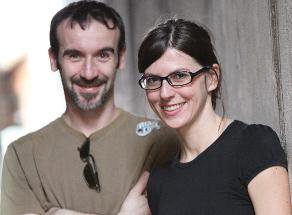
When Zagreb, Croatia–based artists Olinka Vistica and Drazen Grubisic dated, they traveled a lot. But not always together. So they bought a windup bunny to sub in for the missing partner on trips. The bunny managed to make it to Iran—and get his photo taken near a sand dune—before the couple’s relationship fell apart. Now, he’s part of the Museum of Broken Relationships, a traveling, ever-expanding exhibit of objects from failed romances all over the world.
Vistica and Grubisic continue to be friends and co-curators, traveling internationally to collect and show these objects, as well as the anonymous stories that go with them. That’s included a vial of tears, an unopened bottle of champagne, and a “divorce-day garden dwarf.” The exhibit comes to the Schlafly Library this month, making only its second American appearance. Last month, Vistica and Grubisic rang us from Croatia via Skype to talk about the show.
Have you started collecting stuff from people here in St. Louis?
Drazen Grubisic: Usually how it works is that our local partner gives out the call for donations. What happens, since people are quite connected to these objects, they don’t always give them easily. So usually when we get there the local organizer is under a panic attack because they have 10 objects or something. But once the exhibition opens, once they see it, people start bringing in some more stuff. Usually it’s like 20 objects before the exhibition, and then during the exhibition we get 40 or 50, or even more.
I know you have a lot of objects. I’ve heard 200 objects, 400…
DG: Today’s number is close to 600.
Olinka Vistica: We bring about 50 or 60 objects we’ve collected around the world with us, and we join them to the ones collected locally, so each exhibition is different, and St. Louis will be special for that reason. It’s not the same exhibition. So usually we put up like 80 objects in total, because we think it’s the maximum people can take. It’s a lot of emotions and a lot of engagements to go through all of
the stories.
With the first show in the Balkans, there was a parallel narrative of countries breaking apart. Have you seen examples of this in other places as the show has traveled?
DG: Maybe the best example was the Manila show, in the Philippines. We were surprised to see how many objects are connected to stories of people going away, having to go somewhere to work and make a living. Later on, when we talked to them, they were like, “Yeah, every tenth Filipino is working abroad.” So there is this bigger context, however personal and subjective the stories are and these objects are. The higher things are always interweaving with people’s lives.
Yet the teddy bears transcend everything.
[Laughter.] OV: They do—it seems that each story connected to a teddy bear is similar, because usually it goes like, “He left with another.” It’s kind of weird, when you see a bunch of teddy bears with the same story; you’re kind of suspicious when you get a teddy bear from a person! [Laughs.] Sometimes we exhibit all of those plushy toys together, and it makes a nice installation, because it looks like a child’s room, but when you approach, the stories make it something
completely different.
With the gallstone, I heard it was from a woman who blamed its appearance on her cheating husband?
DG: Yeah. It says in the story that the third time he called her the wrong name, she felt this terrible pain. And it was the gallstones. There are a lot of funny stories, there are some sad stories, some people try their best to be poetic. Some of them are just so…real. It presents all the different kinds and stages of breakups.
OV: You can feel the emotional state the person who donated it is in, actually; you can feel the rage if someone has not gotten over it, or acceptance, or just surprise, or whatever. So that’s another level besides this cultural and historical one we were talking about before.
So where do you store all of this? It could be really hard, for the reasons you just stated, to be around 600 of these objects at once…
DG: It’s in a couple of places.
OV: Luckily, the majority of the things are small. And as curators, we always take care of that emotional aspect, thinking about the audience who will experience that. And aesthetically, it has to be appealing. Our role is to give it a charm, and I think we’ve succeeded, because people are not feeling bad after
the exhibitions.
DG: But it’s a positive feeling because we did such a good job curating it. We could really easily put up a show that would make you want to kill yourself! [Laughs.] There are some objects, when we have them on display, I really try not to read the story. Because it’s just so heavy, you know?
OV: But some stories are really inspiring, and we are trying to develop it in some other form, because it seems people connect to it.
DG: It’s like we opened a box that everybody somehow skipped. When we had this idea, the first thing that came to my mind was, “OK, it must exist somewhere already.” So we started looking for it, and we couldn’t find it—it was so strange. For us, it was such a logical idea to have this! [Laughs.]
One day you’ll have to find a building to house all of this stuff permanently, right?
OV: Well, actually, we rent a space… It will be a small museum, with a gift shop and a café. We are trying to make it a really nice space in Zagreb. We hope to open it before we come to St. Louis.
DG: So people will be able to see it. It’s about 4,000 square feet… It’s in a really nice part of town, the old part of town. It’s a Baroque palace from the 18th century. The good thing is that we can change the show anytime we want. We have so many objects…it will never be the same.
And you guys thought at first that you’d end up with just a bunch of stuffed animals and old love letters…
DG: People never cease to surprise… We get 50 objects and none of them are the same.
“Museum of Broken Relationships” runs June 11–June 27 at the St. Louis Public Library’s Schlafly Branch (225 N. Euclid, 314-206-6779, slpl.org). For more info on the exhibit, visit brokenships.com.