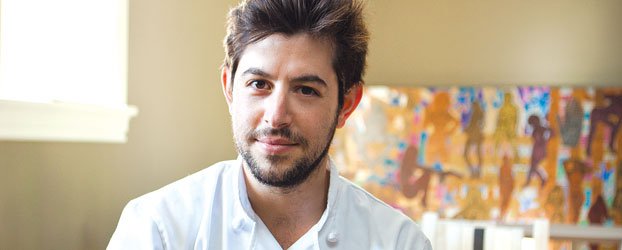
Envelope-pusher. Visionary. Forward-thinker. If there were a Wikipedia entry for Ben Poremba, it would include all of those descriptors. “I’ve always wanted to do projects that would be as successful in New York as in St. Louis,” he says. Poremba’s been involved in several—Taste Fine Catering, Maryland House at Brennan’s, Winslow’s Home, Salume Beddu—and now a two-pronged, seven-figure endeavor in a gumptious part of town called Elaia (elaiastl.com) and Olio (oliostl.com), an exclusive 28-seat restaurant and connecting wine bar at 1634 Tower Grove. And his plans for the neighborhood don’t stop there. We might want to add “gutsy innovator” to that Wikipedia bio.
How long have you lived in St. Louis?
My dad was employed by an Israeli company headquartered in St. Louis and moved our family here when I was a high school senior, 17 years ago. I started college here, didn’t like it, and moved back to Israel.
What did you do when you went back there?
My mother was a classically trained chef and had a restaurant there. Her connections opened doors to for me to stage in France and in Italy, where I noticed a program called Slow Food University, a Masters program that focused on the culture of food, the other side of food. It was not so much about cooking as the history of the menu, military diets, quality ingredients, the commerce of salt–interesting topics, subjects that treated food as a serious subject and an intellectual pursuit.
Sounds very interesting.
Three hundred people applied from all over the world and I got in. So I moved to Italy. There were twenty of us in the program, the most diverse group of people I’ve ever met–a beekeeper from Ireland, a banker from Switzerland, a truffle hunter from Italy–and we traveled all over Europe. It gave me context. I got hooked.
Obviously you came back to the states…
I came back because my parents were here, went back to school, graduated with a philosophy degree, while acting as a nanny and a personal chef at the same time. That gave me the confidence to start up a Kosher catering business here called Taste Fine Catering, a one-man company which ended up being very successful. It was then that I knew for sure this is what I wanted to do professionally.
How long was Taste in business?
Pretty much until I started at Winslow’s Home, almost five years ago. Ann Lipton [owner of Winslow’s Home] had a vision–locally grown produce, organic, sustainable, making everything from scratch, gathering food artisans, everything I learned in Italy–and that’s what made me decide to stay in St. Louis.
Winslow’s Home is a special place.
People forget, though, that when it first opened there were no seats. It was all prepared foods, grab-and-go. We were not even allowed to call it a restaurant and now it’s one of the city’s best.
What else have you done?
I helped Kevin Brennan conceptualize and design the second floor at Brennan’s as well as cooked there: ever-changing menu, small plates, cool stuff. I’ve always wanted to be a part of something that would be as successful in New York as it is in St. Louis. Brennan’s would hold up in New York. Winslow’s Home. Salume Beddu. Elaia and Olio… And that’s always been my scare… mediocre places do quite well here. So if you give St. Louis something excellent, will they get it? I think they do now. Salume Beddu is a good example.
Your name became synonymous with Salume Beddu (suh-LOO-may BAY-doo).
Five years ago I met up with a guy named Mark Sanfilippo who was making salume in his basement as good or better than anything I’d had in Parma. Mark made the product—he was the artisan—and I told the story.
You’ve received incredibly good press, national press.
A feature in The Wall Street Journal and one in Forbes. The Forbes editor, an Italian cured meat fanatic, was here to do a story on St. Louis style pizza and toasted ravs but stopped to see us as well. We sliced up every item we had. His 15-minute visit led to an extended discussion—about food, literature, Greek classics—he even cancelled his flight. Next thing we know he’s called us “the best salumeria in the US.”
What has that accolade done for your business?
It’s interesting. Good press does not always translate into sales. We were perceived by many to be too expensive, so we started offering sandwiches, just so people could sample the product without spending a lot of money. Simple sandwiches: good bread, meat, a homemade condiment, maybe some cheese.
Then your sandwiches started winning awards.
The Food Network called our speck sandwich with preserved lemons “the state sandwich of Missouri.”
What makes your salume the best in the US?
Different influences…Mark’s is Sicilian, mine is spices, mainly from the Middle East and North Africa, so our coppa, for example, is bold, interesting, unusual.
You’re a four-year old local company that many locals still don’t know exists.
That’s why having a presence at 10 Schnucks stores—especially the spread at Des Peres—is such a big thing for us. We try to produce other unique items you don’t typically see, like fig tapenade and an Italian chutney called mostarda.
What’s the biggest retail challenge?
Cost. People have no qualms about spending $20 a pound on cheese, yet resist spending that same money on salume…and it goes so much further. Hey, this is not what you buy for the kids to eat. This is adult stuff, the good stuff.
Elaia [ELL-ya] and Olio are two different, adjoining concepts. Why double your exposure and why open them at the same time?
I look at them as one and the same business, really…the separation is more for marketing. This is a combination of a long, deliberate, chewing process. I wanted—and waited—to do the right thing. Elaia will have a tasting menu plus some items a la carte. It will be more upscale, more exclusive—a true dining experience. Olio will be more accessible and approachable and serve food until midnight. Elaia is a destination; Olio is for anytime.
Different markets then?
Same market, different nights. The food at Elaia will be more complex and layered while Olio’s will be simpler, featuring parts of Elaia’s dishes, often single components, like roasted peppers. A wonderful menu can be created using small combinations of ingredients, then swapping them out for one another. When Tom Colicchio was at Gramercy Tavern and Craft he said that we must treat single ingredients with respect. That comment had a major influence on my style of cooking.
You’ve installed a rotisserie, which allows for even more menu options.
We hope that things like rotisserie chicken will open Olio up to the neighborhood, to families. I think of the place as “European kid friendly.”
Is the style of food there easily defined?
It’s contemporary food with Mediterranean influences. Trace the land all along the Mediterranean coast. Those foods and flavors are much closer in style than to that of their respective countries. Olive oil is a binding ingredient in these regions, hence the names.
Yes, explain the names.
Elaia is the Greek root word for both “olive” and “oil;” Olio is Italian for “oil,” which works doubly well because it’s located in a former Standard Oil service station.
And you’ve hired one the city’s foremost wine authorities to run it.
Andrey Ivanov is an Advanced Sommelier who spent three weeks in Europe sourcing the wines, so the wine program is creative and ambitious. For example, all 300 wines will available by the glass, so if you want to have one glass from a $600 bottle of wine, we’ll open it up. That’s unheard of. The list will have depth in the areas we feel should be concentrated upon, as well as breadth…from places like Israel, Greece, Lebanon, Sicily and Sardinia, incredible wines that people know nothing about.
How can you be assured you’ll sell the rest of that $600 bottle?
I can’t. But if I sell only one more glass, I’ve paid for it. I just want to offer this level of service.
Will you use iPads for the wine list? That seems to be a trend.
Servers will use iPads, but not for the wine list. I thought about it. I probably overanalyzed it. I want my places to be timeless and that part just feels too gimmicky to me.
Is there a common denominator to your cooking?
Addition and subtraction. If something’s been done well, I won’t try to improve upon it. Joël Robuchon’s mashed potatoes are perfect, so there’s no point in trying to make them better. Just follow that recipe and serve it. I won’t make cured meats in this kitchen because Salume Beddu is making it better than I could. Don’t be original to the point of inferiority.
Elaia and Olio are in an area with few restaurants. Any special reason?
I strive for uniqueness. In order to stand out, you can’t do things that are necessarily easy. Across the country, great restaurants have popped up in unexpected places. In New York, Roberto’s is in a garage still with graffiti all over it. And it’s a three-star restaurant. Our corner is easily accessible from two highways, and great things–green houses, a great school–are happening in and around that neighborhood. It’s urban and it’s cosmopolitan.
What else is planned for the area?
I hope that opening two places at once by itself will create critical mass. Just to make sure, though, my wife Angela and I are opening a French pastry boutique with Simone Faure [former pastry chef at The Ritz Carlton, St. Louis] across the street, called Chouquette. I fully believe our three places are only the beginning.
So your wife is involved as well.
My wife is deaf and much more aware of a room than I. She brings a sense of self-criticism, perspective, and finesse that I cannot. I might have the idea, but it is she who polishes it.
Why have you chosen to settle in St. Louis?
I can do things here that I cannot afford to do elsewhere, but more importantly, there is a unique and genuine camaraderie among chefs here. They say it takes a village and Kevin Nashan [owner/chef at Sidney Street Cafe] is the mayor of that village. He supports all of us, all the time. Gerard [Craft], too. National press calls me because of what he’s brought to this city.
You’ve travelled extensively. How does St. Louis’ food scene stack up?
Let me interject a snobbish outsider’s critique here. A good dosage of self-criticism never hurts: we’re too quick to be experts. We don’t simmer things long enough. We didn’t know anything and all of the sudden we know it all. Salume Beddu’s a good example. A few years ago people didn’t know what real salami was now they’re proficient on everything involving cured meat. Diners–and chefs too–need to give themselves a little grace period before we proclaim ourselves the best at something. When I came here there wasn’t even any good bread.
So what does St. Louis lack? What does it need?
It needs more ambitious people to be creative, to have balls, to do exciting stuff, to take chances. Gerard Craft moved a restaurant and started another at the same time–that’s taking chances. It creates buzz. It creates excitement. People think Gerard–and me, too–are out of our minds and then they see the finished product and suddenly it all makes sense.
So we need more restaurant visionaries.
The only one that understood Elaia and Olio from the start was Zoe [Robinson Pidgeon]. People need to look at all that Zoe’s done in her career to understand how best to get it done. It’s not just about food, it’s about putting your stamp on the experience. There’s been entirely too much reproducing going on. We need to create experience-driven establishments. You do that by taking the time to think about what chairs to use, what forks, what cups, how they feel. Just like in Zoe’s places, I want you to see Ben’s vision in all the things I do.
I remember you knocked it out of the park when you cooked at one of 33 Wine Bar’s “Dorm Room” dinners.
It was fun because everyone expected sausages and pork. We served a chilled almond soup with grapes, a brain omelet—my mom’s recipe, a tagine with olives, and mini-doughnuts with orange-blossom syrup for dipping. I never forget anything I’ve ever made or eaten.