Peter Schardan had thought about this moment. The FBI and Michigan State Police had him surrounded, guns drawn. He didn’t have a gun on him. “I’m just going to act like I have a gun,” Schardan thought, planning to commit suicide by cop. Before he could do anything, though, “four of them advanced on the truck, yanked me out, and threw me to the ground,” Schardan recalls. “It all happened so fast… I didn’t
have time to do anything stupid.”
Inside his truck, the police found the loot from Schardan’s fourth bank heist, this time at Montcalm County Bank, where he’d been before returning to his house. They dragged Schardan into his lakefront home and searched for more evidence. Schardan’s fiancée, Jenny Babcock, called (they were supposed to be married in four days), and the FBI answered, telling her that Schardan had been arrested.
Schardan later took a plea agreement. The police wanted to know where they could find the rest of the stolen money, believing he got away with $35,000 (Schardan says it was more). He told them he buried it, but when he took them to the spot, the money was gone. The judge gave him the maximum sentence, a little more than eight years in prison, for not turning over the rest of the loot.
Today, Schardan still swears someone must have taken it. Could the money still be there? His answer is simply “No.”
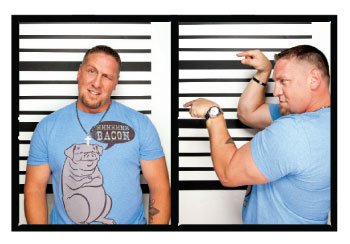
Now, 13 years later, Dean Schardan (he changed his name after his release from prison) doesn’t look like he could have robbed four banks. He has short hair and a goatee, and he’s polite to a fault. He uses words like goofball and knucklehead. We’re sitting in the green room at Comedy Etc. II, located inside a downtrodden Ramada Inn in Fairview Heights, where Schardan performed earlier. His fiancée, Earlene Gotto, and his 18-year-old son, Kody, sit at his side.
Scharden now performs stand-up across the country. He learned comedy at Comedy Etc.’s open-mic nights before he went to prison. He speaks easily about his heists and time in prison, but with some chagrin. (“Bringing it all up again just reminds you what an idiot you once were,” he says.) He prefers to talk about the reality-TV show that he’s working on, the one optioned by Film Garden Entertainment that he’ll be showing to a network this October. It could go into production in December.
“I remember when I was going through my really dark phase, I wasn’t appreciative of anything; I thought the world owed me,” Schardan says. So when he started touring with his comedy act, he and Gotto also began volunteering in the cities they visited and mentoring young people.
Schardan was talking to his manager, Art Vieluf, when the idea gelled for the reality show, tentatively titled Long Road Home (oldschooltimeout.com). He would go out on the road and recruit comedian buddies, and in each episode, they would help kids at risk of making the same mistakes as Schardan by giving back to local charities for at-risk youth.
“When I look at where I was five years ago—to come from there, where I had nothing and I didn’t know who I was or what I wanted to do, to be at this point in my life—it’s amazing,” Schardan says. “I want to encourage others, even though you’ve hit rock bottom and you’re down, you can still get back up.”
Growing up, Schardan was gregarious, a bit of a clown, the captain of the football team and the wrestling squad at Collinsville High School. He sometimes ran with the wrong crowd, “little hell-raisers,” as he calls them, but he kept his grades up and earned a football scholarship to Olivet Nazarene University, near Chicago.
But Schardan was angry. He was angry that his father was laid off from St. Louis Coke & Foundry Supply Co. He was angry that his mother had to take time away from home to work as a special-education teaching assistant. He was angry that his sister Ginger was sick with Crohn’s disease.
During his senior year of high school, Schardan’s girlfriend at the time pulled him aside and told him she was pregnant. For Schardan, whose family was quite religious, there was one option: Get married; have a daughter, Chelsey; and enlist in the Army. He and his wife moved to Fort Devens in Massachusetts, where he became a member of the U.S. 10th Special Forces Group (Airborne).
Then, he says, his wife cheated on him with another member of his 12-man unit. She had a son, Kody, whom Schardan wasn’t even sure was his (he is). When she went home to show the new baby off to her parents, Schardan told her not to come back. They divorced, and Schardan returned to Caseyville, Ill., after quitting the military.
He fell back in with the friends he’s since labeled little hell-raisers. “They were little hoodlums, and they grew up to be bigger hoodlums,” he says. Soon, Schardan was doing “insurance jobs,” burning down houses and running guns across state lines. “I was definitely not what they call a productive member of society,” he says.
His outlet was comedy.
He did his first open mic at Comedy Etc. II on a friend’s dare. “I did probably four minutes of the worst material anyone has ever heard,” he says. “There might have been one good laugh in there.” Still, he was hooked. He became a regular at the comedy club and found other gigs on the road. He also met Jenny Babcock during a show in Michigan. They started exchanging calls, and soon he moved up there.
“We got a lake house, and we moved in together, and the money started running out,” Schardan says. “Someone had told me a long time ago how he had robbed a bank, and something clicked in me.”
In September 1999, he walked into Independent Bank in Ionia, Mich., wearing a wig and a fake beard made of hair clippings he’d found in a Great Clips Dumpster. (That way, if any hair fell out during the robbery, police would find someone else’s DNA, Schardan says.) He handed the teller a note demanding money, and the teller forked over about $3,500. Schardan fled to a hotel room, terrified the police would kick in the door at any moment.
Nothing happened. It was a blip on the local news. So Schardan returned home and started spending.
When the money ran out two weeks later, he went to another bank, this time with a note saying he had bombs planted in the bank and at a local school. “I just remember watching the teller’s face go from the happy smile—‘How can I help you?’—to ‘Holy shit, what’s going to happen next?’” he says. “She read that note, and she grabbed every penny she could find in that place and gave it to me.” (As the Grand Rapids Press reported, tellers would recall how polite he was and that he always said “Thank you” after they handed him the money.)
Schardan robbed another bank eight days later. That’s when the media blitz started. He remembers watching TV while his girlfriend was cooking. “I flipped a channel, and there was my face,” he says. “That was me robbing the bank on TV.”
Deciding he’d go straight after one last heist, he proposed to Babcock, not realizing that her sister had recognized him from the news reports and tipped off the police, he says. Schardan’s house was under surveillance when he left to rob the fourth bank—and the police caught him 45 minutes after the robbery.
He spent seven years of his eight-year sentence in prison (much of it in “the hole” for running poker games and fighting). He again returned home angry—angry that his sister Ginger had died and he hadn’t been able to go to the funeral. “I burned bridges with my family; I’d lied to everyone I’d ever known,” Schardan says.
A few months later, in 2007, he tried buying two cars, one for himself and another for his daughter, but the check bounced “higher than Tommy Chong”—and his parole officer informed him that he’d violated his parole. He stayed on the lam for six months before he was arrested and returned to prison for another year. “I reached out and started talking to a therapist,” Schardan says. “That’s when it really clicked for me. I woke up one day and said, ‘This is not the way that I want to be.’”
When he got out again in 2009, he lived with his sister Barbara. He worked jobs he hated: bouncer, food service—anything honest. While he was working as a laborer that October, a dirt wall fell on him, bruising his pelvis and a lung, breaking three ribs, and injuring his rotator cuff. Knowing he couldn’t go back to a physically demanding job, he returned to stand-up.
When Schardan handed Vieluf, the owner of Comedy Etc. II, a newspaper clipping about his past, Vieluf shoved it in his pocket. Later, at home, he read the story.
“It floored me,” says Vieluf, who’d given Schardan his first job as an emcee before he went to prison. “But it seemed like his head was in a good place.” He let Schardan keep working at the club, and later, when Schardan asked if he could help him find work, Vieluf became his manager.
Then, in 2010, Schardan came up with the idea for the show. He pitched the idea to Opie Cooper, creative director of Mississippi-based Eyevox Entertainment, and Cooper agreed to film the pilot for a fraction of what other companies were charging.
“Dean knows how to work a room, he knows how to talk with people, and he knows how to make people laugh,” says Cooper, who’s also a stand-up comedian. “I think that’s why this other venture is going to work so well—all of us have stories, but his you want to hear.”
For the pilot, filmed last April, comedians Dale Jones and Bill Kirchenbauer accompanied Schardan to shovel dung and clip toenails at Wier World Llamas & Alpacas in Fairview Heights, Ill. In exchange, the owners let the comedians bring a few animals to the Mary E. Brown Center in East St. Louis, where they hung out with the kids and dropped off a sizable donation—a long list of items purchased after a comedy-show fundraiser.
As they were wrapping up, Schardan’s sister Barbara called. Her son had been killed in a car accident. “He was 23 years old, and him and a friend were drinking and driving,” Schardan says, his voice getting low. “He passed away at the scene, and one other girl passed away as well. It was a big mess.”
His eyes are glassy with unshed tears. “That’s really what my show is about, helping others so they don’t go down that same…” He trails off. “But I could never get through to him.”
Another loss. But Schardan isn’t angry. He’s sad, but he remains hopeful that he can give meaning to his mistakes through his search for redemption. “It really was as dark as it could have been for me, and sometimes I look around and think I shouldn’t even be here anymore,” Schardan says. “But there’s a reason I am, and I think this is it.”