When Luck, Wis., was the yo-yo capital of the world, we led the country in the manufacture of dime-store kites. The nine buildings that made up the Crunden-Martin complex, where Top Flites were made, still stand on Gratiot Street; the company made everything from wooden bread bowls to go-karts to gas cans. But when it filed for bankruptcy in 1990, the last 70 workers were making lunch bags, school supplies…and kites. Wilder Manufacturing Company, formerly at Clinton and 17th streets, may’ve been one of the earliest kite-makers, though it was better known for tiddlywinks. And in 1937, when it filed for bankruptcy, Alox Manufacturing Company acquired its patents and kite-making machines.
That company’s founder, John Frier, was definitely a businessman, choosing a name that would always appear in the front of the phone book. But he was a dreamer and a noodler, too: In 1919, he invented the aglet—the metal whatsit on the end of a shoelace that keeps it from fraying—and found himself in the business of laces. Soon enough, he recalibrated his braiding machines to make jump-ropes and toy lassos and opened a separate factory to house a suite of marble-making machines that melted shards of soda bottles and cosmetics jars into clearies and swirlies.
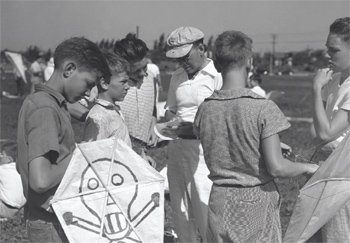
Though Alox was not the last company making paper kites (its factory closed in 1989), its designs had an extra measure of genius. Instead of stamping every sail with an eagle or a rocket ship, Alox made kite kits, with dowel rods, powdered glue, and blank sails. (You could also buy a pack of bright cloth strips to tie your own tail.) Surely more than one little boy drew a Jolly Roger onto that blank white diamond, both emulating a popular printed sail design and squaring himself with the pirate recklessness of the paper kite—which rarely survives its maiden voyage.