Because Kevin O’Malley isn’t a career diplomat but, rather, a kindly and unassuming Irish Catholic lawyer from St. Louis, he assumes that his credentialing as the new ambassador to Ireland will be a simple matter. He’ll walk across Phoenix Park to the Irish president’s home and present his letter from President Barack Obama, and they’ll shake hands.
He’s not expecting to be part of a motorcade. Or to pose for photos in the formal parlor, with him and Ireland President Michael Higgins positioned on opposite sides of the carpet’s central medallion. Or to fight tears when the Irish Army band strikes up “The Star Spangled Banner.”
Get a fresh take on the day’s top news
Subscribe to the St. Louis Daily newsletter for a smart, succinct guide to local news from award-winning journalists Sarah Fenske and Ryan Krull.
Standing on the front steps of Áras an Uachtaráin, hand on his heart, he looks across the park at Deerfield, which will be his home until Obama leaves office. The 28,000-square-foot 18th-century mansion is surrounded by orchards, gardens, and a moat. His grandparents would keel over at the shock of it.
As photographers jockey for the best angle, the new ambassador’s vision blurs, and for a second, all O’Malley can see are the faces of Michael and Elizabeth O’Malley, far younger than he is now. How hard it must have been, in 1910, for his grandparents to leave behind everything and everyone familiar. Back in those days, the Irish held a wake the night before somebody sailed for America, because they knew they’d never see that person again. Yet the O’Malleys bundled up seven children and stepped on board a steamship, nudging through crowds in the lower-deck steerage class. They had no savings, no relatives or jobs waiting for them—just dreams they’d cast across the ocean.
While Higgins waves at the press corps gathered on the lawn, O’Malley dares a quick glance at his wife, Dena, whose teal coat-and-dress ensemble would’ve done Jackie Kennedy proud. A nurse and medical malpractice analyst, Dena’s no better prepared for this than he is, but she’s smiling with warm poise.
Michael and Elizabeth had a good marriage, too, but a quieter, more scripted one. Michael found work as a laborer to support a family that grew to 15 children. Then the Depression hit. Kevin’s father left high school and got a job to help feed his younger brothers and sisters.
Would Ambassador O’Malley inspect the honor guard? They wait in neat rows, their olive green uniforms white-belted, their backs straight as yardsticks. Taking his measure.
When he was little, he used to ask his grandparents about Ireland. They never said much. Sure, they talked about everything else, told stories and gossiped and bantered and prayed aloud. But on the topic of home they kept a stoic, impenetrable silence.
“It must hurt too much,” his dad said with a helpless shrug.
Michael and Elizabeth had left knowing that they’d never see the auld sod again.
If only they’d known where their grandson would stand.
He’s prosecuted organized crime and racketeering cases for the U.S. Justice Department; won big medical negligence, white collar crime, and personal injury defense cases for Greensfelder, Hemker & Gale; taught and mentored young lawyers. But ambassador to Ireland? He’s still pinching himself as he and Dena pack.
“You were born to be an Irish ambassador,” insists Jack Krings, his best friend since their Saint Louis University days.
The previous ambassador, Dan Rooney, chairman of the Pittsburgh Steelers, resigned in December 2012. Rumors flew: a woman in Wisconsin, a lawyer in Washington, one of the Carnahans… Then a long silence, and growing Irish discomfiture—where was their ambassador? In March 2014, O’Malley received a call from the White House. News of his nomination broke in June.
“He’s not a bundler,” one Irish columnist exulted. A Democrat, O’Malley had grown close to the president, but more as a friend than as a donor. He’d helped with the 2008 Democratic National Convention and tried to bring the 2012 one to St. Louis. Pure Irish on both sides, he even held dual citizenship (although now he’d have to return his Irish passport). A former seminarian who’d decided against the priesthood, he’d lived as holy a life as he knew how. The vetting went smoothly—mainly he had to explain how partners are paid at his firm and that the royalty checks were for authoring a secular bible, the nine-volume Federal Jury Practice and Instructions. At the confirmation hearing, senators questioned him like teachers who wanted the student to get a good grade. O’Malley threw his heart into his answers anyway. Ireland is more than a place, he told them. It’s “a way of life: hard work, spiritual values, family, determination, and wit.”
Fond nods from senators, and the matter seemed all but settled. Then the Senate hit a snag confirming the ambassador to Russia. Stalled, the senators broke in early August, delaying O’Malley’s confirmation for five weeks. He was trying to lease his house, and people kept asking when it would be available. He raised his hands, palms up, unable to offer anything but “When the U.S. Senate says it will.”
On September 30, Vice President Joe Biden swore him in. On October 7, the O’Malleys flew to Dublin. It had been 20 months since Ireland had a U.S. ambassador, the longest span since formal diplomatic relations were established 90 years ago. The Irish press went crazy.
O’Malley spent most of the summer in D.C., prepping. There’d be the usual ambassadors’ academy, but he wanted to meet personally with people from the Pentagon, the CIA, the Department of Agriculture, the Department of Commerce, the Treasury, and his old stomping ground, the Department of Justice. He wanted every possible perspective on Ireland.
When he asked for consultations about trade and investment, the State Department brought experts into one of its Foggy Bottom conference rooms. Through the window, he had a perfect view of the Lincoln Memorial—but stopped noticing when he heard the numbers. Ireland’s annual trade with the U.S. topped $38 billion. At least 700 U.S. multinationals were doing business in Ireland. Google, Facebook, and Twitter had all established their European headquarters in Dublin. Investment between the U.S. and Ireland totaled $370 billion.
How did this happen? How did an island less than half the size of Missouri wind up being the seventh largest contributor to direct foreign investment in the U.S.?
Ireland’s flexible (and controversial) corporate tax structure was only part of the answer. Ireland had a highly educated, ambitious, English-speaking workforce and a strategic location within the European Union. But the biggest reason, O’Malley decided, was the shared bloodline—his and 40 million other Americans’. The Irish don’t share nearly as much DNA with the rest of Europe. They’re proud that Irish-Americans helped build the U.S., fought in its wars, amassed fortunes, and started dynasties. And Irish-Americans are just as proud of what’s before the hyphen. In other words, the relationship’s familial.
You don’t have to translate anything for the Irish, he thought. They just get it. They understand us, and we understand them. And because there’s that bond, Ireland is an excellent interpreter for us in the EU.
He was beginning to see why this post had required such a long and careful search.
The relationship between the two countries makes sense on paper at the State Department, but it comes to life when O’Malley arrives in Ireland. Strangers take his hand in both of theirs, look him in the eye, and say with a lilt that he is very welcome. Not because he’s thanked them for anything but instead because this is the land of céad míle fáilte, a hundred thousand welcomes. And because the Irish “lean forward”—he can’t think of a better way to put it—toward America.
He’ll need to throw a party right away, to return the welcome and invite people to Deerfield. He and Dena call the house staff together. (Deerfield isn’t quite Downton Abbey, but close.) Clearly these people know what they’re doing. On October 14, less than a week after the credentialing ceremony, the O’Malleys stand in the reception hall greeting, one by one, 250 guests. The line stretches all the way out the door. Ninety minutes later, O’Malley lets his cheek muscles sag for a second, takes a deep breath, and makes his way to a small stage set up in the ballroom.
“Formally,” he says, “welcome to Deerfield.” His eyes twinkle through his silver-rimmed specs as he pans the audience. “Informally, let me say, this is quite a house!”
He talks about his grandparents, how they left “penniless but not hopeless” at a time when the Atlantic was, in James Joyce’s phrase, “a bowl of bitter tears.” “Today,” O’Malley says, “that bowl of tears is a crackling conduit of activity.” The metaphor’s dangerously mixed—all that sloshing water and electricity—but they take his point.
He swears that he’ll work to break down any barriers to trade and business that still exist. He promises to “continue a respectful dialogue on global taxation,” promote “a permanent and just peace in Northern Ireland,” and use the arts to bring the two countries even closer.
He tells the story of how his hero, President John F. Kennedy, was asked by a close buddy in 1963—just months before he was assassinated—which Democrat he’d endorse as his successor. Kennedy listed the usual suspects, high-profile Dems. His friend pressed. The one who’d name me ambassador to Ireland, Kennedy replied with a grin.
People tilt their heads back in appreciation. O’Malley has found a story that crosses the ocean, and it’s both witty and maudlin.
The bloodline prevails.
When you’re ambassador to a small country with a soft spot for your own much larger country, the access you receive is startling. He’s met with Ireland’s prime minister, president, deputy prime minister, and almost all cabinet members, plus most of the high court judges and the chief of staff for the Irish Defense Forces. O’Malley runs through a mental list of all the CEOs and civic leaders he’s met, heads of Google and Boston Scientific and Hewlett-Packard, executives in aerospace, software, engineering, healthcare, pharmaceuticals, electronics. He’s chatted with the Lord Mayor of Cork. He’s talked with the head of Ireland’s Marine Institute about cooperating to sustainably manage the ocean. And he’s listened to enough stories to know that there’s some skillful trans-atlantic networking taking place.
A big part of his job is to promote that kind of collaboration, increase trade, put people together, knock down the rules and regulations that create barriers. For a U.S. company of any size,
selling a product in Ireland should be no different than selling it in Illinois.
He agrees to speak at the Web Summit and finds out that it’s one of the hottest tech conferences in Europe. He joins the Taoiseach (prime minister) when he and Web Summit founder Paddy Cosgrave ring the Nasdaq opening bell.
Later, for an audience of young tech entrepreneurs, O’Malley flags New York, Boston, and Silicon Valley on a map. “That’s what you all think about,” he says, then talks for 15 minutes about St. Louis. He tells them it’s a lot like Ireland: smallish and slow-paced, so people know each other; family oriented, with good schools; centrally located and affordable, so startups here have a lower burn rate (operating expenses that dip into capital) than those on the coasts. There’s opportunity in both directions, he says—for St. Louis businesses to expand to Ireland, and for Irish entrepreneurs to dig a toehold in St. Louis’ clay soil.
The Irish saw the Celtic Tiger, the good times when business roared and sprang ahead. From 2007 through 2012, they saw bad times far worse than ours, a downturn they’re just now shaking off. They’re committed to not going back.
Last summer, after Sen. Claire McCaskill slipped and called Ireland a NATO ally (it’s not a member), O’Malley swiftly changed a line in his planned statement to the Senate Foreign Relations Committee, deleting “Ireland is today one of our most reliable allies” and substituting “one of our closest friends.” He emphasized that despite its careful neutrality, Ireland commits its soldiers to some of the most dangerous peacekeeping missions on the planet—calming the Golan Heights, doing refugee work in Syria.
Back when he had a first name, before he entered the highly formal, protocol-driven embassy world in which he is “His Excellency the Ambassador,” diplomacy was a matter of kindness, prudence, and legal caution. Now it’s his career. He thanks God that he spent years negotiating compromises, exercising patience, refusing to clamp down and adopt the first position. There are some who’d call him dull, he knows that. But he’s always enjoyed the process, so tedious for some, of finding and staking common ground.
There are expectations of him, headlines warning that he’ll “need his lawyer’s nous to navigate the Irish ‘illegals’ issue.’” People celebrate Obama’s executive action, which will cover thousands of undocumented immigrants who’ve overstayed their visas. But activists are calling on O’Malley for further help, such as getting the 10-year ban after deportation waived, and the Oireachtas committee on foreign affairs wants him to exempt hundreds of still-undocumented Irish business owners from visa-violation laws.
There’s the lingering vitriol over “double Irish” tax plans. When he first heard the phrase, God help him, he thought it meant multiple births. Now he’s learned all about double Irish, which allows a foreign company to pay Ireland’s low 12.5 percent corporate tax, then form a subsidiary that incorporates in a place with barely any tax at all. The practice is being phased out, and O’Malley tells the Irish press that he doesn’t think business will suffer one whit as a result. He also points out that it’s not only the U.S., with its complicated tax code, that facilitated double Irish. He says that President Obama opposes sham companies that don’t create real prosperity, real jobs for real people.
Then, of course, there’s Northern Ireland. American reporters keep asking about it, tossing out questions whose answers are too delicate, too tentative even to phrase yet. He’s glad that the Irish don’t expect such answers. They know that this will be a long and painful process; the Good Friday accord only salvaged the possibility of peace. The Irish just want to know that the U.S. is involved in the process—and it is. Gary Hart is in Northern Ireland representing U.S. Secretary of State John Kerry, who has a strong interest in the peace process, as does O’Malley.
At SLU, O’Malley majored in philosophy and political science. They are equally useful in his new career. He can’t blurt out everything he knows. He can’t slip into the very different inflections of a trial lawyer. Cameras click and whir everywhere he goes, but it’s a friendly gaze; he’s not so worried about slouching or spewing broccoli as he is about missing a chance to listen, to be available.
At every event, people line up to talk to him, to pitch an idea or a business or an immigration issue or an opinion. Nobody’s afraid to approach him; they feel free to do that, as part of the open relationship between the two countries. It’s not that his answer always has to be yes, but people want the ambassador to hear them out.
The daily flow of events is never dull. He listens hard. He doesn’t want to disappoint the president, and he doesn’t want to embarrass his country.
That’s why he doesn’t want to play golf.
His law firm gave him a new set of clubs as a going-away present, in the desperate hope of improving his swing. Enda Kenny, the Taoiseach, has already invited him to play. He wriggled out of the invitation. Now Kenny has suggested that they travel together to their place of common ancestry: Mayo, a county beribboned with misty emerald-green fairways.
Sooner or later, he’s going to have to tee off.
Presidents have slept at Deerfield; so did Bing Crosby and Princess Grace of Monaco. Young Winston Churchill roamed the woods when his father came here as private secretary to the viceroy, the Duke of Marlborough. Periodically, somebody yells that this house—built by a British overseer in 1776—should be the residence of the Taoiseach. But when Ireland declared its independence in 1922, the U.S. was one of the first countries to recognize its new diplomatic status. Soon after, Deerfield was allocated to the U.S. ambassador.
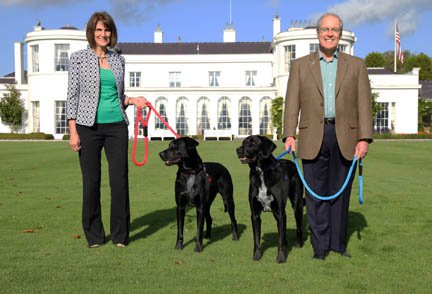
The O’Malleys’ bedroom is in a turret, its huge curved window overlooking part of Deerfield’s 62 acres and beyond them, Phoenix Park, said to be the largest urban park in the world. The O’Malleys’ dogs, Liam and Kieran (fortuitously named, long before the ambassadorship) have free run of the house and 62 acres. They just have to stop at the moat, lest they trouble the herd of fallow deer that grazes the parkland.
Ah, but they don’t always want to stop at the moat. The guards fetch them back, and they lollop (they are Labs) into the ambassador’s private living room—adjacent to the turret and equipped with TV, comfy sofas, a phone, a fridge, a microwave. After big events where they’re doing too much greeting to eat, the O’Malleys have late suppers here, his tie loosened, Dena’s heels kicked off.
Their chef, he thinks with a sigh of satisfaction, is amazing. Nobody would believe how good Ireland’s food is. Maybe in the Celtic Tiger days the Irish turned into foodies. All he knows is that at a recent luncheon with the deputy secretary, the salmon was so good, it was a distraction. O’Malley’s Irish-descended mother was what you’d call a plain cook—she’d boil or roast the meat until it was well done and then cook it another hour. The veg came out of a can. No spices, just salt.
Now, for breakfast, he has Irish steel-cut oatmeal, berries on top, and scrambled eggs and this wonderful coarse brown bread and soft, creamy Irish butter. Dena loves the afternoon tea. When they asked the chef to make a St. Louis gooey butter cake for a fundraiser, an international bazaar with booths from different embassies, the chef said that they didn’t use cake mixes in Ireland and started from scratch. Mustering his courage, O’Malley nixed the first version—not buttery enough—but the second attempt was perfect. St. Louis Gooey Butter Cake was the hit of the fundraiser.
His mind turns to his wife. This appointment’s hardest on her, because her spirited, independent identity has been stripped to “ambassador’s wife.” She has no career or colleagues here, and her first grandbaby, born on Thanksgiving, is 6,000 miles away. Her touchstone from home is the dogs, rescued when she was volunteering at the Humane Society of Missouri. She’s volunteering at its Dublin counterpart. And she’s learned, with some hilarity, to drive on the left side of the street.
He, on the other hand, has a driver. Kevin O’Malley, who once bought an Edsel, laughingstock of the automotive industry, for $350—a bargain because it was pink. That made him the laughingstock of the Saint Louis University campus. He’d sold it the minute he could afford to—a few years before the pink Edsel became a collector’s item.
Now he’s just grateful to be dropped off at the embassy and the four or five functions a day he must attend. He’d only manage two if he had to find his own parking spots on Dublin’s narrow streets, clogged with traffic now that the economy’s back.
He’s feeling thoroughly at home here, warmed by the sense of family that wiggles past even diplomatic formality. Thanksgiving morning, he received word of his grandson’s birth. He and the Taoiseach were both speaking at a luncheon, and word rippled from one man’s staff to the other’s about the birth of young Caelan. O’Malley received warm congratulations—and, a week later, a letter from the Taoiseach, embossed with the gold harp that is Ireland’s coat of arms. “Dear Caelan,” it read. “Welcome to this world … I was privileged and delighted to be with your Grandfather today when your birth was announced. While the business at hand was serious, I think the Ambassador, as professional as he is, was somewhere else … At some stage in your life you will hear the phrase ‘walking on air.’ … Today, your Grandfather, the Ambassador of the United States of America to Ireland, walked on air.”
Visitors step into Deerfield’s reception hall and see Mark Twain. Through the Art in Embassies program, the O’Malleys could select pieces in the States and Ireland for display at Deerfield. Before they left home, they browsed the regional collections of the Saint Louis Art Museum, the Missouri History Museum, and the St. Louis Mercantile Library at the University of Missouri-St. Louis—dressed not in their usual Sunday-afternoon jeans but like people to whom you’d be willing to lend art.
Because there’s never been an Irish ambassador from St. Louis before, they asked for art that would evoke Missouri. At MoHist, curators brought out early drawings of the Mississippi River and paintings of steamboats, then pointed out local sculptor Don Wiegand’s bust of Mark Twain. Perfect. The Irish read Twain, and the bust has just enough gravitas to hold the center of Deerfield’s high-ceilinged reception hall.
Art selected, O’Malley turned to music. He’s bringing over a succession of singer-songwriters, because the Irish are as devoted to American music as Americans are to Celtic. The musicians will perform at Deerfield and in pubs, record a little music, and headline a festival involving Irish music teachers.
He wants to make sure that young people experience the special connection between the two countries. He also wants to make sure that Irish citizens with ancestry in Asia, Africa, and the Middle East feel part of Ireland’s historic relationship with the U.S.
Everywhere O’Malley goes, that relationship rises up to remind him. Granted, when people say “Where are you from?” they mean originally, in Ireland. But after “Westport, in County Mayo,” the conversation crosses the ocean, and, sure enough, somebody’s got a cousin who lived in St. Louis or a daughter who went to Saint Louis University. Before the USA-Ireland soccer game in November, he spoke to a group of troubled youth. The other speaker was the game’s commentator—a St. Louis University High School grad who’d been in the class behind O’Malley’s youngest son’s.
Different phases of his life come into play at different times. When O’Malley addressed law students at University College Cork, he urged them to make time for a spiritual life, however they defined that—to be in touch with that part of themselves that is looking for more than they can touch. He spent his novitiate years in a monastic setting in Perryville, Mo., and the silence he learned there has kept him peaceful, given him a sense of purpose. Even with his current frantic schedule he walls off time for contemplation. It’s not optional. It’s what gives him strength.
Just as it did his grandparents.