“Great people, not policy.” These words, plainly stated in web development firm Integrity’s employee handbook, are part of the company’s underlying ethos. The University City–based company eschews rule-filled manuals.
CEO John Simanowitz doesn’t track time off or ask employees. He just asks that employees check in with their teams to ensure that the work is done well on time. “Everyone’s an adult,” he says.“They can make good decisions. If they don’t, we let them go.”
Get a fresh take on the day’s top news
Subscribe to the St. Louis Daily newsletter for a smart, succinct guide to local news from award-winning journalists Sarah Fenske and Ryan Krull.
An August Gallup poll found the average American worker works from home two days per month.
Based on the concept of “holacracy,” popularized by Zappos CEO Tony Hsieh, the management model is gaining traction. Today, flexible work hours are among the most highly coveted of employee perks. An August Gallup poll found the average American worker works from home two days per month.
In St Louis, even large institutions are taking note. Edward Jones lists “compressed workweek options” and telecommuting as benefits for its branch associates. In 2014, law firm Bryan Cave gave employees the right to request flexible working hours and locations. And at Barry-Wehmiller Companies, a global supplier of manufacturing technology and services, employees are allowed to work flexible hours. Chairman and CEO Bob Chapman is known in management circles as an evangelist for “truly human leadership,” in which success hinges on the workforce’s well-being.
To that end, however, the telecommuting trend is often stacked in favor of upper-income workers. Studies show that it’s far more common for white-collar professionals than for blue-collar workers and those in the service sector. And telecommuting can have a downside, with some remote workers expressing feelings of isolation.
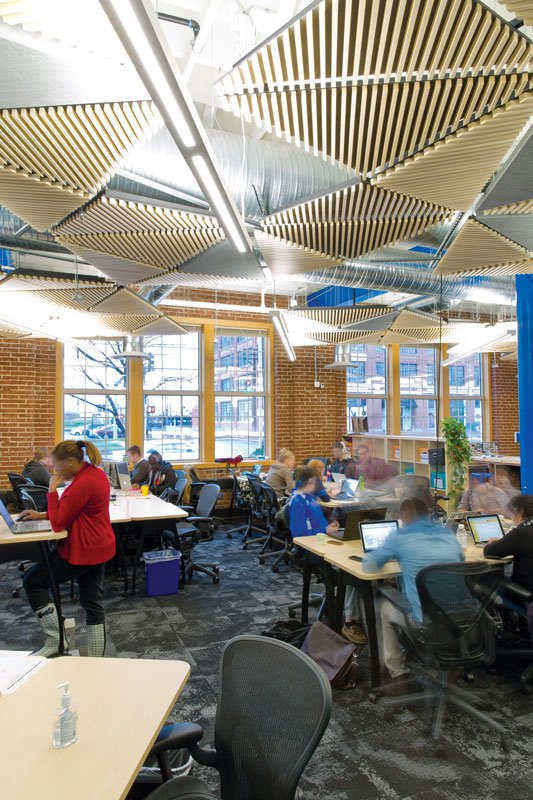
Workspace alternatives are changing that for telecommuters and freelancers alike, though. A flurry of co-working spaces have opened in St. Louis in the past few years. For a fee, remote workers can find solidarity in like-minded communities. There’s TechArtista in the Central West End, Hive44 in Fenton, and Nebula in the Cherokee Business District, which bills itself as an “unconventional workspace for the unconventionally employed.”
For employers, though, the unconventional path isn’t necessarily easy. Hiring workers who are fit for a flexible work environment can be challenging. “It’s definitely a lot harder,” says Simanowitz. Typically, if he were hiring a programmer, he’d look primarily for proficiency in programming skills; now, he also needs to make sure that person is an excellent communicator and trustworthy.
And though some Integrity employees are truly remote, telecommuting from other cities, Simanowitz prefers that most of his staff be locally based. “Having the ability to get everyone in the room and work it out is critical,” he says.