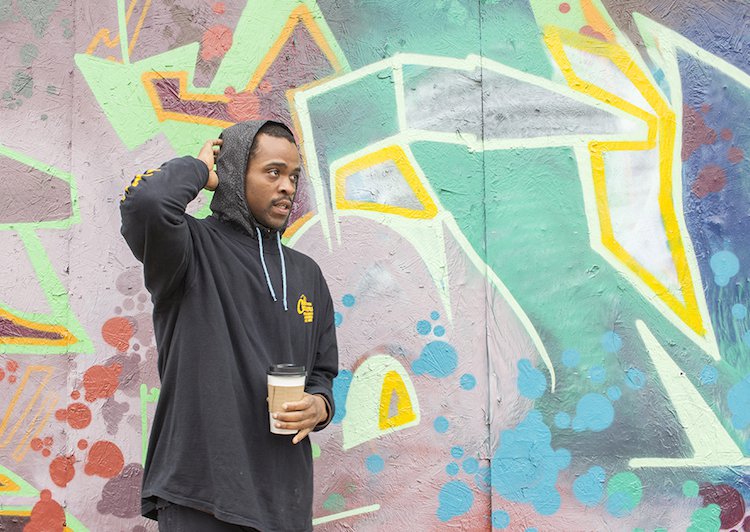
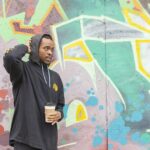
“When I think about [the music] too much, it just really doesn’t work out. I try to keep things as intuitive as possible. I see it as me building a riddle in a live setting,” says sound artist Olan, short for Thomas Olanrewaju Osunsami, the figurehead behind Biggie Stardust. He relates a stream of consciousness using two sample machines, calling on pieces pulled from lost or long-forgotten sources.
Olan’s approach feels most akin to a journey—like soundtracking a film too alien for the human eye to see. He counts on brevity to break from the pack, with set times that run roughly half the length of his peers in the ambient genre. That respect for the audience’s time can be traced to Olan’s roots in the DIY scene of his hometown of Peoria, Illinois.
Get a guide to the region’s booming music scene
Subscribe to the St. Louis Music newsletter to discover upcoming concerts, local artists to watch, and more across an eclectic playlist of genres.
Once part of Peoria’s Fancy Hawk collective, Olan lent his voice and backtracks to more traditional rap songs. He started performing live in 2013 at shows where noise and hip-hop shared a stage, where genre-swapping was commonplace, and the crowd seemed receptive. That scene was ample ground for Olan to bring Biggie Stardust out of his basement and to the stage.
Outgrowing the cramped quarters of small-town U.S.A., Olan came to St. Louis in early 2015 and started circulating at punk shows right away. The communal vibe he felt spurned a permanent move to the river city, as opposed to Chicago, which tends to be the path many artists from Peoria take.
“I feel like that’s generally what the ‘Peoria kid’ does. In Peoria it’s always about 18 to 20, then they go to Chicago or maybe New York or wherever. But St. Louis kind of spoke to me,” Olan says.
He was first invited to perform in St. Louis by Austin Smith of Acid Kat Records, a hybrid collective that books shows on Cherokee Street and produces both small-print zines and cassette tapes. Since this past spring, Biggie Stardust has played several stages throughout the city, but still cites Cherokee Street as his homebase.
To date, Biggie Stardust has yet to release any solo recordings, but an early collaboration with Fancy Hawk can be found in digital form. The release is less of an album, and more like a salvage effort from a wrecked hard drive.
“I feel like I’m always in ‘create mode’ as opposed to ‘document mode,’ but I want to do a release eventually. First, get the live show down, and then go and release something and hopefully work more with others,” he says.
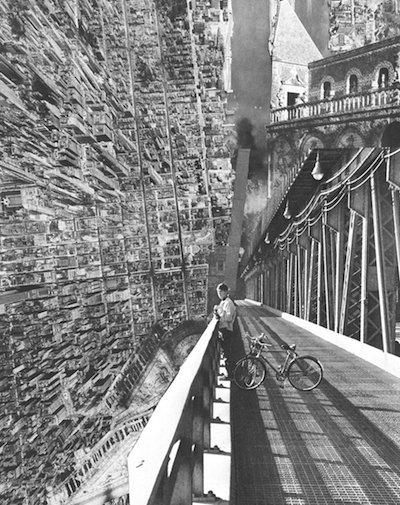
As a visual artist, Olan applies a similar aesthetic through black and white collage. Before leaving Peoria, his pieces were featured in two art shows. Be it through print or sound, he effectively recycles raw materials into new, distinct works. We sat down with Olan ahead of his show this Saturday, January 23, to talk more about the link between the two disciplines and his plans as Biggie Stardust.
From your first show with Fancy Hawk to your debut as Biggie Stardust, could you describe your transition into a solo act?
Well, I always experimented with sounds and rhythms with what gear I had at home, even a bit before the collaboration with Fancy Hawk. During the Fancy Hawk era, I would mainly contribute vocal tracks or maybe an idea for a hook—things like that. It was fun. That whole process and experience made me want to apply some of those ideas to different mediums.
As a visual artist, you create collages—primarily in black & white. As Biggie Stardust, much of your sound is built from audio samples. Do you feel there is a correlation between the two? And to what end?
To an extent, I feel like there is a correlation in the creative process with the two. I tend to start out with a small piece of something, and build that small piece into something a bit bigger and elaborate. This could be an image I’m working on, or something with sound. For the most part, I usually do not have a set goal but more of a set vibe that I would like the work to embody. That’s as far as the relation goes with the two, I’d say
How do you mentally and musically prepare for each performance?
I used to get kind of nervous before I would perform. Afraid that people might boo me off stage, or like throw a drink at me, ya know? I’m rather chill about it these days. I don’t have a pre-show ritual or anything. Maybe just a shot of whiskey and deep breathing.
You typically play in one 10 to 20 minute chunk—a practice common with noise or punk bands. Why did you choose to adapt that format?
Yeah, I guess I have always been into that style, and thought it would be cool to kind of merge it with other things and ideas. When you go non-stop like that, you kind of build yourself some momentum to take the crowd wherever you want while you are presenting your art. Almost like you’re telling a short story. I think it lets your performance be an actual single body of work in its own, as opposed to playing one song after another. Transitions have always been important to me.
Despite being active for more than two years, Biggie Stardust has no studio recordings. Is this a conscious decision, or should we look out for a release in the near future?
It’s tough to say if it has been a conscious decision or not. I guess I have always put a heavy emphasis on live performance, not really being too concerned with documenting it. It would be cool to put out a tape or something though, for sure. I have always liked the idea of a visual EP or visual mixtape, or to put out a collaborative release with a visual artist. But at the end of the day, I know I would like to share something with the world, even if it’s a few jams or live recordings.
Last words: Rest in peace, David Bowie.
Biggie Stardust performs January 23 at 8:30pm at the Livery Company, 3227 Cherokee. Admission is $5. For more information, visit the Livery Company on Facebook.