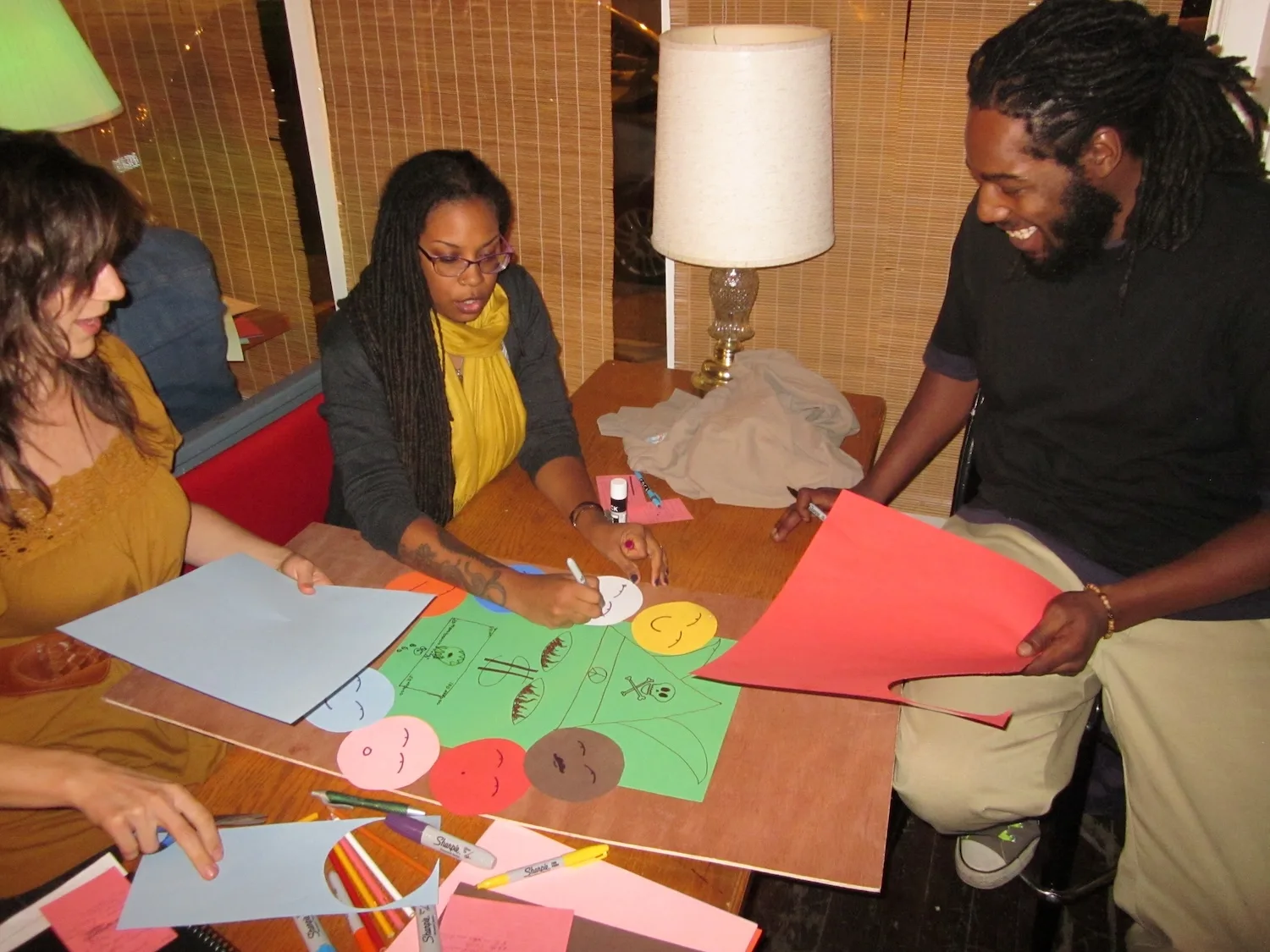
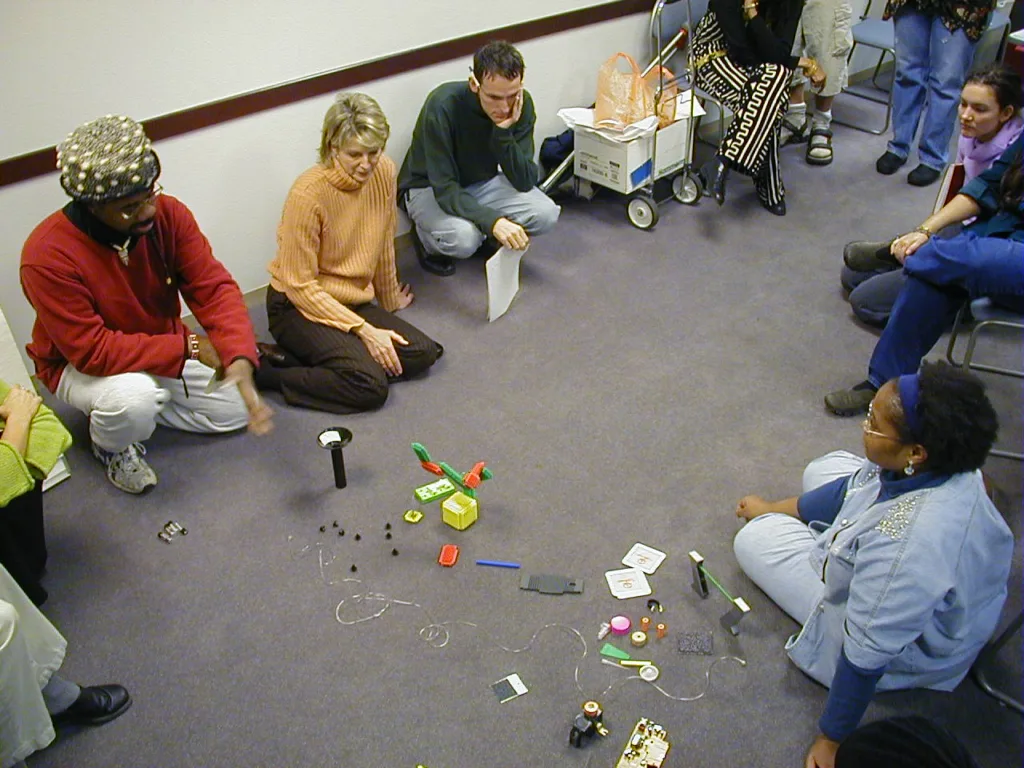
When the Community Arts Training Institute was founded, members of its first cohort met in the basement of a Webster University building around folding tables and stacks of Xerox copies. City Museum had just opened its doors and the term “community arts” had only recently entered the collective consciousness. Now, 30 years later, the CAT Institute has expanded into a flourishing educational institution whose fellowship boasts a network of more than 400 alumni. These St. Louis-based artists and community collaborators have been trained to incorporate art as a tool for social change, with many going on to establish arts-based community programs, advocate for social justice initiatives, or work in public policy.
And this year, the CAT Institute celebrates a milestone: its 2027 cohort will be its first as a fully independent nonprofit, separate from the Regional Arts Commission under which it had previously operated. (Despite this development, the CAT Institute will still be financially supported by RAC.)
Get a fresh take on the day’s top news
Subscribe to the St. Louis Daily newsletter for a smart, succinct guide to local news from award-winning journalists Sarah Fenske and Ryan Krull.
Roseann Weiss, who ran the CAT Institute as a RAC employee from 2003 to 2017 and is now one of the CAT Institute’s founding board members, says that she is thrilled with the institute’s new independence. “I do feel like I helped foster something that is now coming into its own in a way that we dreamed about,” Weiss says.
Jenny Murphy, co-director and head of organizational development at the CAT Institute, believes that standalone status will offer the program more autonomy and creative control. “We’re a 30-year old startup, because we have a really long history with our programming, but being a nonprofit is new,” Murphy says.
Pacia Elaine Anderson, the CAT Institute’s co-director and head of community building, says that the transition is akin to “moving out of your parents’ house.”
While much of the past year has been spent establishing the organization’s structural foundation, she says leadership is looking forward to expanding its program offerings and raising its public profile.
Both Murphy and Anderson are CAT alumni working with visual art and poetry, respectively. Murphy, a sculptor who founded the creative reuse organization Perrennial, says that her CAT experience helped her better define her desire to make art in collaboration with community. “When I started CAT, I was like, ‘Oh, there’s a word for what I wanted to do. Actually, there’s a practice that’s been going on for a long time,” Murphy says.
As Anderson explains, one of CAT’s core principles as a community arts initiative is to act “with, not for:” While the program can do a lot for the community, its focus should be on actually incorporating community voices in its decisions.
As for her own CAT experience in 2014, Anderson says that it was “transformational.”
“There was a lot happening,” Anderson says, “We started right before Mike Brown was murdered.”
St. Louis was thrust into a state of reckoning, she recalls, and she was personally as well.
“It became an anchor for me emotionally, to kind of help work through what was going on. But I wasn’t deep in community work yet, so it also helped prepare me for the life that I was going to have for the next 12 years,” Anderson says. “In the wake of the Ferguson uprising and in other uprisings nationally and in the city of St. Louis, it’s almost part of the fabric of being an artist” to be in constant conversation with such social issues.
To keep up with the ever-changing artistic landscape, Anderson says that the CAT Institute’s curriculum behaves like “a living document” that adapts and evolves: “The CAT experience is different in ‘97 than it was in 2001, and it was different in 2008 and 2012 and 2014.”
Anderson adds that the five-month fellowship’s focus on collaboration allows for cohort members to share skills and offer alternative perspectives. In Anderson’s own work, for example, she can turn to the CAT network, asking, “I’m working with this community group and this issue came up, do you have some resources or facilitation techniques?”
Anderson also says that learning the “nuts and bolts” to an artistic career was an invaluable part of her CAT experience—such as creating an invoice, properly charging for labor, and negotiating a contract. However, Anderson found the interpersonal, social, and intellectual lessons just as important, including asking questions like “What does it mean to sit with your own internalized racism? What does it mean to use your art in a way that has real benefit to real people?”
“We talk about arts-based community development or activating positive social change and those things can seem really abstract,” Anderson says.
Adds Murphy, “We want to give people real, hard skills to leave with,” even as the interpersonal learning experiences still comprise “the soul of the work we do.”
“One of my big hopes is that, when this cohort wraps up in the summer of next year, as an organization, we will have even more set up to really shepherd them into the next steps of their projects and of their careers,” Murphy says.
The CAT Institute’s transition to independence should help with that, she says. Now, Murphy says, the focus will include more research and data collection around its alumni, many of whom she says are “in places you wouldn’t expect” due to the program’s preparation for its fellows to navigate a variety of real-world environments.
Some notable CAT alumni include Elaine Cha, host and producer of St. Louis Public Radio’s St. Louis on the Air, and Sarah Paulson, the Pulitzer Arts Foundation’s program manager. CAT has also boasted successful local partnerships with the nonprofit Prison Performing Arts, Bread & Roses MO, Peter & Paul Community Services, and Metro Theater.
Applications for the CAT Institute’s 2027 cohort closed on Oct. 28, with its 16 new members to be chosen by November 19. The organization is hoping to include a diverse range of artistic backgrounds, life experiences, and identities. Yet these factors, says Anderson, are “secondary to just coming in with an open mind and an open heart.”