

Misogyny is as old as history itself, and just as Western Civilization continues to chug along into a new millennium, it becomes obvious that it is still present in our own city of St. Louis. Western philosophy has dealt with the fundamental contradiction of oppressing both loved ones and strangers with both bursts of enlightenment and failure over several millennia.
Historically, Plato’s Republic, apparently the most widely assigned book in college curriculum in America, starts off the conversation. Plato assigned women equal responsibilities in society if not equal status, but still relies on the bias that the upper class are more fitting for public service than those of lower social classes. Aristotle, Plato’s student, is unequivocal in his stand on women; they are relegated to second class. In Aristotle’s Politics, women are inferior to men, further expanding on his teacher’s beliefs that men are the ruler, and women are the ruled. The Romans continue the same theme: the very root word of virtue means manliness. To behave virtuously is to behave as a man, a vir.
It did not get much better as the ancient world faded into the medieval world. In I Corinthians 14:34, the judgment of women’s role in public life is clear: “Women should remain silent in the churches. They are not allowed to speak, but must be in submission, as the law says.” St. Augustine, the great 4th Century philosopher and theologian, also misses an opportunity to attack ancient biases against women. In his Confessions, women are roadblocks to St. Augustine; his concubine, after whom he “lusts” for years in what was basically a common-law marriage, must be jettisoned so his and his colleagues’ faith can be complete. His mother, Monica, while depicted positively, has little of her own agency, but exists as subservient to her son.
Jean-Jacques Rousseau, the great Enlightenment philosopher, while given credit for helping to create modern democracy, had hardly enlightened views on women: “They must be exercised to constraint, so that it costs them nothing to stifle all their fantasies to submit them to the will of others.” When the French Revolution issued the Declaration of the Rights of Man and of the Citizen, they didn’t forget to add “and Women.” Only reason and intellect are attainable by men in the eyes of the Enlightenment. And no, despite claims to the contrary, “Man” was not some sort of generic term for both men and women back in the 18th Century.
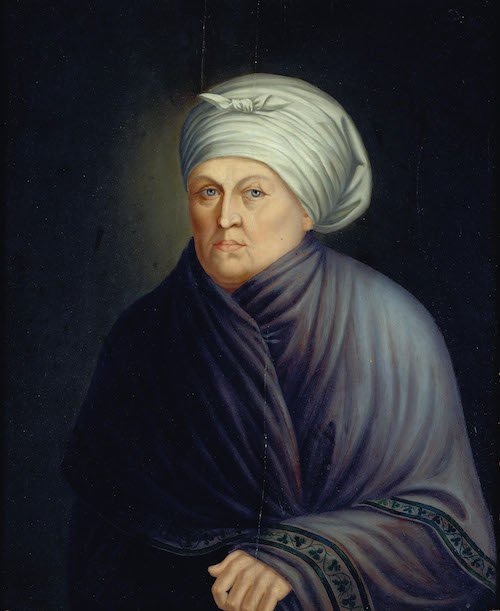
The mother of St. Louis, Marie-Thérèse Bourgeois Chouteau, could speak to the inherent bias women faced in the supposedly Rousseau Enlightenment Land of Louisiana. Despite being married to an alcoholic deadbeat who walked out on her, Madame Chouteau could not divorce him under Spanish or French law. One wonders what it was like for the first woman in St. Louis to live under such conditions. It seems obvious, however, that she was a strong woman who fought back against the discrimination she faced in her lifetime.
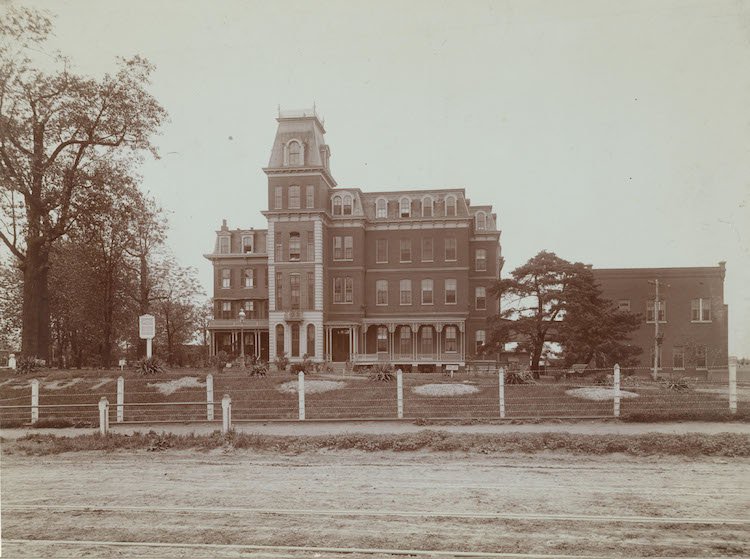
St. Louis would later engage in another social experiment in the infamous Social Evil Hospital of 1873-4. Seeking to cut down on the spread of sexually transmitted diseases, the city opened the hospital to treat prostitutes. Notably, it was women who were seen as the vectors of the problem, not their male clients. Not surprisingly, the social experiment failed, and Sublette Park is the only memory of this strange chapter from St. Louis history. St. Louis still struggles with how to handle prostitution and its clientele.
At the same time as the opening of the Social Evil Hospital, women would have been reading etiquette books on how to be a “proper lady.” Among dictums about how to dress in the morning, there are strict admonitions about walking about alone after twilight. While it certainly is likely that it was dangerous to walk around many St. Louis neighborhoods after dark in the 19th century, the implication is that it is women’s responsibility to alter their behavior, and not for men to change their behavior. In fact, the use and threat of violence has always been what men have used to dominate society, and women are still subjected to harassment on a daily basis on the streets of the city. Sadly, it’s been revealed recently that degrading and vulgar threats of violence towards women are also present in St. Louis politics. And “good men” continue to be silent.
Chris Naffziger writes about architecture at St. Louis Patina. Contact him via email at [email protected].