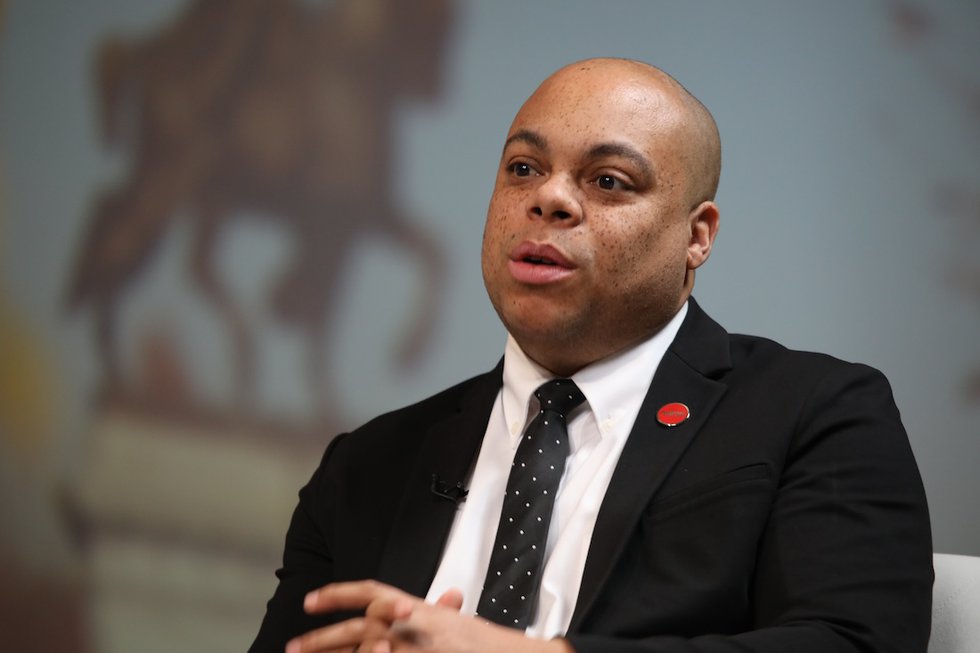
Recorder of Deeds Michael Butler sat down with Nine PBS and SLM for an interview focused on the five items identified as most important to residents via the Citizens’ Agenda. This is a transcript of his remarks. See more coverage of the agenda and other candidates at ninepbs.org and at stlmag.com.
Sarah Fenske: Okay, so we have five agenda items here. The first one is transparency and accountability and we’re gonna kick this off with a short video from one of our focus group participants.
Get a fresh take on the day’s top news
Subscribe to the St. Louis Daily newsletter for a smart, succinct guide to local news from award-winning journalists Sarah Fenske and Ryan Krull.
[Citizen Video]
My name is Aminhan Lobster and I’m a resident of the Midtown neighborhood. My biggest concerns in regards to the future of the City of St. Louis involve transparency, accountability, and planning for the future. In regards to transparency, I would like to see more active ways in which the community can get involved and readily informed about the status of programming within the City of St. Louis, the status of the city services. For example, when citizens submit requests, I would like a more active portal so citizens can be aware of where those requests are and the status of being answered. In addition, I would like more accountability. I would like continued public hearings and forums in order for citizens of St. Louis to talk to whether that be the Board of Aldermen or even the Mayor’s Office in regards to offering feedback and also getting status updates toward their concerns.
SF: So something we kept hearing is people feel like the decision makers at City Hall don’t really want to get their input, that they might hold a public hearing but they’re not really listening, they’re just gonna do what they want to do anyway. What will you do to incorporate the voices of the communities you serve when you’re making decisions that affect them?
Michael Butler: People don’t feel heard it sounds like and I can attest to that. There are people inside City Hall who don’t feel heard as well. What I will do to change is one of course make sure we have a lot of that, those transparency portals online just as and have a great dashboard that’s topical. One thing I’ve learned being a state legislator and being in City Hall that people respond to topical asks, not just what do you think but what do you think on crime or what do you think on transparency in general, what do you think on how can we improve this and make it topical and marketable and I think we’ll get some better responses online.
In person as well, we’re doing more town halls and partnering with local aldermen and local elected officials. I think that’s another thing that people want to see, they want to see not so many meetings that the alderman has a meeting and the ward has a meeting, there’s a neighborhood meeting and then the mayor has a meeting. We want to make sure we’re partnering with everyone and not having fiefdoms.
The third thing when I think about accountability and transparency is I think about audits and my office has been audited by the state government once in the past six years and twice by the local comptroller and we’ve got to be welcoming to audits for all of our departments because audits, formal audits allow us a chance to change and not a chance for us to deflect. And lastly of course it’s got to be the media, we’ve got to be open to the media and there’s been a lot of complaints from the media about this administration’s unwillingness to cooperate and respond to questions that are sometimes coming from the public. So being open to the media is a very big part too because you guys can help spread the message that the good things that are going on in the city of St. Louis.
SF: So you mentioned audits, you know we heard from people about recent headlines involving the St. Louis Development Corporation, the sort of scandals in the building division. What does the city need to do differently to prevent public funds from going to bad actors?
MB: The city has to have better management and oversight. So when you think about oversight we think about legislative oversight, that comes usually after. Preventive measures is that the mayor has to be on with their director and deputy director and dive deep into the processes that each of those departments use and that’s the kind of mayor that I want to be. I’ve got a masters in public administration, I’ve got a bachelor’s in business.
What I’ve seen this administration do is use a lot of consultants to do the work that the current mayor and their administration should be doing every day. I could be a consultant and I’ve done that in the recorder of deeds office where we have, we dive into all of our tasks from primary tasks to secondary tasks and I like to remove what I call old tasks, these are things that we do just because we’ve done it all the time or out of place tasks that are things that could be better done somewhere else and when you start to dive deep on individual tasks and processes for your departments those things tend to weed out and you tend to get better results.
SF: So SLDC, Cara Spencer says she’s lost faith in Neal Richardson and his administration of that department. How are you feeling on that question?
MB: I’m feeling that SLDC was at the leadership of the mayor and quite frankly a lot of the choices that were made were based upon relationships with elected officials, not relationships with the director and I don’t think that one individual director should be defined by the one negative instance. If there are multiple then when I’m mayor Neal Richardson will be on the short lease but I won’t commit to firing Neal on the first day.
I believe in the economic justice plan that has been presented, that was a part of the mayor’s vision as well as part of Neal Richardson’s execution. I want to continue some of those economic justice plan things that I think he had really made a good name for himself and I wouldn’t want to tarnish that organization’s important work that they’ve done and they can do with a big change on the first day. I think there’s still some good that can be done there with a better manager at the mayor and better direction from the mayor’s office.
SF: Better manager meaning a stronger mayor.
MB: Correct.
SF: You also mentioned consultants. This is something that residents are kind of aware of. The city has a penchant for planning. They like to hire consultants to do reports. Then that report might lead to another report. What would you do as mayor to move past the consultant stage and get to the action stage?
MB: I would be present and I would be more focused on doing that work in-house. I’m not a big fan of third-party contractors for any kind of work, especially in government work. There we have plenty of money that we can hire those FTEs ourselves and we have better control over them. I can understand the need to find people fast and to find a way that you can hire folks that then you don’t have to be accountable for later, but I’m not that kind of leader.
I’d like to be accountable for what’s going on day to day. I’d like to get reports back about how we can change. Quite frankly, the most important thing here is that we need a sense of urgency in our government.
People are hurting and they want medicine from the city government to change their daily lives right now. They can’t wait a few months for a report to come out and then three months for legislation. There are things if we have day to day employees that we can change immediately that consultants can’t tell us about.
SF: You say people are hurting. What are some things the city could be doing to address the kind of hurt that they’re feeling that the city’s not doing?
MB: Almost all of the issues that people are feeling, these are things that deal with getting trees cut in their neighborhood, getting potholes filled in their neighborhood. Of course, we all went through the snowstorm and some people were trapped in their homes. These are city government services that people are hurting from. What we can do, number one, is to hire enough people to fulfill those jobs.
I haven’t had a vacancy in my office in over four years in the Recorder of Deeds because I believe in one thing, quality over quantity. I want to pay people what they’re worth and give them the technology they need to succeed. The city can be doing better at that.
Paying people what they’re worth, give them the technology they need to succeed so we can fulfill a lot of the undone work across the city that people complain about day to day when I talk to them.
SF: You’ve slid right into our second agenda item and I love it. That’s city services. You mentioned you haven’t had vacancies in your office. That’s even though when you took over, you did do some house cleaning. You got rid of some people. The people you’ve hired, they’ve stuck around. You haven’t had turnover there?
MB: Correct. Yes. No, we’ve kept a lot of those. The easiest way to put it is that when I first got into office, I terminated about 20% of the workforce on day one.
Over time, from the past administration, about 50% of those folks have been either terminated or retired and we’ve replaced them with folks. We haven’t had turnover with the new folks that we’ve had, but most importantly, we have a wait list for folks to try to work in our office because there’s a little known fact around City Hall that we’re just the best and the easiest office to work for. We pay people what they’re worth. We give them the technology they need. We give support. No, there hasn’t been a lot of turnover because of that. I feel I can do that for the rest of City Hall.
SF: Other city departments definitely don’t have that going on. Some of them have many, many positions unfilled and that is really affecting city services. Take something like Refuse, where maybe people don’t want to drive a trash truck. They might enjoy working in the Recorder of Deeds office where it’s this nice white-collar atmosphere. What can you do to deal with that in some of these jobs that might be the kind of jobs that are less desirable to certain people?
MB: There’s only one way to make folks, to entice people, to incentivize them to do a job that is less desirable. That’s paying them more. So making the job attractive for a salary and then being able to recruit more folks.
So we’ve got to have more than competitive salaries. We’ve got to have better salaries than the other counties and cities that are surrounding us now.
SF: Do you think the mayor hasn’t been aggressive enough about that? She’s definitely talked about the issue. Could she have done more?
MB: Not aggressive enough, absolutely. We have a $42 million surplus for our budget each year, mostly because of vacancies. We can absolutely be more aggressive with that kind of surplus.
SF: So you mentioned the city’s snowstorm. This happened on January 5th and it took almost three weeks, I think, before most of the ice was gone. What do you think went wrong and what would you do differently if we get this kind of level of snow followed by cold?
MB: The first thing the city government did wrong was that we didn’t prep the streets. We didn’t prep with enough salt prior to that. They’ll say they did some, but no one can attest that they had salt down on the main street. So we didn’t do enough prep work for the streets and we knew this storm was going to be bad.
There could have been days, at least two days of prep work, knowing that this storm was coming. The second thing we didn’t do is that the city government didn’t seem to want to touch side streets at first. I’ve always wanted to do that.
Since the last big storm we’ve had, I don’t see why the city government can’t take a stance of salting and plowing side streets. I’ve taken that stance and I don’t know if any of the other candidates have. There’s enough money in the budget to make sure that we can stack up, save some money, about $400,000 every year to set aside in our special budget project fund.
And when we get to about $2 million, we have one of these big snow storms every five to eight years, we’ll have $2 million to hire contractors to come in and we’ll already have contracts ready for them that will be probably the first place that they come to help with our side streets while we’re doing the main streets and the secondary streets. The third thing is that the reaction was too slow to hear from people. Our citizens clearly have always wanted their side streets paved — plowed. We’ve always talked, people complain about this every time there’s even a little storm, even though it’s two inches. And being a business owner in the city, having lived in the city for so long, I know how much that affects our business community as well. And we can make that money back by not having those days off.
We should not be a city that shuts down when it snows more than two to three inches. And what we did wrong as a city government in the past is we decided we’re going to be that kind of city rather than deciding we’re going to be a better city when we’re delivering that service.
SF: So about two weeks after the storm, the city streets director spoke at an aldermanic hearing and then she came out that evening after the hearing and apologized and said that she had been misled on the condition of the streets by her employees.
That got some consternation from people saying, you’re the streets director. How did you not know what condition the streets were in? If that was your employee, how would you have handled that?
MB: I think, I plan to be a mayor that is on the ground and not just my, and I don’t just expect that of my directors, I expect that of myself. And not just for snow, I expect that for potholes, I expect that for tree cutting, I expect that for all of our city service. I’ve told folks that I’m knocking on their doors and walking in their neighborhoods like this won’t be the last time you see me.
So part of the transparency conversation we had, people don’t feel like they see us enough outside of election time and a lot of our citizens are responding to that. So how I’ll handle that, I’ll lead by example first. And I’ll be a mayor that is present and is, I mean, I was walking on those sidewalks and in those streets during the snowstorm just trying to get folks to vote and I can’t change that when I become mayor. I have to be the same person. If I’m going to be that person the way they vote for me, I’ve got to be that person as a leader as well.
SF: Do you want your streets director to also be out there?
MB: Oh yes, absolutely. Yes. And the deputy director. Yes.
SF: So there’s a proposal with the Board of Aldermen to bring in a city administrator that some people feel like would solve some of these city services plans. Do you think we need a city manager or a city administrator?
MB: This is a new idea and I’ve been joking with folks, man, you really get right into it with this one. I can talk for an hour about this but I know I can’t.
SF: Yeah, you can’t.
MB: The more I learn about the idea, the more I begin to like it more. I think it’s a serious solution that deserves serious consideration. I think there are some easy ways to be against a city administrator.
There are some easy ways to be for it. I would want to, as a mayor, consider both the pros and the cons. I will say this, hiring a city administrator is going to cost us quite a bit of money, about twice the amount as we pay the current mayor, to do half the job of the current mayor, which is interesting and at the same time is an opportunity for us to maybe right size what the mayor should be doing and what the city administrator can be more focused on. I think it’s a serious idea that can be given serious consideration at this time.
SF: So let’s go to our third agenda item. This is public safety and policing. Jay Schroeder, the president of the Police Officers Association, says the police department has lost 512 officers since 2021. That’s the year that Tishaura Jones took office. Do you think her administration is to blame for them leaving and what should she or could she have done differently?
MB: I think the number one thing that I hear from police officers, their complaint is that their equipment is not up to date and there are police cars that we’re driving that shouldn’t really be on the road and there are things that they’ve requested that they can’t get as far as equipment. And they feel that when we were under state control before, they didn’t have those issues as much, no matter who the mayor was. And there was a different administration then.
So I think that we could do better as a city government. We’re providing the technology and equipment that police officers need on a day to day basis, not just police officers, everyone in the police department. The number two thing is while we have continued to increase salaries, we’re competitive, but we’re not beating.
And we’ve got to be, in a city like ours, we’ve got to be beating the other counties and cities in our region in order to retain those officers. So there is a little blame to go around for not being aggressive enough, as we mentioned before, on increasing salaries.
And I can talk to that a little bit. I think governments like to give salary increases to every single person in order not to disappoint or have one city government office manager and another one. I don’t have that strategy.
I think we need to listen to people and hear what their issues are and hear what departments they think are more important than others. What I’m hearing from folks is the police department, the streets department, and other public safety departments like the Citizen Service Bureau and the Neighborhood Improvement Specialists, they all, these consumer citizen facing offices need higher salaries and need higher education and need to be given more aggressive recruitment to fulfill those vacancies so we can get the work done.
SF: So at the same time, some citizens have the perception that the city hasn’t always held officers accountable when they violated civil rights, when they behaved badly. The Bar: PM case, you know, they crashed this car into the bar and then arrested the bar’s owner. The city is still pushing criminal charges against the bar’s owner. Should the city drop that? And is the city doing a good enough job of holding bad officers accountable?
MB: No, the city is not doing a good enough job. And it’s easier to hold officers accountable when you’re focused on quality.
When you’re able to raise salaries and you’re able to get people to come back to that department, you’re able to be a department of choice in the region, then you can begin to terminate and move more folks out faster. I think that, no, we’re not doing a good enough to hold folks accountable because we’re at such bare bones that sometimes governments make decisions they want to keep as many people as possible. I won’t do that.
I’ll focus on quality over quantity and make sure we have quality officers. And if you don’t meet the standard, then we’ve got to move you on because that’s going to continue to deteriorate the relationship between the community and the police department. And our police department has done the hard work of trying to repair that relationship between the community.
We’ve got to make sure that we’re moving that forward. And the city should not be suing bar owners based on things that they had no control over at all, which is a city employee running into someone’s place of business.
SF: So you’d like to see those charges dropped?
MB: Absolutely.
SF: So one of the things that comes up when people talk about safety is they don’t feel safe when they’re a pedestrian, when they’re a bicyclist. It took the city more than two years after two fatal crashes at Ted Drewes to begin the work that’s now underway to change the infrastructure around that very high traffic zone there. What can the city do differently to move more quickly on issues like pedestrian safety?
MB: I think I’m happy that the city has escalated pedestrian safety and traffic calming quite a bit over the past five years. What they can do, what we can do is to focus on city services first and not too many pie-in-the-sky ideas.
Now we have to eat gum and walk as well, chew gum and walk as well, but I think there hasn’t been a focus on responding to what citizens have been saying for a long time and then sometimes pushing that off on that we’re aldermen rather than people who can actually get it done in the executive branch. I’m glad to see that there’s a plan for that area now, for that intersection, but there are many more plans and many more intersections across the city that are dangerous. I, for one, know that people are looking past plans and they want to see actual things happening.
We’ve got more money than we’ve ever had before to make those things happen quickly.
SF: Would you like to see more traffic enforcement, even though sometimes those kinds of initiated confrontations can be bad for people of color?
MB: I would, and I think people of color are asking for us to enforce our traffic laws, but I think we have to understand the difference between criminals and crime.
And our police officers have to take the next step when we begin to increase, enforcing our traffic laws is that there’s a difference between someone who rolled stopped and someone who ran through a red light. And there’s a difference between someone who doesn’t have all their tags and someone who is driving a stolen car. And I have faith that our police department understands that in this day and age.
And I think that I want to listen to many people all across the city. They absolutely want us to enforce our traffic laws, and I’ve committed to that. At the same time, I want to, I will set the tone as mayor that we have to understand the difference between what’s criminal and what’s just sometimes crime.
SF: We’re rolling into our third agenda item: That is revitalizing downtown. And we have another short video that Olivia will play for you.
[CITIZEN VIDEO]
Hi, my name is Ron Crooks. I live in the central west end. I think we have to understand that and agree that there is a critical lack of momentum in the single most important demonstration of a city’s viability, and that is our downtown. We’ve got to be asking some good questions about this and really look into whether or not we’re doing everything we can to build a downtown that is attractive to business and to residents and potential residents and tourism. There simply must be a plan to improve both the reality and the perception of St. Louis’ downtown viability to these strategically important audiences.
SF: So, 10 years ago downtown felt like a more desirable neighborhood. What do you think happened to that momentum?
MB: Population decrease across the entire city and I think a stagnant decrease downtown. What many people see downtown are vacant retail businesses and graffiti that comes along with that. And quite frankly, businesses follow population increase and they follow societal statistics.
So, if there’s a high income, average income in an area, then we’ll have more business moving in. So, where I feel it’s appropriate for the city government, what I would focus on as mayor in improving downtown is improving housing options and improving affordability downtown so that we can increase population downtown. There are two major groups that will most likely probably move downtown and we’ve got to focus on retirees again who came down and felt how loud it was and kind of moved out.
It wasn’t quite for them. So, we’ve got to have a more residential space, probably more downtown west where they’re creating more of a good housing area, residential sub-neighborhood for downtown. And then also there are single people and married folks with no kids.
So, people who don’t have kids are more likely to move in a huge urban area like St. Louis City and we’ve got to do a better marketing with those two groups to get them to move downtown and increase population there. So, I’d be focused on getting a number of customers downtown and increasing population downtown and in turn, I believe that that will drive more businesses and keep more businesses downtown.
SF: So, developers haven’t really been banging down our doorstep eager to take on some of these big projects downtown. Do you think the city needs to do a better job of luring developers here? Ado you think big tax breaks are appropriate if they can get downtown moving, if they can take over a block, do something big down there?
MB: I think on a case-by-case basis we need to determine whether tax breaks or TIF is available. We are definitely in a situation where we can’t lose or we have to deploy every possible tax incentive that we can.
So, yes, I do think that those are necessary. But most importantly, I think I would like those to be consumer-based. I would like that those tax breaks and any incentive that we give can be passed on to the consumer to make downtown more affordable and make downtown more attractive.
So, I’m not going to be just focused on developers. There’s plenty of vacancy in our existing buildings that we can just spur folks to move downtown without developing something new.
SF: So, you would do things like tax districts where the revenue they generate then helps pay for the building? Is that what you mean by consumer-based?
MB: No, I’m thinking more consumer-based like rent abatement. And I’ve heard a lot of talk about rent control in the St. Louis region, and it’s something that’s happened in other areas. Rent is a big deal to folks nowadays. And as we increase population, rents will go up downtown. So, we’ve got to make sure that it stays affordable and that we’re marketing as a place that’s affordable and easy living. And we can’t do that if rents start to go up and then people start to move out. So, I’m thinking long-term.
SF: That feels like one thing that developers hate. Are you worried that if you try to tackle the affordability of housing there, that the kind of people we need to invest are going to run for the hills?
MB: Well, I think that developers will have the right incentive for us to make that happen. I know that developers are looking at the most possible profit, and it’s up to the government to be a check on that.
Our goal is to get the most possible population and not the most possible profit for a developer. So, we’ll be reasonable, but I want to focus on housing increase in population, and I want our developers to be focused on that too, not just a bang for the buck.
SF: So, downtown residents tell us that the quality of life has improved there in the last couple of years. You know, there were some big issues in the pandemic that made a lot of people want to get out of that neighborhood. They say things are better, but there is still this negative perception. Why is that? Do you feel like it’s the mayor’s responsibility to try to tell a more positive story, even if there are still issues?
MB: I think it’s the mayor’s responsibility to solve those issues, and the story, most times, will tell itself. So, we’ve got to continue to listen to those residents and continue to listen to all aspects of the story, because sometimes, having been downtown and spoken with downtown business, sometimes, to be frank, the black side of those stories gets masked, and quite frankly, a lot of African American residents have moved downtown to keep sustaining its population.
So, now we have a mixed neighborhood and an area where there is some, I agree that there are some things that are getting better downtown, but we have more than one voice that is not being heard directly just through neighborhood associations.
SF: So, as we talked before about transparency, we’ve got to hear all sides and solve those issues, not put them against each other. And Black residents are moving into downtown, you’re saying?
MB: Yes, absolutely.
SF: Okay, and they feel like their voice isn’t always given that same weight as some of the older white residents who’ve been there a while?
MB: I agree, yes, yes.
SF: So, let’s switch to our fifth agenda item. This is a vision for the city’s future. We have another short video here to kick this one off.
[CITIZEN VIDEO]
I’m Sid Issar, and I’m in Ward 7, and with regards to the upcoming mayoral election, the most important issues for me are that we use public money, city expenditures, to fund non-charter St. Louis public schools, and make sure that we increase the availability of free pre-K for everyone that needs it, after-school services, and various city social services for the populations that need it most. I don’t want to see city money going to fund corporations that are complicit in war crimes abroad and in weapons manufacturing, and I don’t want to see increases in police budgets. Instead, we need to reallocate money to make sure that the most vulnerable and our city public schools are properly funded, and that we need to make sure that we keep the money in our wards and in our city instead of going into the pockets of corporations.
SF: So, Sid had a lot of thoughts there. But one of the things he touched on a few times in that is the St. Louis public schools. That has been a source of many bad headlines in the last six months. It’s obviously something where the mayor doesn’t have much control. What would you do as mayor to right that ship?
MB: So, Sid is going to like me a lot. I worked in St. Louis public schools. I worked for the local teachers union. My grandparents worked in St. Louis public schools for 30 years, and my little sister is currently a teacher in the St. Louis public schools. So, I understand the needs of the St. Louis public schools. I think it’s appropriate for the city government to focus on wraparound services. What I’d want to do is invest—part of our Rams fund has been part of my plan—$5 million a year, about $500,000 of that going to advocacy for wraparound services for our 20th most low-income schools in the region.
That’s both the north and south side. And what wraparound services are is making sure you have a full-time therapist, a full-time nurse, and another full-time social worker so that our impoverished kids can get the services they need. We know how poverty affects student achievement, and it’s upon the city government to reduce the effect of poverty when folks go into the classroom.
SF: So, people sometimes leave when their kids get to be of school age because they’re not thrilled with their options, but there’s lots of other reasons that people have been leaving the city as well, clearly, or we wouldn’t have lost the people we’ve lost. What would you do to try to retain the people that St. Louis needs?
MB: So, population increase is really important. I think that what I hear from folks on the ground is that improving our schools is very important, reducing crime, and improving our housing options are all three things that we’ve really already touched on. If I can start with the schools, with school-age folks, we have quite a few good public options with our magnet program, but anything outside of our magnet program seems to be something that is not desirable for a lot of parents. So, giving those wraparound services and giving students the ability to access services and go into school ready to learn every day, I think it’s going to improve our test scores and improve the amount of good work that our teachers can do every day.
When it comes to reducing crime, I know Sid mentioned not being able to increase police budgets. I agree with him in the sense that we need to increase the amount of anti-poverty programs that go to the root cause of crime, and I’ve constantly given our mayor kudos for funding a lot of those programs with ARPA dollars, but those dollars are going away, so we have to find a way to continue those programs in our general revenue budget. And lastly, I’ve talked about housing.
I want to spend a lot of our Rams money on reducing vacant housing and building new spaces, and I think those three issues together, when we fix those, we’ll be able to have folks who have less excuses to leave, and we’ll get that word of mouth going to where folks know they can be here, be safe, and live easy here in the city of St. Louis.
SF: So, something we’ve heard time and again is this perception that we’re being outpaced by Kansas City, that St. Louis has fallen behind to them. Do you think there’s anything we can learn from Kansas City’s successes?
MB: I was in the legislature when Kansas City passed us. It was around 2014-15, and I’ve said this for over 10 years as what I found the difference between Kansas City and St. Louis is how their leaders work together. When the election is over in Kansas City, it’s over, and they get together, the local elected officials and state elected officials, Democrats and Republicans, and they come to Jefferson City with a plan, with a bold idea for UMKC or for the Negro League Baseball Museum, and they support these big-picture issues, and they see us fight each other, and they take all the money over to Kansas City.
We can do the same thing. It’s about leadership, and it’s about having leadership that works together, and no matter what our governance structure is, we’ve got to have good leaders that are not wanting to fight against each other, that want to change our culture. We’re going to go and have big ideas we can do on our own and big ideas we can do in Jefferson City or Washington, D.C.
SF: Our last question today, people say the big thing they want from a mayor is they want a vision for a better St. Louis. What’s yours?
MB: When I think about a big vision, I think what I hear first is that we’ve got to take care of our home, but the big vision while we’re chewing the gum and we’re walking towards something is I want to improve our riverfront. I think the big product that folks want to see is our riverfront be a space that people want to go to, a retail space.
There are customers that come from all over the region, and there are projects that we can support north of the arch and south of the arch that improve our riverfront for housing, for retail, and a place that people can live, work, and play. Improving the riverfront will be something that we want to support with funding so that four years from now we can say, wow, we have something nice and new that we can point to that the city administration has done.
SF: Well, Michael Butler, thank you so much for joining us today.
MB: Thank you.