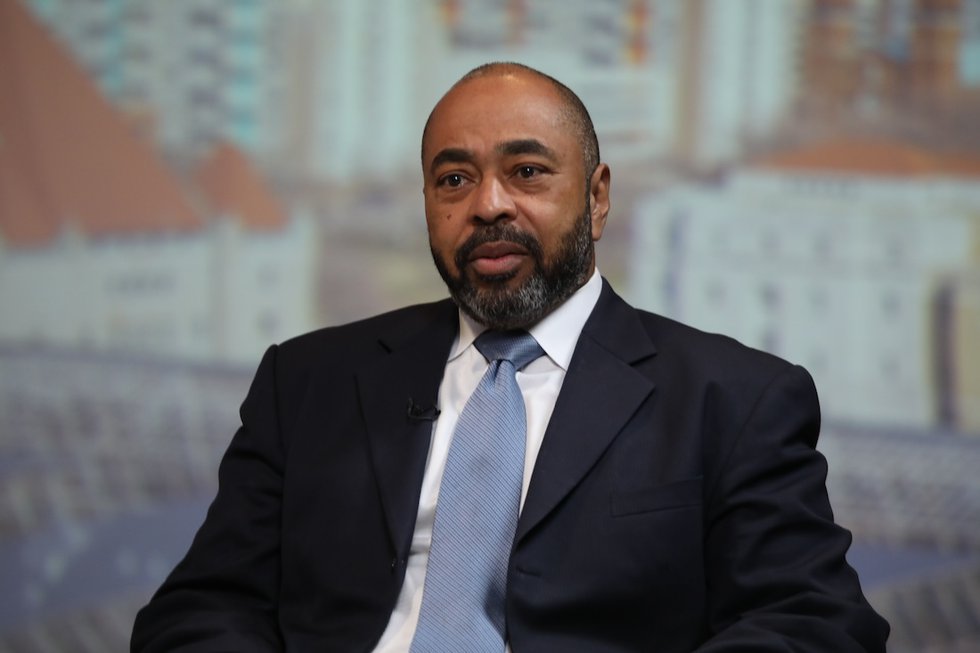
Mayoral candidate Andrew Jones sat down with Nine PBS and SLM for an interview focused on the five items identified as most important to residents via the Citizens’ Agenda. This is a transcript of his remarks. See more coverage of the agenda and other candidates at ninepbs.org and at stlmag.com.
Sarah Fenske: All right, so our first agenda item is transparency and accountability. And for this one, Olivia is going to bring us a video of one of our focus group participants.
Get a fresh take on the day’s top news
Subscribe to the St. Louis Daily newsletter for a smart, succinct guide to local news from award-winning journalists Sarah Fenske and Ryan Krull.
[CITIZEN VIDEO]
My name is Aminhan Lobster, and I’m a resident of the Midtown neighborhood. My biggest concerns in regards to the future of the city of St. Louis involve transparency, accountability, and planning for the future. In regards to transparency, I would like to see more active ways in which the community can get involved and readily informed about the status of programming within the city of St. Louis, the status of the city services. For example, when citizens submit requests, I would like a more active portal so citizens can be aware of where those requests are and the status of being answered. In addition, I would like more accountability. I would like continued public hearings and forums in order for citizens of St. Louis to talk to whether that be the board of aldermen or even the mayor’s office in regards to offering feedback and also getting status updates toward their concerns.
SF: So, one of the things we heard from people in the focus group is they feel like decision makers at City Hall don’t really want their input, that they’re just sort of checking a box by having a public hearing. What would you do to incorporate the voices of the communities that you serve when you’re making decisions that impact them?
Andrew Jones: Well, that is right up my alley. I think this is a softball served up for me. It’s a softball answer. If you can recall, when I first ran for mayor in 2016, I was criticized and made fun of because I said that we wanted a comprehensive economic development plan because in order to plan, when you plan, you plan on succeeding, you plan on providing all the intricate details on what and where we need to be and we know who’s responsible for those things.
I’m certainly for transparency and the economic development plan will certainly do so. So, in order to move the city forward, we need to get all stakeholders involved, everyone involved, contribute to the economic development plan so that we would have a clear understanding on where we are within the plan, doing a SWOT analysis, a genie co-efficiency. We have everyone’s buy-in and input and so what I submit is that no one wanted this plan and they were critical of the plan because it does open up for citizens to be able to look and see we’re at December 4th and this is where we should be.
Why aren’t we there? Who’s responsible? All of those things make it necessary to have an economic development plan and that’s certainly what I want to drive for after we deal with these security issues.
SF: So, you feel like people didn’t want to have that level of detail out there because it would be a way of holding them accountable if they didn’t hit what they said they were going to do.
AJ: Absolutely and again, they called me the plan man, the pejoratives, all the negative things, but I kept writing it because I know in order to fix things, you have to have a plan. If you don’t plan to succeed, you don’t have a plan.
You must have that plan in order to do so so you can drive economic development, business development, community development. We get everything involved and we have a planning system. And what we have now, I believe, is more of a knee-jerk response, a natural kind of movement towards doing certain things, but if it’s not planned, you may get things in areas where you don’t particularly have necessary infrastructure development there, things of that nature. So, we want to plan around trying to develop the city of St. Louis.
SF: So, beyond economic development, do you think the city should make changes to make it easier to track and weigh in on what’s happening in neighborhoods and the city as a whole?
AJ: Well, again, without being intrusive because now you’re talking about invading people’s privacies, things of that nature, but we want to be able to have a handle on what’s going in particular areas and see if it coincides with that. And we certainly don’t want to discourage any type of business development or any type of growth that people want, but we want to have a handle and a guide to what we want in those particular areas so we can have controls in order to make things grow.
SF: So, the second sort of aspect of this, along with transparency, is accountability. There have been a lot of bad headlines lately involving the St. Louis Development Corporation, involving the building division, people getting their hands on public funds when they maybe don’t have the city’s best intentions at heart. What can the city do differently to prevent public funds from going to bad actors?
AJ: Well, again, I’ll go back to the economic development plan. It secures all of the information necessary so we know where the monies are. We know what the ideas surrounding those particular concepts and ideas and projects. We have a clear understanding of what’s happening, and that minimizes the opportunity for people to take advantage of certain things and, dare I say, some corruption to leak in, but we have monies that are available now.
They haven’t been suggested on what we’re going to do. We keep saying we’re going to do this. We pull back. We’re going to do this. We pull back. When you have an economic development plan, it encompasses everything. It’s comprehensive in its scope and scale, and that’s how we’ll keep a track on what’s happening.
SF: Right now, Neal Richardson is running the St. Louis Development Corporation, and there have been, again, some scandals on his watch. Would you want to retain him as part of your administration?
AJ: Well, I met the young man, and we did a show together.
SF: What kind of show?
AJ: It was a radio show, Freeman Bosley’s radio show, former mayor.
SF: You were both guests there together.
AJ: Yes, we were both guests, and I took from the young man that he has some great ideas. I think his intentions are meaningful.
I believe he’s sincere in trying to help, but I think he’s been giving a short shift, so to speak, because, again, not having a plan, and I explained that to him on the program, is that I believe he’s being set up for failure. The next thing I knew the following day after that interview, Cara Spencer resigned from SLDC, and there’s all the issues surrounding it, so I think the young man will succeed with the right initial programs behind him, with a very comprehensive plan behind him, but if he doesn’t do that, he’s planning on failing, and there probably, if there’s going to be an issue, there’s going to be, dare I say, I hate to say this, they may end up setting him up for the fall because of the incapacity, the incompetence that exists, and this is a way to get around it and have a scapegoat. This is what I’m submitting, and I’m not saying this is absolutely true, but it lends to that.
SF: Let’s go to our second agenda item, which is city services. Residents had a lot to say about this. Some of them said the inadequate nature of services provided by the city makes them feel like they aren’t valued by the city. Do you think that’s fair?
AJ: Well, you have gaps in services, streets, infrastructure, or the lack of retaining certain things. People do feel like there is some type of gap in the services, so to speak.
I would hate to say that this is intentional, but it certainly seems like it, or there’s a level of incompetence or a mixture thereof that certainly lends itself to show that we need to really explore what it is that people are seeing and try to gauge whether or not it’s intentional or not. And I just don’t think it’s intentional, but boy, it certainly lends itself to it.
SF: So what would you do to try to change that situation?
AJ: Well, certainly when you have leadership, and I always say leadership, a fish rots from the head down. Leadership absolutely leads it, and certainly you’re in charge of, the mayor is in charge of certain departments, where we can do something about it by having our employees being state-of-the-art, effective in what they do in communications, state-of-the-art in providing information relative to what’s going on within the systems and being comprehensive and also providing detailed information on what’s happening so that people won’t feel those gaps in between and you can satisfy them in that regard. And that comes from the leadership. And I’ve headed up our customer service divisions and customer focus divisions.
We’ve done all of those types of things where we stay engaged with our customers to make them feel wanted, make them feel vital and very, very important to our overall system to make things work.
SF: What do you think went wrong after the snowstorm on January 5th, and what would you do differently or do better if you were in charge?
AJ: Well, being a former, I am retired now as of September 1st, and being a former utility person, we coordinated with other systems in order to make sure that we are able to deal with potential ice storms.
That is a no-brainer for us. We have to coordinate and get information and get services from other utilities when they’re not hit as hard, and we provide those types of services. So we’re looking at townships, municipalities that may not have gotten hit because of the storm, we can get those services and plan ahead and be comprehensive in those particular areas so that we can be ready for whatever happens during those particular times when those snows or anything happens. You have to have those type of relationships built so that you can do so.
SF: Would you like to see the city shift to treating side streets, which they historically haven’t done?
AJ: I would think that that is something that is absolutely embraceable, but we also have to take into consideration, and I accuse the administration of not thinking things through and not having really good planning.
But when you look at the side streets, if we go down initially and we push snow to the side there, now you’ve got people blocked in. That would be another problem. But when you’re comprehensive and understanding on how things work and you can build things out, we certainly could do something about that.
But you have to think those things through. And what I submit is that this past snowstorm is not unprecedented. I heard those terms used, unprecedented snowstorms.
I’ve seen far worse in St. Louis, and we’ve managed to get through those things like nothing. So we don’t have to go visit other cities to get their plans. We just have to go back to plans of thinking.
SF: Many city departments are pretty badly understaffed, and that can be a big problem with the services they’re meant to provide. What would you do to increase staffing levels?
AJ: Well, certainly we want to encourage people to stay in the city of St. Louis. We want people to buy into working for the city of St. Louis. But we can’t get away from first-level thinking. First-level thinking, and we have to go to the next level, is that we’ve done something to drive people away.
We’ve driven people away from the city of St. Louis, so we’re losing population, and that population also impacts the personnel. It also impacts the lack of people being eligible to be able to work for the city of St. Louis, and we have to ensure that we promote the idea that the city of St. Louis is back. I’m saying under my leadership, the city of St. Louis will be back, and we’ll promote heavily the encouragement of people coming to participate in the city on the upward bound.
SF: Would you support the creation of a city manager or city administrator position?
AJ: Well, I think that’s Bill 162. It shows, boy, and I would like to talk more about what I can do, but Bill 162 is an example, and it demonstrates that the Board of Aldermen, the person that instituted the bill, is looking for some type of cry for help to do something about what’s happening in the city of St. Louis. The city of St. Louis once had 900,000. We never had any city administrator during that particular point in time. We had 500,000.
No one thought about doing it at that particular time. We’ve gotten so low that we have to embrace those type of concepts to try to build the city of St. Louis, but what I’m submitting is that under my leadership, we wouldn’t have to do that. We will build slow.
We will build true. We will motivate people. We’ll get things done, and therefore we won’t have to utilize Bill 162.
SF: Okay. So let’s talk about our third agenda item. This is public safety and policing, something residents have had a lot to say about. Jay Schroeder, who’s the president of the St. Louis Police Officers Association, says that the St. Louis Police Department lost 512 officers since 2021. That’s the year Tishaura Jones took office. Do you think she’s to blame in part for them leaving?
AJ: Well, I would say that she’s part and partial. I never like to try to assign total blame on someone. Certainly you have to have a great look at it, have to be comprehensive, but certainly she’s a contributing factor because during that particular time, people were talking about defunding police, reimagining police, and that certainly lends itself to police not being motivated, not wanting to be exposed to possibilities of lawsuits, things of that nature, if they’re involved with a circumstance of shooting someone, unfortunate scenarios that happen when you’re a policewoman or a policeman, and we have to make sure that we have to have someone in charge that people understand supports the police. Since 2016, I have been an avid, avid supporter of our police, everyone else that I know that are on this particular race.
They are opposite of the police. They don’t want to see the support of police, and I’m submitting that that is a negative. Police are reasonable people. They read and they understand that they don’t have those levels of support, and it’s a detriment to the city of St. Louis in retaining those police.
SF: You feel like all three of your opponents are not supportive enough of the police?
AJ: I believe so. I believe when we look at Cara Spencer, Cara Spencer has gone to the police and said that she did not want their support. Now, she’ll say safety, and she may have other means of doing things. I’ve granted that, but she did not want the support of police.
Anytime you say that you don’t want the support of police, you are certainly saying emphatically that you don’t particularly care for the police, you have other ways of going about it, and police understand and know this, and certainly you can talk to the police, and they can tell you that they were emphatically told this. Tishaura says she’s reimagining police. She’s absolutely reimagining police.
That means you’re looking at defunding police, and that’s a way of getting around that you want to defund the police officers. Michael [Butler], I know that he’s saying that he’s in support of the city of St. Louis maintaining ownership of the police, and I know that Kehoe is looking at trying to take over. So I’m saying all of these messages are sending clear messages that they don’t support the police, and this contributes to the lack of encouragement for the police in supporting the mayor and anyone else.
SF: You mentioned this issue of state control of the St. Louis police. That’s something the governor has said he wants to do. Do you support that?
AJ: Well, under the current circumstances, I have to certainly consider it, and if you had to make a decision as of today, I would say certainly I am in support of it because we are in dire straits. We’re critical. We are absolutely critical.
Our police are not supported. You see all types of support systems or ancillary systems that are being promoted to solve violent crimes. They talk about social workers riding with police and doing all of those things.
We’re saying let the police do their job. They do a phenomenal job. The men and women do a phenomenal job, and we can bring in those type of things if you want to go back to the broken windows concepts where you do everything to beautify, you support your neighborhoods. You do all of those things, but that can’t be the lead. Our police has to be the lead, and they know this, and so they get discouraged by it.
SF: Would you pull back on programs like Cops and Clinicians that send social workers to respond to some of these calls?
AJ: Well, certainly now that we’re putting them in their position relative to support, I’m certainly in support of everything, even police in the neighborhood. There are a whole lot of programs that exist out there. I hate to name one, but there is one that I would not support, and it’s one where we have former police, former criminals who hit up programs who want to try to deter and push things back, and they want to lead people in the right direction. I forgot the name of it.
SF: Is this the Cure Violence Program?
AJ: The Cure Violence Program. I am certainly not in favor of that because we have too many outstanding people who can lead and do that without having those who have a criminal past associated with it. We can lead with outstanding citizens. We don’t have to have the others doing so.
SF: You mentioned the Cure Violence Program, which has engendered some bad headlines, somebody involved in that program who was involved with a murder-for-hire. At the same time, there have also been some bad headlines where St. Louis police officers didn’t behave appropriately. I’m thinking of the Bar: PM case where they crashed into someone’s business and then someone came and arrested the guy. Do you think the department has done enough to hold officers who behave badly accountable?
AJ: Well, I think there have been delays in decisions. I certainly don’t think they were just awarded. Someone was just awarded multimillions of dollars recently because of the death of their young son. It was an 18-year-old son. I just saw that the other day.
SF: The Mansur Ball-Bey case.
AJ: Yes. I saw that, and I certainly believe that we have to have, and this goes back to the very first question that we talked about, transparency. We have to have a leader that will stand tall and be able to take the bullets about having thick skin and broad shoulders to stand and say, when our police do an effective, clear job and they did it by the book, we stand there and applaud them and say, unfortunately, a young person passed away. But when a young person gets killed and there’s questionable circumstances, he also has to be there to also say that we are taking this under advisement, we move quickly, and we explain exactly what’s happening, and we be transparent relative to that.
So it’s all on the leadership in order to move things in the right direction to make sure we hold people accountable and cheer for them when they do things right.
SF: So one of the other issues people bring up when they talk about public safety is they don’t always feel safe as a pedestrian in the city or as a bicyclist.
AJ: Yes.
SF: It took more than two years after two fatal incidents at Ted Drewes for the city to begin putting in some of the improvements there to make that area more safe. What could the city do to expedite these kinds of improvements? What would you do as mayor?
AJ: Well, certainly what I want to do and see are most of the temporary plates that you can go back and we have little fun things that we do in our family, who can go back the furthest of the temporary plates that have been expired. Most of those people are in a significant number when they’ve expired and they continue to drive a year afterwards. They are driving recklessly. They’re speeding. We need to pull those people over. We need to do things that will get this out of the way.
And again, we’re talking about a very small number of people that will push these concepts and ideas where it mitigates over to where people may say, ah, boy, I think I can get away with something too. We have to let people understand that we have laws. We have to abide by those laws.
And that will mitigate against adding those barriers up, looking at St. Louis downtown where it used to be a beautiful downtown. We got barriers up trying to curb speeding, things of that nature. Once we have police on and full force, we can get at those issues and those challenges because, again, it gets down to effective policing is where we solve these problems.
It’s not coming up with those things that peripheral that come up with these concepts, and you’ll constantly see things deteriorate. We lead with the police. We lead with effective policing, and that will solve the problem.
SF: So for you, this is less about infrastructure improvements and more about just enforcement of traffic laws.
AJ: Enforcement of traffic laws, law abiding.
SF: Let’s go into, you mentioned downtown, so that’s a perfect segue to our fourth agenda item, that is revitalizing downtown. And we have a short video that Olivia will play for you.
[VIDEO]
My name is Ron Crooks. I live in the Central West End. We have to understand that and agree that there is a critical lack of momentum in the single most important demonstration of a city’s viability, and that is our downtown. We’ve got to be asking ourselves some hard questions about this and really look into whether or not we’re doing everything we can to build a downtown that is attractive to business and to residents and potential residents and tourism. There simply must be a plan to improve both the reality and the perception of St. Louis’ downtown viability to these strategically important audiences.
SF: So 10 years ago, downtown felt like more of a desirable neighborhood. What do you think happened to that momentum?
AJ: I can’t say what happened with that momentum, but I’m saying it’s a consistent issue with a lack of a comprehensive economic development plan. It comes down to that. I have over 40 years of electric utility experience, and I have 26 years of dealing with economic development, business development, and all of those center around economic development plans. In Southern Illinois, we helped the city of Alton, Edwardsville, Centralia, all of those cities in Southern Illinois because we have comprehensive plans.
I can’t say it strong enough. You have to have a plan or you plan on failing. We look at what’s happening within the city of St. Louis, and again, it was a detriment to me saying I was the plan man, but I understood it and know that in order to get things done, you must center it on those particular plans. This is the reason downtown St. Louis is boarded up or things are going the way that they are going because people didn’t feel safe at all, and you can’t do anything without the safety. That’s number one, but your plan has to be broad enough where you can attract those businesses that are necessary to be the lifeblood of the city of St. Louis, and you don’t have to depend on windfalls from Rams money or ARPA money, things of that nature. We’ll have continuous economic development because of the income that comes in from the taxes, the taxes from those businesses.
We also have under the economic development plans, you also have a retention program. I talk to businesses throughout the city of St. Louis, downtown St. Louis. No one’s there talking to them to see what it is that they need to broker a deal, so to speak, where we can keep them there, we can keep them satisfied, and once that’s taken care of, you can also attract those businesses that will come here, and I have a deep Rolodex of all those types of businesses who are considering St. Louis, and we’ve always talked about St. Louis has the ways. They have the ways. They have the airways, they have the waterways, they have the highways, and they have the railways. We have everything that says St. Louis is a beautiful city, St. Louis is open for business, but if we don’t utilize it and we don’t plan on utilizing it, we’re going to fail, and it’s going to be our fault that we didn’t do so.
SF: Would your economic development plan involve big tax breaks for developers or people doing big projects downtown?
AJ: Well, one thing that you don’t do, and I’m an advocate of it, is that you don’t lead with tax incentives. We talk about the beauty of St. Louis. We talk about all the things that we can do to generate them making money for their businesses. They’ll pay taxes, and that revolving door is the one that stimulates what’s going on. We don’t have to depend on those taxes to be the lifeblood of the city of St. Louis, and certainly we are looking at the city’s earnings tax, 1%. We need it at this particular point in time, but certainly I promise that if I become mayor that we will eventually get off of the 1% earning tax because we’ll be making more money by bringing in businesses.
SF: Downtown residents have said that the quality of life there has improved in the last couple of years, but that doesn’t seem to be the perception that’s out there. Do you think it’s the mayor’s responsibility to be a cheerleader to try to tell a compelling story about downtown?
AJ: Well, certainly. That’s what the mayor is supposed to be doing, but you also have to be clear in assessing what exactly is going on at a particular point in time, but we’re step, rah, rah, rah. You just heard me say we have the ways.
We have everything necessary so that we can bring businesses to the city of St. Louis, but I also must say, oh, woe is me that these things are here, and we have to correct those things. Two things could be true at one time. We can be critical of the city of St. Louis. We have to assess the city of St. Louis and think through what those issues are, but we can say that there’s something coming down the pike that is absolutely beautiful that we can resonate with with the citizens of the city of St. Louis, and we can make this a beacon of hope for people in the city of St. Louis, and once that goes, I’m certainly, hopefully I’ll be ready to retire during that particular point in time, and someone else can take the reins and maintain what we’ve established, the city of hope.
SF: So our fifth agenda item is a vision for the city’s future. We’ve got one more short video for you.
[CITIZEN VIDEO]
I’m Sid Issar, and I’m in Ward 7, and with regards to the upcoming mayoral election, the most important issues for me are that we use public money, city expenditures to fund non-charter St. Louis public schools and make sure that we increase the availability of free pre-K for everyone that needs it. After school services and various city social services for the populations that need it most, I don’t want to see city money going to fund corporations that are complicit in war crimes abroad and in weapons manufacturing, and I don’t want to see increases in police budgets. Instead, we need to reallocate money to make sure that the most vulnerable and our city public schools are properly funded and that we need to make sure that we keep the money in our wards and in our city instead of going into the pockets of corporations.
SF: So Sid had a lot he talked about there, but he did mention the St. Louis public schools. This is something where the mayor doesn’t have direct control, but it’s so important for the health of the city going forward. What can the mayor do to help right the ship with some of the problems that have been publicized at the public school district lately?
AJ: Well, one thing that I would like to make plain and make absolutely understandable is that the city of St. Louis public schools are flush with money. Now, they have lost money because of some of the things that have taken place, but historically, money has never been a problem for the city of St. Louis public schools. I believe anyone can go and look that information up.
The city has been absolutely flush with cash. Now, what people do with it, corruption, things of that nature, that’s a whole total different thing. So when the gentleman mentions that the Rams money or things of that nature, ARPA money, some of the monies that we’ve been talking about here that are windfall monies should not go to corporations and things of that nature, and they should go to schools, and schools are okay with money.
We have cultural issues within the city of St. Louis public schools, and that’s a big thing that we need to take care of, and I certainly will use the bully pulpit for the city of St. Louis to help bolster, to help parents with PTAs, PTOs, talking about those things that are necessary to get our children up to speed when it comes to education, but certainly we are not looking at issues that are a direct result of monies associated with it, and again, I’ll just add this to that particular question, that we should table some of those monies.
We should absolutely, if it’s not infrastructure, development, things of that nature, we should table those monies because, again, this is a one-time thing, and we can’t depend on it because what happens next year? What happens in four years when that money is not there? What will be the issues?
What will be the problems relative to it? We have to develop economic infrastructure in order to make things better, to build a tax base so that we can have continuous growth and not a one-time benefit.
SF: So residents have the perception that the region and the downtown have fallen behind our western neighbor in Kansas City. Do you think there’s anything we can learn from what they’re doing right?
AJ: Well, the City of St. Louis, relative to them, I don’t know it’s an apples-to-apples comparison. Certainly what I’m hearing is that there have been some improvements, but I’ve been focusing more on the City of St. Louis and what we can do, and again, when we look at those measurables on how we can deal with those ways, those airways, we have outstanding airport, we have waterways, we have a port system. Most people don’t know anything about the port system, but it’s a vital port system. It’s a thriving port system, and we need to utilize those. The airways distribution all throughout the metropolitan St. Louis area, we’re centered just ideally for everyone to deliver to us. We have everything necessary to move the City of St. Louis to its highest projection, and I don’t discount what Kansas City’s doing, but I’m saying that we are number one. We’ve always been the number one city in this particular state, and no knock on Kansas City whatsoever. I wish them the greatest, but right now I’m saying we have everything necessary to make us a great city.
SF: So we’ve come to our last question here today, and this is a big one for people. Residents say they want a vision for a better St. Louis. What’s yours?
AJ: The vision for St. Louis is optimal performance. We want optimal performance from every endeavor within the city. From the police, we have to have optimal performance from those guys.
It sends a message to people that not only are you safe, it sends information and critical information that we will not tolerate anything from those who are breaking laws. We are law-abiding citizens here in this city, and we want people to follow those instructions. We want optimal performance from our city administrators and all of the people associated with the city of St. Louis that we perform at a very, very high level, provide optimal services to people, and that resonates with people when they can see just a small change in attitudes. You hear people, and people will judge you based off of those attitudes on whether, boy, I went down there, I had a bad experience because the person down there was very abrupt with me, sharp with me, things of that nature. It’s all about appearances. It’s all about what you project, and that is how we turn things around, but you have to have leadership in order to do so.
It must be the leadership that stands there that tells people that we’re going to do it this particular way, but it also falls upon the leadership to wear that crown to be an example for everyone. So what I’m submitting is that I will be that representative that will promote the city of St. Louis in all of those ways, all of those other things. I think I touched on all of those, and I don’t want to be redundant, but it falls down to that leadership and subordinates up under me that we will perform at a high level.
We will demand it from our personnel, and this will shine through to people to give people hope to say, hey, look, in St. Louis, they’re performing a little bit better. Hey, we should consider St. Louis when we’re thinking about doing a new project. Hey, do we really want to leave?
We don’t want to leave now because St. Louis seems like it’s turning around. It starts with that germ. It starts with that germ that continues to grow and grow, but it starts with leadership as well.
SF: Well, Andrew Jones, thank you so much for your time today.
AJ: Thank you.