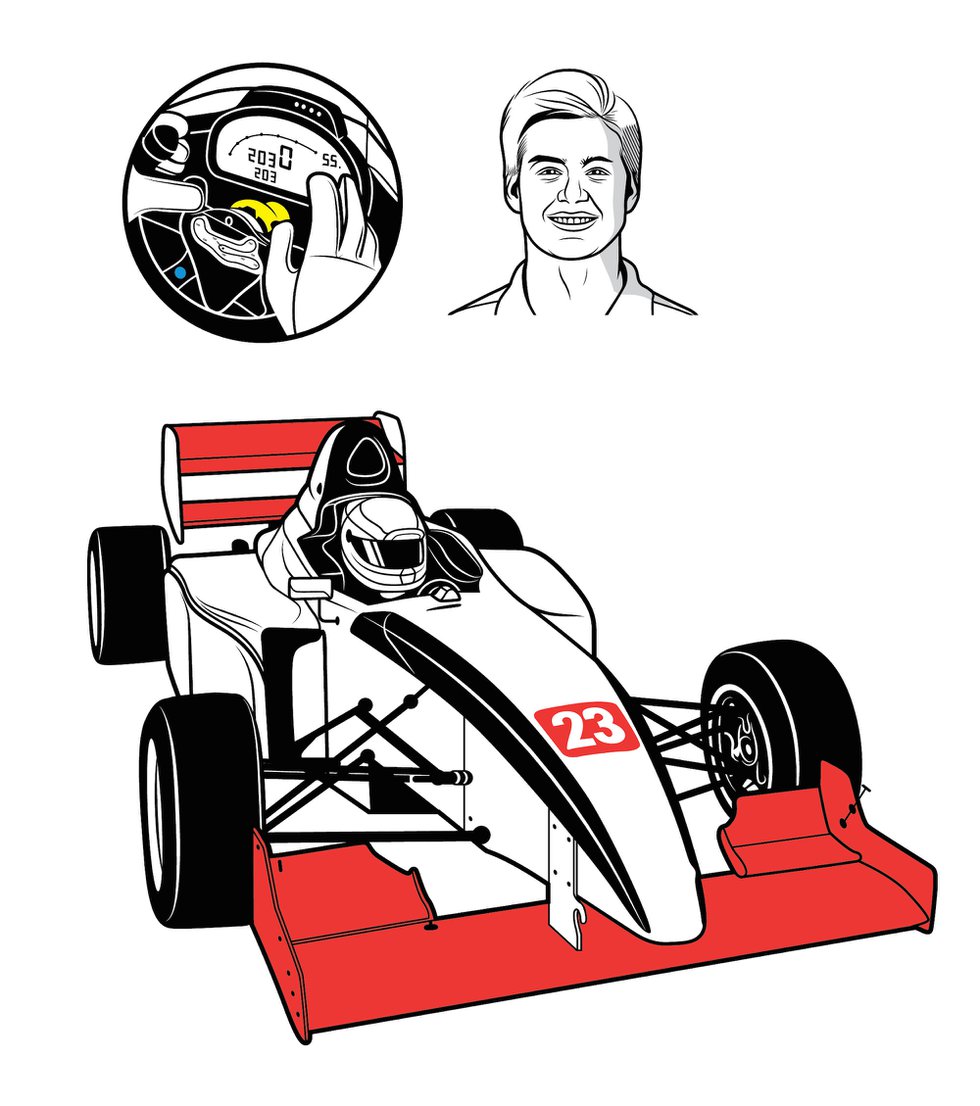
Tristan DeGrand’s racing career began on his seventh birthday, when his father gave him a go-kart. Now 19, the Christian Brothers College High School graduate is quickly climbing the open-wheel Indy racing ladder. After winning Rookie of the Year honors in 2013 on the Canadian F1600 circuit, he took the checkered flag in 18 of 24 starts last year. Now, DeGrand has stepped up to the Pro Mazda Championships, where he plans to compete full-time in 2016. (He finished fourth in his only race this year and is using the rest of 2015 to tinker with his ride and look for a sponsor.) His ultimate goal is a victory in the Indianapolis 500. “If you said five years ago what I was going to do, I probably wouldn’t have believed you,” DeGrand says, “but when you’re there and doing it, that’s all you expect. I’m here to win.”
Engine: The Mazda Renesis, a rotary engine, can generate 260 horsepower and is capable of powering the car to speeds of 160 mph. “It shoots flames and is really, really loud,” DeGrand says.
Are you a CITY SC fan?
Subscribe to the CITY Scene newsletter to get a fan’s guide to the pro soccer scene in St. Louis.
Chassis: In the carbon fiber composite chassis, introduced in 2004, the seat is molded to the driver. This provides the most comfort and safety and prevents DeGrand from moving around and possibly losing focus. He likes to sit as low as he possibly can.
Tires: The car gets super traction with Cooper slicks (no grooves), which prevent sliding in turns. The rear tires are about twice as big as the front ones because the car is so powerful. The large tires give the car more grip on the track.
Brakes: With four alloy calipers pressing on each disk, DeGrand gets double the brake power he had in his F1600 car. He applies as much as 600 pounds of pressure when he hits the brakes going into a turn.
Wings: There are two, one on the back and one on the front. The rear wing acts like a parachute and keeps the car grounded. If DeGrand wants to go faster down the straightaways, his crew adjusts the front wing to be flatter; if he wants better turning ability, they raise it. Changes are made in millimeters.
Dash: The software for the dash includes a gear indicator, as well as gauges for RPMs, oil temperature, and lap time. He also has a dial that adjusts traction control and a rain light switch that turns on blinking lights.
Gearbox: The Hewland six-speed sequential manual transmission allows DeGrand to keep the pedal to the metal while shifting. He calls it a “no-lift shift.” A computer system automatically adjusts the throttle briefly when he changes gears.
Safety equipment: In addition to his suit, gloves, and carbon fiber helmet, DeGrand wears a HANS device—a carbon fiber brace that rests on his shoulders beneath a five-point seat belt and hooks onto the back of his helmet. The straps prevent his head from moving forward or to the side in the event of a crash.