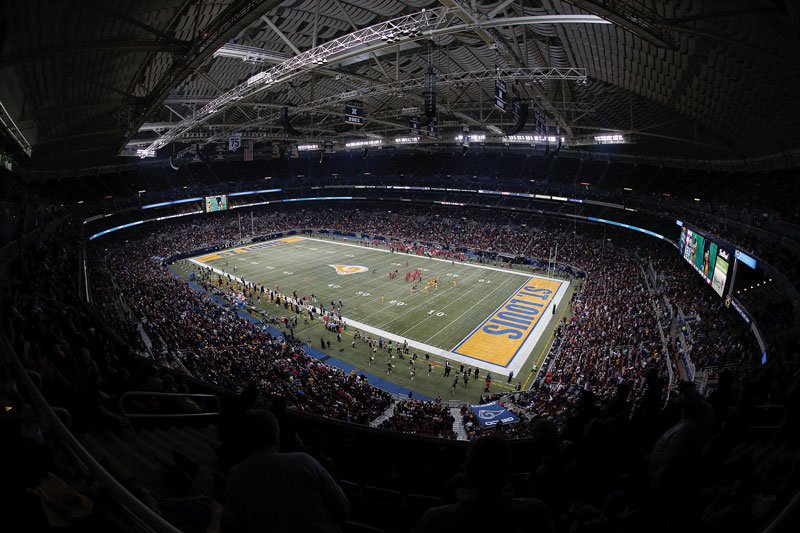
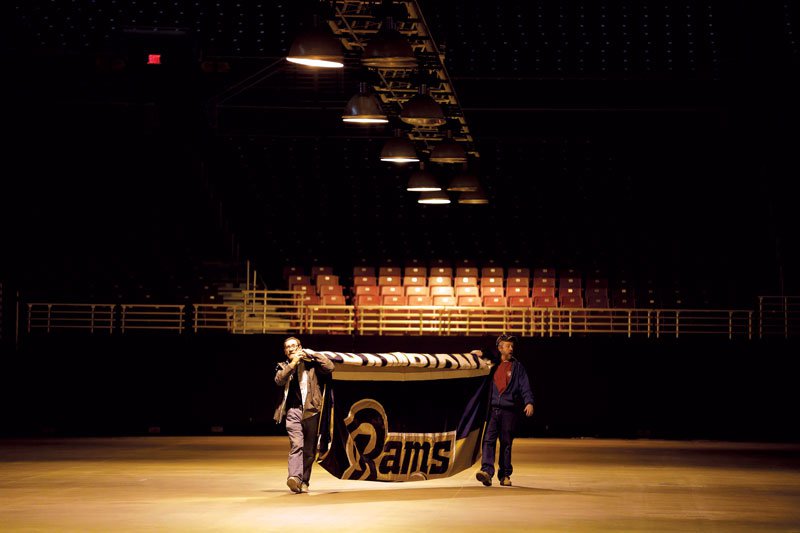
Since the Rams packed their carpetbags and returned to the Left Coast, the dome has become the largest abandoned building in a city already rife with vacant lots and empty houses, all reminders of what might have been or what once was. The dome, once home to the Greatest Show on Turf, will be, this December, the site of the Gateway Dirt Nationals, billed on the dome’s website as the “biggest indoor stock car event in 34 years,” held on a “fifth-mile, semi-banked oval.” Gentlemen, start your engines. The NFL is in your rear-view mirror. Fans, prepare to eat some dust.
The doomed dome’s high-profile days are over. No more aerial views on national television before yet another Rams loss. The Rams are gone. That is not necessarily bad news. Pro football is morphing into the tobacco of sports: Concussions, glorification of violence, dwindling youth participation—all point to the sport’s steady, if slow, decline.
Are you a CITY SC fan?
Subscribe to the CITY Scene newsletter to get a fan’s guide to the pro soccer scene in St. Louis.
For the folks who run the dome, getting out from under the Rams’ lease means that they are free at last from a deadbeat low-rent tenant. The Rams paid a measly $20,000 per game to use the dome. “Whether it was a good idea or a bad idea, the Rams had a slick deal,” says Andy Leonard, chairman of the board for the Convention and Visitors Commission, which runs the America’s Center convention complex, including the dome. Scheduling around the Rams meant that each year from August to January it was difficult to use the dome for other sports, concerts, or convention-related events.
A net increase in revenue from renting the dome to alternative events, instead of the yearly eight NFL games, is an achievable goal, Leonard says. Booking Monster Truck Jams, motorcycle races, college sports, or even hooking an occasional big fish like WrestleMania would eclipse prior revenues. Concerts, too, would rake in more cash, although stadium acts aside from the Rolling Stones, U2, and One Direction are scarce.
But even though it’s now billed as The Dome at America’s Center, using the stadium as an addendum for increased convention and trade shows is not an easy sell. Nationally, exhibit hall space grew to 70 million square feet in 2011, up from 40 million in 1990. That increased space was not met with equivalent demand. In his book Convention Center Follies, author Heywood Sanders dedicates an entire chapter to St. Louis as an example of convention center expansion based on overly optimistic economic projections made by consultants. A consultancy—one that long ago went under—told the city that convention business would double with the addition of a 1,100-room “convention hotel.” Despite the construction of the dome and later the opening of the Renaissance Grand Hotel, “total room nights” went virtually unchanged in St. Louis, from 448,512 in 1996 to 425,411 in 2014. The hotel on Washington Avenue was foreclosed on in 2009, sold for 32 cents on the dollar.
“Convention expansion is sold to cities as economic manna from heaven,” says Sanders, who is professor of public policy at the University of Texas at San Antonio. “America’s Center didn’t come anywhere close to forecasts. That’s not unusual. We’ve had economic downturns, relatively slow growth in the convention business, and a whopping increase in space.”
Jeff Rainford, former chief of staff for Mayor Francis Slay for 14 years and now a consultant, dismisses the academic analysis by Sanders and resorts to the reality of the street. “Our downtown is built around the hospitality industry and sports,” he says. “The rest of us get to enjoy amenities that would not exist without the convention business. We get to enjoy restaurants downtown that would not exist if they didn’t have business from out-of-towners.”
Yet there is no such thing as a free lunch. The CVC has met with city, county, and state officials to discuss upgrades to America’s Center and the dome that could enhance convention business. The costs range from $350 million to $450 million and could be financed with a mix of bonds, taxes, and state allocations. The 30-year note on the dome, which consists of an annual $12 million payment by the state and $6 million each from the city and St. Louis County, expires in 2021.
On July 23, a “Legends of the Dome” game, featuring Isaac Bruce, Kurt Warner, and other former Rams, will be held to benefit Bruce’s charitable foundation. Part of the advertising for the event is the admonition “You won’t want to miss the last game in the dome!” The flag football exhibition won’t be the dome’s last game—there will still be soccer, college football and basketball, and a variety of high school sports.
But things have changed. Spending $720 million in public funds over 30 years to build the dome and then watching the Rams flee has brought with it some harsh lessons. Rainford boils it down: “You deal with the NFL at your own risk. The people who run the NFL are scumbags.”