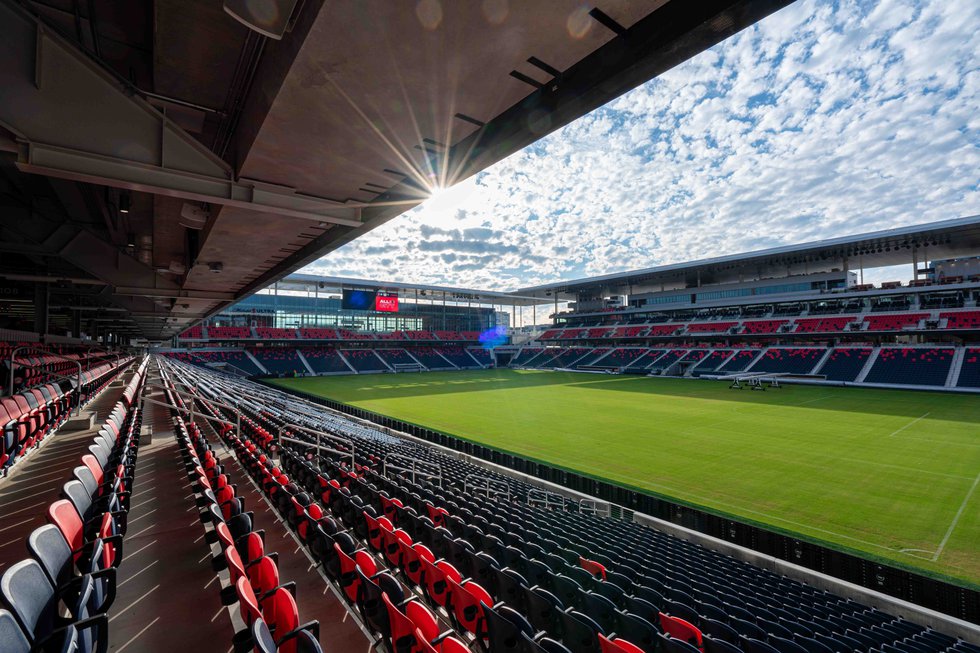
Some days, Josh McPherson wakes at 3 a.m. and reaches for his phone. On those early mornings, CITYPARK’s bleary-eyed director of stadium grounds thumbs through his home screen and opens an app. He’s not checking his email or scrolling social media like the rest of us might do in the middle of the night. Instead, McPherson is looking for answers to questions like:
What is the current root zone temperature of the CITYPARK field?
Are you a CITY SC fan?
Subscribe to the CITY Scene newsletter to get a fan’s guide to the pro soccer scene in St. Louis.
What is the moisture level?
Should I adjust the field’s heat level? Maybe kick it up another five degrees?
Work is never far from his mind, and for good reason. For the past several months, McPherson has been tasked with overseeing one of the most challenging roles in St. Louis CITY SC’s organization. It’s up to him to grow the grass that will serve as the stage for CITY’s inaugural season in Major League Soccer. In Missouri—and in the winter—it’s a job that takes a special set of skills.
And a specific set of tools.
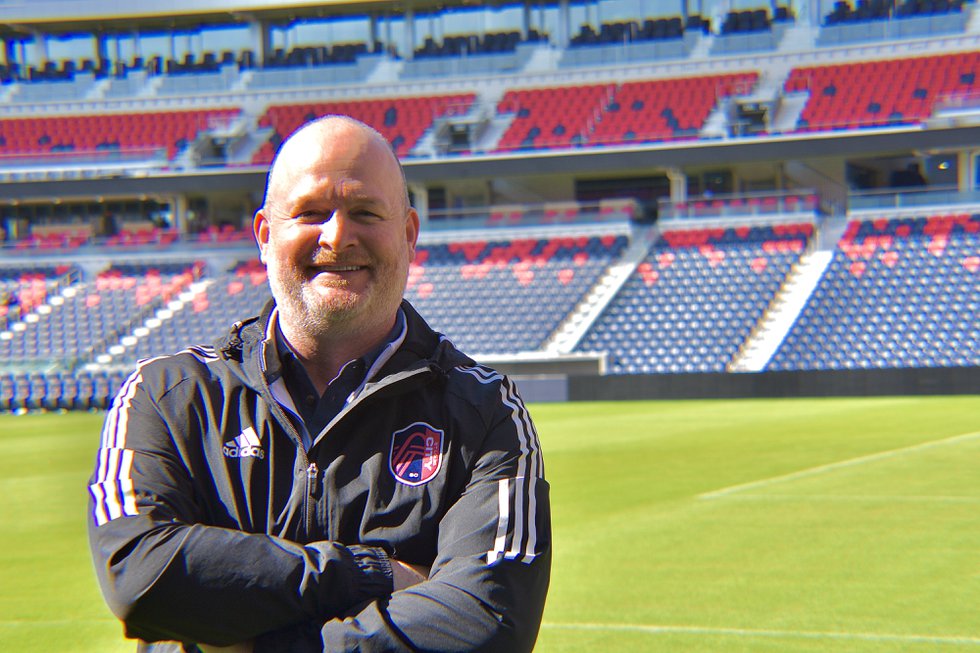
“I always joke that I have like eight or nine apps that I’m always looking at,” McPherson says with a smile. “It’s a blessing and a curse.”
To be honest, McPherson says, it was the equipment that drew him to this role in the first place. He came to St. Louis last year after spending the previous 12 years as the University of Missouri’s director of sports fields. He never really wanted to work in pro sports, but he’d heard that CITY was doing the right things. But to really be sure, when he began talking with CITY officials about the position, there were three things he had to know: Are you doing Bermuda grass? Will the field be heated? Are you buying grow lights?
“They were like, ‘Yes, yes, and yes,’” McPherson says.
For McPherson, affirmative answers were crucial on all three fronts. Missouri is located in what’s known as the transition zone, an area where cold winters, hot summers, and wild temperature changes in between the extreme seasons can make consistent growth difficult. In other words, it’s too hot for bluegrass and too cold for Bermuda grass. However, the latter is a preferred surface among field managers like McPherson, so he knew he’d have to be resourceful. Having expensive tools like grow lights and translucent field covers helps the process.
“My team excels at making the grass play well when the weather’s not the best,” McPherson says. “With Bermuda, its off-time is typically November through February. If you think of an MLS season, we might struggle on the ends a little bit. But the prime of the season is when we’ll be thriving and growing.”
Those prime days, of course, are still weeks away. The grow lights help in the meantime, simulating sunlight to promote healthy growth during the offseason. Six of the eight machines that CITY bought are especially large, hulking fixtures that look like irrigation systems but spread light instead of water. They can be especially bright. When they’re turned on, anyone flying into St. Louis Lambert International Airport will spot CITYPARK awash in gold—even from thousands of feet overhead.
LOOKING FOR MORE CITY SC COVERAGE? SUBSCRIBE TO OUR FREE CITY SCENE NEWSLETTER.
In recent weeks, McPherson and his team of three have made regular trips to the press box atop the west stands to look for brown spots to work out. There are several areas along the south and east sides of the field, for example, that haven’t seen direct sunlight since October. McPherson is eagerly awaiting the third week of April when the sun will be high enough in the sky to touch the entire field. The lighting rigs are just a small part of the process to promote offseason growth. Underneath the sod is a layer of heating coils sandwiched between a 10-inch layer of sand and a four-inch layer of rock. The sand and rock help with drainage.
“When those bad storms came through last summer, that was when we were installing the sod,” McPherson says. “We had a 1,000-year rain event and there was no standing water anywhere. I feel pretty confident drainage is not going to be an issue.”
Although you won’t find him in a CITY uniform this season, a case could be made that McPherson is equally as responsible as any player for making soccer in St. Louis a beautiful game. Just as it is Roman Bürki’s job to stop shots, João Klauss’ task to score goals, and Eduard Löwen’s responsibility to drive play through the middle of the field, it is McPherson’s mission to prepare the canvas on which they will work.
“Making things smooth and flat calls to my obsessiveness of it,” McPherson says. “I love seeing that perfect pass and seeing how the ball is received. I’ve always loved the idea that I’m making this perfect surface.”