It came to a head over weeds.
For some months, neighbors in a pretty patch of Benton Park had been discussing the way the area was changing.
Get a fresh take on the day’s top news
Subscribe to the St. Louis Daily newsletter for a smart, succinct guide to local news from award-winning journalists Sarah Fenske and Ryan Krull.
All the hallmarks of a beautiful, historic St. Louis neighborhood are there: big trees that shade portions of the street; narrower streets than the adjacent Benton Park West just across Jefferson Avenue; and stately brick buildings, complete with the iconic stars affixed to 19th century edifices.
Neighbors had grown concerned about Senate Square, said to be the biggest single-owner apartment complex in the neighborhood. After the 100-unit development was bought by a New York-based firm in 2022, complaints multiplied.
Many units have emptied out since the purchase, and some are now in such bad shape that the city has barred entry, with condemnation notices and boarded-up doors—some now pried open. Elsewhere, parts of buildings have been left vulnerable, with crawlspaces left unlocked and doors ajar. Predictably, squatters have noticed. Overall, neighbors around Senate Square worry that continuing on the same trajectory could destroy historic buildings that for years allowed a more affordable rent than nearby homes.
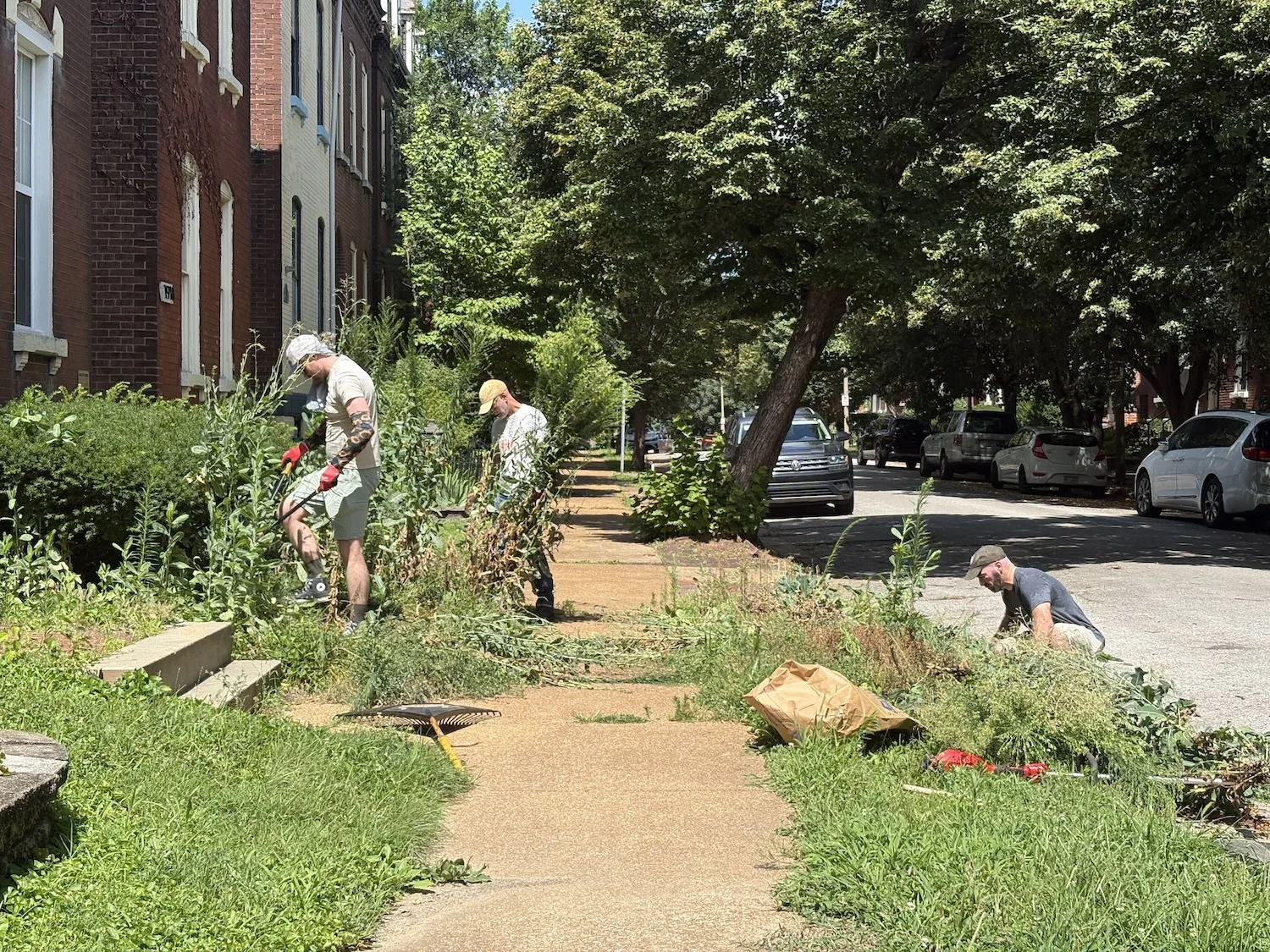
Some neighbors hatched a plan to address the most visible part of the problem in mid-July. Weeds in some areas were growing taller than your average person. And so the neighbors called in the Lumberjacks.
The crew of Benton Park volunteers, which cares for greenery in the eponymous park, came to Senate Square on July 18 to cut down the grass and weeds along the four streets.
While many neighbors agreed that cutting the overgrown grass was long overdue, not all wanted it to happen that way. As Kendah El-Ali described it, the move was “controversial.” Some thought that removing the weeds, a visible sign of the issues they’re having, removed a key tool they had to illustrate the problem.
“It’s like the Olympics in Rio,” says Sergio Reinert, a Benton Park resident who was born in Brazil and now lives next to some Senate Square properties. “You keep all the homeless guys from the center of where the tourists are going to be. This whole city looks nice; the problem is still there.”
Says Reinert, “I prefer this messy because the eyesore is what gets the people motivated.”
Part of Benton Park’s renaissance
Senate Square does not look like your typical apartment complex. It’s not a collection of faux-townhomes with a parking lot, or a high rise. Rather, Senate Square is a collection of historic 19th century rowhouses spread out amongst the typical single-family homes one associates with Benton Park—only instead of selling for $300,000 or $400,000, they’ve all been absorbed into a single owner and, until recently, rented quite reasonably.
Many of the rowhouses contain multiple units. Green placards with white text mark apartment numbers; some have a gold emblem on the side that says “Senate Square.”
The roughly 30 buildings that make up the development are spread out across four streets within a single block along the picturesque streets of Sidney, Senate, and Congress, all east-west streets just west of Soulard and Interstate 55. A few also sit along the north-south Salena Street.
Benton Park has a storied history, and the Senate Square apartment complex became part of that in 1979. “The Senate Square Apartments were created from the rehabs of run down properties owned by absentee landlords,” local Realtor Dan Brassil wrote in a blog post that does double duty as a sales pitch for potential homeowners and a history lesson.
The neighborhood was changing in the 1980s, which Brassil attributes in part to tax credits for historic rehabs. Venice Cafe opened in 1988, Frasers in the early 1990s. And, right near Senate Square, Sidney Street Cafe opened in the early 2000s and Peacemaker Lobster and Crab in 2014.
“People around here go to great lengths to maintain their property, whether they own or rent,” says Elliot Liebson, a planning and zoning professional who’s lived in the neighborhood for more than 15 years.
‘Ghost town’
For years, the Senate Square buildings appeared to be in decent shape. One resident recalls that in the middle 2010s, Senate Square was brimming with young, Black professionals, a veritable community of friends and family.
But in just a few years, neighbors say conditions have declined sharply. Concern about the out-of-state owners and their control over the complex has started a conversation among neighbors about what they want their neighborhood to look like.
Kelly Eldridge, who lives with her husband in a large home adjacent to one of Senate Square’s densest streets, says the economic diversity is part of what drew her there, along with the rich architectural history.
“I love living next to mixed use; I love that there is an apartment building with multiple families mixed in with people who own their homes; that was a draw to me,” she says. “I want to live in a mixed community, and we just loved that fact about Benton Park. We loved the historic homes. We loved the old brick, the history of the neighborhood.”
But things have changed since they moved in two years ago.
“Everything was still mostly taken care of,” she says of 2024. “Some of the buildings probably could have used a little bit of work, but it wasn’t like it was that bad. [Now], when you walk down Sidney, I mean, it just looks awful. It looks really bad. There’s a lot of damage to the windows, you can see water damage.
“We liked that it was going to be a dense little area with the apartments and the houses and the walkability, and now it’s like … a ghost town,” Eldridge continues. “There’s hardly anybody that lives on that street anymore. Like, a handful of people, and that’s not what we wanted when we lived here.”
El-Ali says the streets were looking unkempt, she sometimes noticed strangers she didn’t recognize hanging out during the day, and the area also seemed emptier than you’d expect it to be. Some doors have clearly been boarded up, though some have the boards pried off. Multiple units lack a deadbolt, and can be seen ajar.
A particular inflection point for Eldridge was a persistent leak in the basement laundry room of a building adjacent to her house. After taking out the trash one day, she says, she could hear the sound of running water from the door to the laundry room, which is frequently left open. (After she alerted the manager of Senate Square, she says, the city ultimately shut off water to the building.)
“It was almost like the dam broke and everything just went from looking maintained to looking not maintained at all,” she says. “Then we started getting a lot of people coming into the neighborhood and breaking into the house and squatting in some cases.”
That unit was subsequently boarded up with a crude patchwork of wooden boards, which she says looked like “something on the Looney Tunes.”
Living there
Tenants, too, say there have been more problems. A recent Senate Square resident who asked not to be named listed a litany of issues during their two-year stint there. They left in August.
They had moved in with high hopes. “Whenever I checked them out, they had originally been all redone, like all new flooring, all new paint, all new appliances,” the former resident says. “So whenever I moved in, my apartment felt brand new.”
Some of the issues they encountered were simple, external ones, like derelict, undrivable cars left in the parking lot, they say. At one point, they say trash piled up for months, even as the grass went unmowed. “The trash had not been taken care of for months on end, and I noticed neighbors were even commenting on the Google reviews, all of the problems that they were having,” they say. “Just in this last year, probably since last August, I have just had like one thing after the other after the other after the other.”
They say their air conditioning was out for months, from the height of the summer until the end of that year. When maintenance finally came, they thought they were there to fix the heater. “The people came in here, and they’re like, ‘Oh, what’s wrong with the heat?’ And, I’m like, ‘Nothing’s wrong with the heat. It’s the air conditioning that’s been out for months.’”
Even something as simple as renewing a lease proved complicated. After renewing under a prior property management firm in May 2025, they were told that August that “it must have got lost in translation,” they say, and the new company had no record of them. They eventually negotiated a shorter term lease this year, after a few months of silence on both sides.
Others may well have given up. “Whenever I moved here, I had plenty of neighbors, it seemed like every unit, at least within my distance of me, was full, and I would chat with the neighbors because my dog’s a great conversation starter,” they say. “I would chat with them quite a bit. But, now there’s like nobody that you know hangs out outside, and I would assume they’re all vacant.”’
Former Senate Square tenant Jessica Cartier posted a warning on her TikTok page last September. “If you live in the St. Louis area, and you’re thinking about looking at Senate Square apartments, don’t,” she says in the video.
Throughout the video, Cartier gets emotional over the protracted damage. “I have been having my ceiling leaking since October 2024.” In the video, which clearly shows a hole in the ceiling. “They’ve ignored me, they haven’t fixed anything,” she continues, welling up with tears. “I wanna show you what … almost a year of water damage has done to my fucking ceiling in my townhouse. This, look at this shit.”
Cartier tells SLM she repeatedly asked the city for help, and even had a city worker inspect her home, but heard nothing before she finally left for good in May. (Before that departure, she says she was moved to another unit that was better than the one depicted in her video.)
She says she saw squatters around, and had water damage even before the hole in her roof. “It was stressful for sure,” she says.
Cartier says the conditions in her unit led her to withhold rent at points, which led to the property owners filing to evict her. She ended up with a settled payment plan. (Court records show that an eviction petition was filed in February, but dismissed in early March by an attorney for the company that owns Senate Square.)
“Myself and my daughter are asthmatic, we can’t live like this,” she says of the conditions there. They’ve now moved in with family members.
Trouble with accountability
The Business Journal reported that an Ellisville real estate firm sold Senate Square, along with four other apartment complexes, to New York-based David Stern Management in 2022. After the sale, multiple sources say, rents increased dramatically, with one saying rent asks went up to around $2,000 for a unit that previously cost closer to $800. Suggesting the market couldn’t bear those prices, they later went down: Senate Square’s website lists its largest unit at $1,650, and its cheapest one-bed unit at $1,000.
Reinert and El-Ali have both done extensive research looking into the goings-on at Senate Square. After Reinert grew frustrated with a situation involving the dumpster behind his property, he dug into Missouri court records and traced the ownership of the complex.
It wasn’t easy, and who exactly owns Senate Square isn’t obvious. City records show the units are held by a series of shell companies, most often one called ST LOUIS 5 2022, which was at one point registered to the CEO of David Stern Management, David Shemano. The apartments appear to be managed in part by a firm called Aurox Equities; its branding sits plainly on the Senate Square website. Aurox oversees a few places in St. Louis and reportedly $1 billion worth of property elsewhere, per its LinkedIn page.
A clue to the business relationship between Shemano and Aurox lies within the minutes of a July government meeting in Memphis. The man listed as Aurox’s owner, Isaac Perlmutter, described how their property investments worked.
At least in some cases, Shemano owned the properties, but Aurox was an investor.
“For certain properties, funding comes from Aurox Equities, and other properties, there are funding reserves with the lender,” the minutes read. “Perlmutter stated that with Country View, the funding is coming directly from Aurox Equities, and it is very difficult to invest money in a property that you do not own, and there is no legal recourse for the money that is being given.”
In Missouri, Shemano transferred ownership of ST LOUIS 5 2022 to David L. Shores in 2024. In another Memphis meeting’s minutes, a David Shores is listed as a potential—though ultimately unsuccessful—receiver for a troubled property involving Shemano and Perlmutter.
Whether Senate Square properties are in receivership is not clear. Shemano did not respond to an email asking for clarity on the ownership of Senate Square. There was also no response to a message left on the official Senate Square phone line. SLM was not able to identify a way to reach Shores, who did not use a personal address in records filed with the secretary of state.
Going to court
In early July, a legislative assistant for Ward 8 alderwoman Jami Cox Antwi emailed some Senate Square neighbors.
“As of now, the City has initiated active legal action against half the units in Senate Square. This is just the start. There is more to come, and I will share further updates with this group as soon as I am able,” they wrote on July 6, adding that residents should continue to file reports with the Citizens’ Service Bureau or call the police’s non-emergency regarding activity at Senate Square.
Missouri court records show the City of St. Louis has filed more than 30 municipal court cases against ST LOUIS 5 2022 LLC and other firms that hold Senate Square properties. All of them appear to be for a “minimum housing standard violation” at a Senate Square unit.
The firm was ordered to appear in municipal court in St. Louis on September 10. Nobody showed up, leading to a warrant for failure to appear for ST LOUIS 5 2022 LLC in more than a dozen of the cases. There is no attorney listed on Senate Square’s behalf in those cases.
Local eviction attorney Matthew Chase has handled some eviction cases for Senate Square’s owners in recent years. Chase said he wasn’t able to discuss specific concerns regarding Senate Square, but acknowledged that he’s handled a few cases for its owners. (Chase said his client had declined comment, and Chase himself did not respond to a detailed list of questions regarding Senate Square.)
“If a company owns several properties—and the Senate Square ownership, they own several properties—they are working to make them better,” he tells SLM. “It is an uphill battle. They are swimming upstream.”
St. Louis, he adds, is an “unusual market.”
“There is a culture of non-payments in St. Louis,” he says, adding that the way laws are written in Missouri, tenants sometimes can return with lawyers after agreeing to a payment plan and breaching it. This makes the eviction process much longer, he says.
“The way the system is, there’s all these built-in delays that tenants can do, but at the end of the day, the landlords are hurting,” he continues, adding that it might seem unsympathetic. “Now, I know your readers are not going to feel any sympathy. The reality is that many of their friends and neighbors work in property management.”
Multiple Senate Square properties are now tagged with notices from the city. Some of them appear condemned and boarded up, though the condemnations are scattered between other, typical units.
“[We are] trying to find the appropriate path to go after as many of the negligent and bad actor out-of-state landlords as possible,” Antwi says. “That’s always been our ultimate goal. We want to make sure we preserve the viable aspects of the property to keep as many residents as we can in the 8th ward. But we don’t want to continue to allow the units that are causing a problem to continue to cause a problem.” She says the city is looking to pursue a “broader lawsuit” against the out-of-state landlords.
But holding property owners accountable can be difficult when they consist of LLCs and tangled investor relationships.
Liebson, who previously worked as a neighborhood stabilization officer for the city, recalls having a problem with a landlord based in Belleville. “He wasn’t answering my calls. He wasn’t answering my emails,” he says. “So… I put my badge on, I drove to his house and knocked on his front door, and that did the trick. He did not like that the City of St. Louis building officials were coming to his front door.” That trick, however, doesn’t work so well when the property owner isn’t just across the river, but in New York City.
Searching for next steps
On September 1, Antwi met with the Benton Park Neighborhood Association. There, she detailed the path forward for the many pending city actions involving Senate Square units. Residents were handed a packet with a list of Senate Square addresses, respective statuses in the city’s action pipeline, and the deadline the owners have to repair inspected damages.
Once the deadlines pass, and if issues aren’t remedied, the city could levy fines. Unresolved violations will start racking up fees, and the number of offenses could compound every day things aren’t resolved. Further on, that could mean citations, a special tax bill for the owners, or potentially a lien, the document says.
El-Ali has vented her frustration with her experiences dealing with the city. When she was living in Lafayette Square, for example, she had frequent run-ins with young car thieves, sometimes nicknamed “Kia Boys,” who abandoned stolen cars in front of her home, and wasn’t pleased with the city’s response.
But after Antwi communicated thoughts about the path forward that day, El-Ali seemed more optimistic about the city’s responsiveness.
“I feel like the collaboration and all the pieces are starting to come together,” she tells SLM. “The awareness is there. It’s been really interesting, much more successful than I thought it would ever be. Collaboration between the neighborhood and the city, like they are actually working with us. They need us, and we’ve been able to provide them what they need.
“My experience has been either you’re calling 15 times for the same stolen car dumped on your front lawn and nobody comes, or the city doesn’t have the time and ignores you, or you’re told that your problem’s not big enough, or you’re told that your crime isn’t perfect enough. I feel like that’s the most malignant part of this reactive system that we’re in, and that is really no longer the world we’re operating in … there’s a good momentum.”
The city’s actions may have finally gotten the attention of the buildings’ owners. On September 1, a neighbor witnessed two people removing the boards on some condemned Senate Square properties. One was wearing an Aurox T-shirt. The other told the neighbor they were hired by a bank to look at the properties. They later replaced the boards.
Neighbors can’t help but wonder if their efforts are finally paying off. They emphasize that their issue lies with the management of the properties, not the remaining residents of Senate Square.
“I want it to be very clear, I’m not going after apartment dwellers,” Eldridge says. “I’m not going after people who live in apartment buildings. I love that; I think that’s great. I’m going after the owners who are neglecting these.”
The situation has started, among neighbors, a conversation about what they want property ownership to look like. Who gets to rent in my neighborhood? What should the cost of housing be? How can the levers of power be used to facilitate an economically diverse population?
“I’d love to see these buildings potentially sold to people who want to be a great property owner and take care of the buildings—or restore the buildings to their original beauty–-and then have renters that can have a decent home,” says neighbor Katie Taylor. “I think it’s unmanageable to have so many buildings under one ownership, especially someone who lives out-of-state and is not invested in the area.”
Lori White, the vice president of the Benton Park Neighborhood Association, sees rental housing like Senate Square as critical to the neighborhood’s identity, a key piece in keeping it a place for artistic people. “This is where the musicians live,” she says.
She recalls that the decision to call in the neighborhood group to cull weeds came after months of mounting frustration. The idea was to at least address one visible issue while other avenues took time.
“Ultimately, if we let this go, then now we’re a target,” she says. “So, I’m hoping to at least get into the rumor mill in Brooklyn. Like, ‘Don’t try Benton Park, it’s annoying.’”