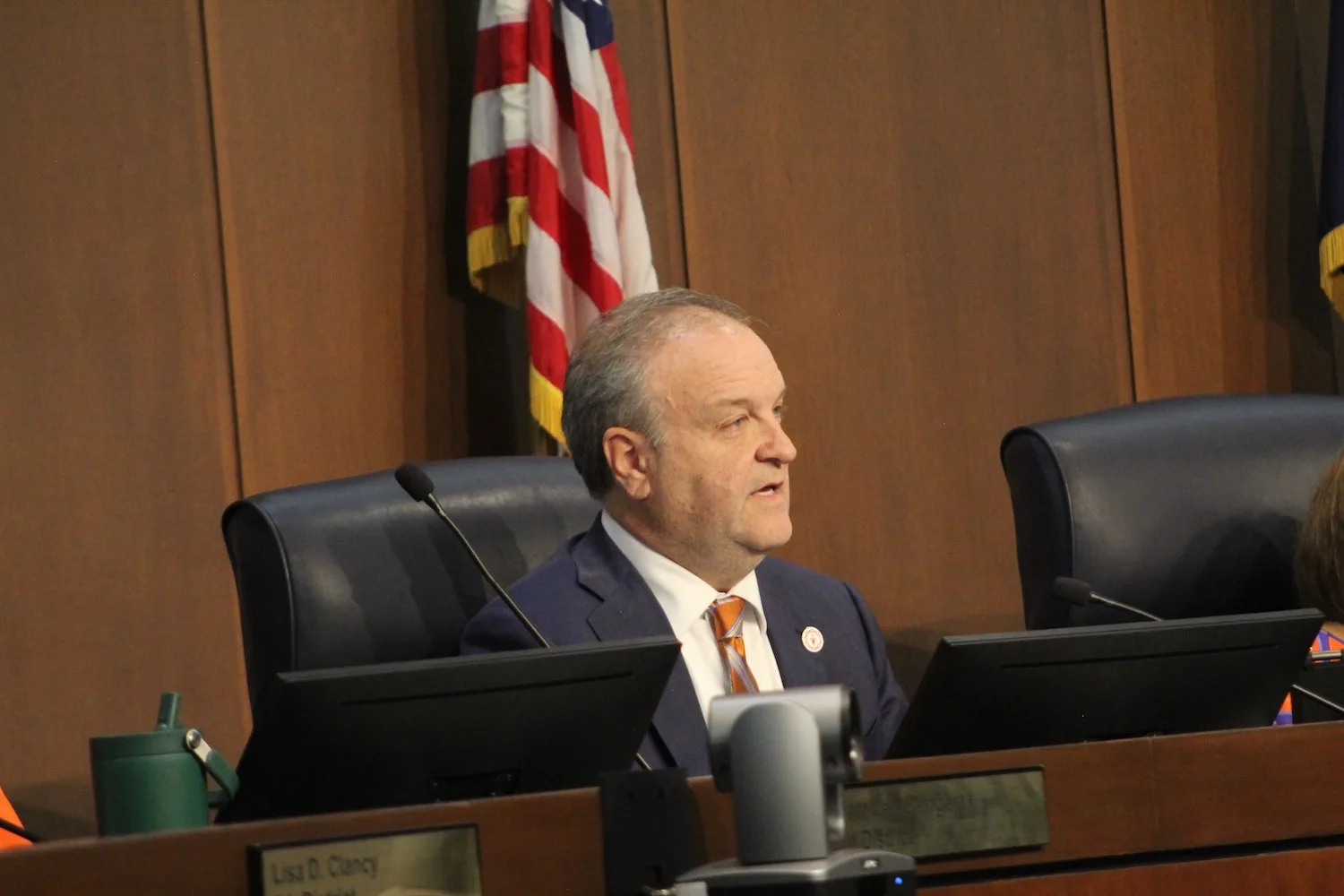
Attorney General Andrew Bailey announced yesterday that St. Louis County Executive Sam Page had been indicted on four counts, including two felonies, over charges that he used county funds to send a postcard to voters.
The postcard provided information about Prop B, the ill-fated initiative that would have allowed the county council to fire department heads. Page has defended the use of county assets as a permissible public education campaign. Bailey says it is instead the theft of taxpayer money.
Get a fresh take on the day’s top news
Subscribe to the St. Louis Daily newsletter for a smart, succinct guide to local news from award-winning journalists Sarah Fenske and Ryan Krull.
Bailey’s prosecution stems from a complaint filed by University City-based watchdog Tom Sullivan, who unearthed county expenses of $4,999.55 for printing the mailer and another $30,771.44 for postage. The grand jury yesterday returned indictments on two counts of stealing by deceit and two counts of election law violations.
Sullivan estimates he’s filed at least 20 similar complaints against various election-related expenditures by government entities, including many in St. Louis County. Very few, he acknowledges, have been taken seriously.
“It’s a whole big issue that’s generally been ignored,” he says. “I’ve often felt that St. Louis County is probably the state capital for what we’ve had for so many years with this particular part of the law.”
Historically, Sullivan says, he’s complained to the Secretary of State, who has then referred the cases to the local prosecuting attorney. In this case, St. Louis County Prosecuting Attorney Melissa Price Smith recused herself, sending the matter to the county’s presiding judge, who appointed Bailey special prosecutor—with perhaps predictable results. The Republican AG has a demonstrated interest in high-profile meat for his base, and Page, a Democrat, is the bête noire of many conservatives in St. Louis County.
Typically, Sullivan says, prosecutors have simply failed to take any official action on these complaints. He ticks off a long list of complaints that went uninvestigated by everyone from former county prosecutor Bob McCullough to St. Louis Circuit Attorney Jennifer Joyce. “I can assure you, if Wesley Bell had still been a prosecutor and it was sent to him by the Secretary of State’s Office, he would have sat on it,” Sullivan says.
A rare exception was St. Louis Circuit Attorney D. Joyce Hayes, who forced St. Louis’ then-fire chief to pay back the funds he’d used to send a mailer about a bond issue. In another instance, Sullivan filed a civil lawsuit against the University City library district for a similar expenditure, only to see the lawsuit dismissed for lack of standing.
He acknowledges that he was surprised to see the matter lead to felony charges. Does he support those charges? “In other parts of the country, they send people to prison for this sort of thing,” he says. “Here, they say it’s just a regular deal.”
Criminal defense attorney Terry Niehoff says he’s handled hundreds if not a thousand stealing cases in his 30 years in practice. He isn’t convinced that the conduct Page is accused of meets the criteria for felony stealing. He says that Page had the authority to OK the expenditures, so it’s unclear how they’d be considered unauthorized. He also says he’s unsure how the attorney general will prove Page knowingly committed a crime. “They’re saying he took this by authorizing the spending of the money to send out the flyers, knowing that he’s not authorized to do that, when, in fact, he was authorized to do that.”
Adds Niehoff, “I don’t know how in the world that can be a stealing. I’m sure it has nothing to do with politics, at all.”
Defense attorney Scott Rosenblum defended previous County Executive Steve Stenger on public corruption felony charges, for which Stenger was ultimately sentenced to almost four years in prison. Rosenblum says that the charges against Page are of a much different, lower order than what Stegner faced. He compares them to a secretary at a law office sending wedding invitations out using the office’s postage. “Would we turn her into the police? Probably not.”
Rosenblum isn’t as skeptical as Niehoff about Page’s actions meeting the criteria for felony stealing. He describes Page’s alleged conduct as falling into a “gray area” and predicts an intense fight ahead. “It’s a whole new landscape out there,” he notes. “If you take the President Trump approach, you take a pretty aggressive approach, right?”
Adds Rosenblum, “In these situations, I don’t see anybody pleading guilty. It wouldn’t be the best thing for their political career and probably be the end of their reign.”
Page is scheduled to be in court for arraignment on Aug. 29.
In 1976, the California Supreme Court explored a case alleging the director of the California Department of Parks and Recreation had wrongfully misspent $5,000 to promote a bond issue. A civil lawsuit had sought to force the director to personally repay the funds.
The court gave the suit the go-ahead, finding, “A state park department’s use of public funds to finance an election campaign in favor of a park bond issue may, at first blush, seem like a quite innocuous, and perhaps even salutory, practice. But, as the United States Supreme Court cautioned nearly a century ago, ‘unconstitutional practices [often] get their first footing’ in their ‘mildest and least repulsive form.’ In our polity, the constitutional commitment to ‘free elections’ guarantees an electoral process free of partisan intervention by the current holders of governmental authority or the current trustees of the public treasury.”
The decision noted an important caveat: “Although the department did possess statutory authority to disseminate ‘information’ to the public relating to the bond election, the department, in fulfilling this informational role, was obligated to provide a fair presentation of the relevant facts.” Sullivan, for one, has sought to illustrate the way the county’s mailer on Prop B didn’t do that. And Bailey, clearly, believes the mailer crossed the line.
“I conducted this investigation into Sam Page’s alleged misuse of public funds because the people of St. Louis County deserve accountability, not corruption,” Bailey said in a statement. “Public officials must follow the law, and my Office will work to ensure that they always do.”