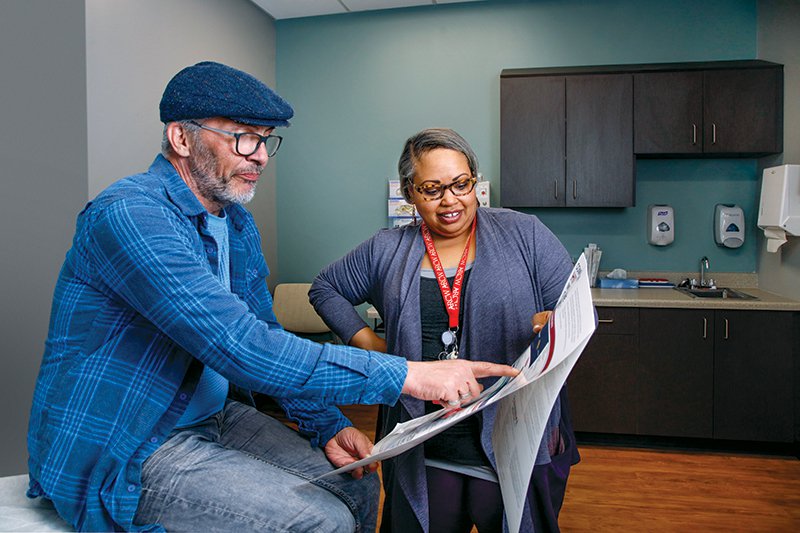
Tawnya Brown hasn’t been to a funeral in a while. It’s a powerful statement for the VP of operations at Saint Louis Effort for AIDS, who began her career in 1997. Back then, an HIV diagnosis meant taking handfuls of pills multiple times a day with unpleasant side effects. And Brown was attending funerals regularly. Now, most HIV patients take one pill daily, and those who are diagnosed early and stay in care live into their seventies. But Brown’s work isn’t over. Soon, to more fully address patients’ needs, EFA will change how it cares for people. This new HIV Medical Home model is the only one like it in the state.
About 6,200 people in St. Louis live with HIV, but just 54 percent are receiving medical care. “What’s evident in the data over the last 20 years is that HIV has a disproportionate impact on people with low access to socioeconomic resources, and what then overlies that population is inconsistent or lack of access to health care,” Brown says.
Get a fresh take on the day’s top news
Subscribe to the St. Louis Daily newsletter for a smart, succinct guide to local news from award-winning journalists Sarah Fenske and Ryan Krull.
EFA already offers free HIV and STI testing four days a week, plus 20 case managers, seven exam rooms, and an onsite lab. Brown leads a tour of the sunny building on Locust, her tone light as she shows off the condom supply room (“Every size, flavor, and color”) and more serious when she explains the wraparound services that will soon be rolled out. A mental health suite, dental office, and food pantry will open, allowing EFA to address not only a patient’s most direct medical needs but also factors that make it difficult for someone to live with HIV. Most people with the disease whom Brown serves don’t have access to dental insurance, which is important because there are connections between oral health and overall health—and HIV can have manifestations in a patient’s mouth. And food? Another basic that patients sometimes don’t have.
The wraparound services are important, Brown says, because many HIV patients aren’t only thinking about how to get access to a doctor for treatment: “Many of us have never had a time where we didn’t have access to transportation, to a doctor, to food in the house, to a stable home—most of us have never had to think about those things and then deal with a disease. A lot of people with HIV are thinking about those things all the time and have to deal with a disease.” To access services, many patients have to go to multiple places, using up what little resources they have in the process. With this new model, plus a combination of routine-based testing and a regimen of PrEP, a medication that lowers the chance of infection in those at risk for exposure, Brown envisions a future in which all people living with HIV in St. Louis achieve an undetectable viral load—meaning that they can’t transmit the virus.
Mitchell Ballesteros-Lynch, a patient, compares EFA’s ease of access to urgent care. “They work alongside you, and as much effort as you’re going to put into it, they’re going to match that,” he says. “They’re going to do everything they can to keep you moving forward.” He has a community nurse, health coach, and case manager. He can text one a question, and by the time he’s taking a break at work, he has a response.
One thing that still surprises Brown is when she encounters people who don’t know that this system of care exists, which would be essential to getting every HIV patient in St. Louis to an undetectable viral load.
“Leave aside that we’re about to transform HIV care in the St. Louis region because of this model,” she says. “They don’t know that there’s a system at all. We’re decades into this and we still haven’t done a good enough job of letting people know that there’s support, that you don’t have to be scared? There’s more work to do.”