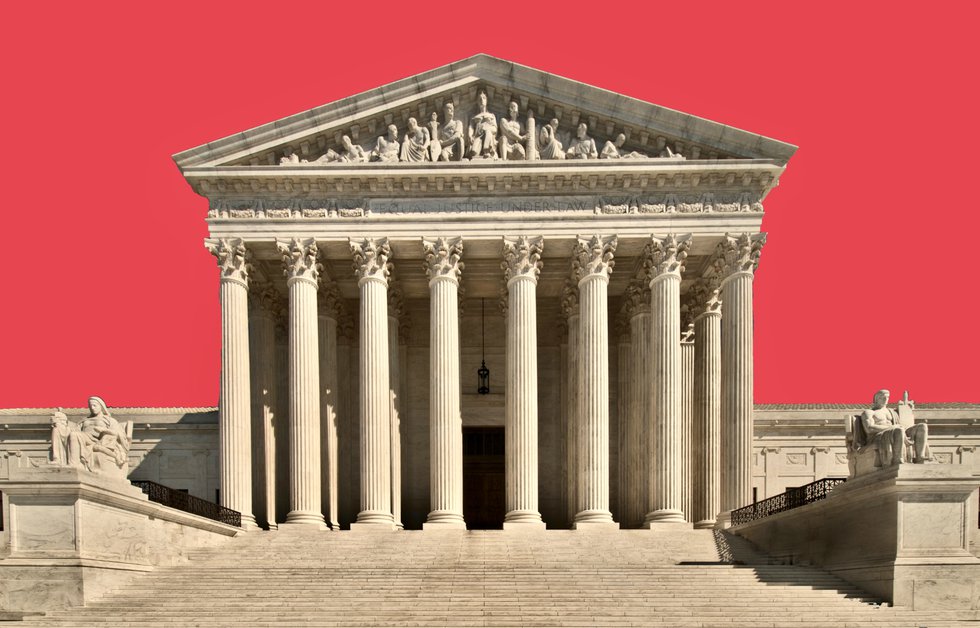
On Friday, in a historic decision, the United States Supreme Court overturned the 1973 landmark ruling Roe v. Wade, ending 50 years of constitutional protections for abortion.
In a 6-3 ruling in Dobbs v. Jackson Women’s Health Organization, a case that considered the ban of abortions after 15 weeks of pregnancy, the court decided that the Constitution does not confer a right to abortion. “Roe and Casey are overruled; and the authority to regulate abortion is returned to the people and their elected representatives,” the decision reads.
Get a fresh take on the day’s top news
Subscribe to the St. Louis Daily newsletter for a smart, succinct guide to local news from award-winning journalists Sarah Fenske and Ryan Krull.
In Missouri, the court’s decision had an immediate effect. That’s because in 2019, Missouri passed House Bill 126, which contains a trigger ban, a ban on abortions that goes into effect “after the state’s attorney general, governor or other specified official certifies that the central holding of Roe has been overturned in whole or in part.” On Friday, both Missouri Attorney General Eric Schmitt and Governor Mike Parson issued those proclamations, effectively outlawing abortion in the state of Missouri except in cases of medical emergency.
On Friday, Gov. Parson said, “Today, our efforts have produced what generations of Missourians have worked and prayed for: Today, we have won our fight to protect innocent life.”
In Missouri, medical emergencies are complications that endanger the life of the pregnant person or put them at “serious risk for substantial and irreversible impairment of a major bodily function.” There is no exception for rape or incest.
Under the trigger law, anyone who knowingly performs an abortion when no medical emergency is needed can face five to 15 years in prison. The prosecuting attorney of each Missouri county will also have the power to decide if the physician will be charged for performing the abortion. However, people seeking or receiving abortion care cannot be prosecuted.
In regard to abortion pills, Missouri law requires that the initial dose must be done in the physical presence of the physician who prescribed or dispensed the drug or chemical. After the initial dose, the person must make a follow-up appointment with the physician.
For St. Louis residents seeking safe access to abortion care, Illinois will continue to protect abortions under the 2019 Illinois Reproductive Health Act. There are two clinics near St. Louis where people can still access reproductive health services: the Hope Clinic for Women in Granite City and Planned Parenthood of the St. Louis Region’s health center in Fairview Heights.
Missouri’s only Planned Parenthood clinic that offered abortions before the trigger law went into effect is located in the Central West End. It is planning to host a rally outside its clinic Friday at 6 p.m.
Planned Parenthood of the St. Louis Region and Southwest Missouri issued the following statement on Friday:
“Today is the worst case scenario for 36 million people of reproductive age who live in 26 states including Missouri where abortion is now poised to be banned. Everything that led to the overturning of Roe should be a stain on our history from which we must learn and do better. This begins a rebuilding of a future with abortion equity — not just rights or access, but rights and access for all people. From this day on, we cannot accept compromise, middle ground, or ‘good enough’. We must demand a system that creates abortion access for all people who need it, no matter their identity, insurance status, or zip code.
“Reproductive Health Services of Planned Parenthood of the St. Louis Region joins our partners in committing to re-building this system, for as long as it takes. We’re not going anywhere. We’re just getting started.”
At an afternoon press conference, Planned Parenthood of the St. Louis Region and Southwest Missouri said that it was preparing for an increase in patients—to about 14,000 people annually—at its Illinois clinics and urged officials to declare a public health emergency. Over the last couple of months, Planned Parenthood has been increasing staffing at Illinois clinics in anticipation of out-of-state patients.
Locally, St. Louis Mayor Tishaura Jones called on Congress to codify Roe v. Wade and said that “as mayor, I will fight like hell to protect reproductive healthcare and get St. Louis families the support they need.”
St. Louis County Executive Sam Page released a statement that: “Rolling back Roe triggers a major public health crisis in Missouri, where our state legislature has already discussed some of the most extreme laws in the country. Abortion should be legal, safe, accessible, and affordable.
“Therefore, our health department will consult with every abortion provider and use every resource of St. Louis County government to ensure County employees and residents have access to the services they need to stay healthy.”
U.S. Rep. Cori Bush, who represents Missouri’s 1st District, which includes St. Louis, was at Planned Parenthood in the Central West End on Friday after the Supreme Court decision came down.