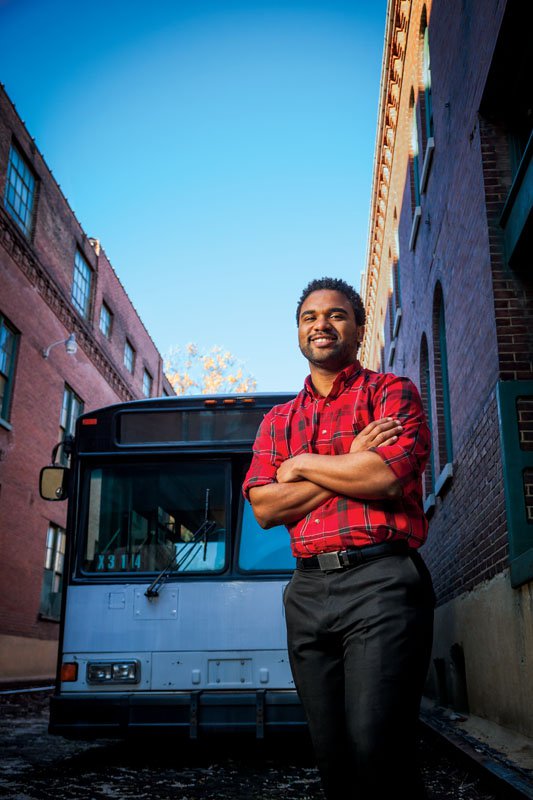
Saint Louis University medical student Jeremy Goss and recent Washington University graduates Tej Azad and Colin Dowling are the co-founders of St. Louis MetroMarket, the area’s first mobile farmers’ market. With the help of a retired Metro bus, the nonprofit seeks to bring healthy food to low-income neighborhoods known as “food deserts” because of their limited access to grocery stores. Goss, a 26-year-old Houston native, plans to continue as chairman of the nonprofit despite the likelihood that he will leave St. Louis this year to begin a residency in pediatric plastic surgery.
How did you come up with the idea?
Get a fresh take on the day’s top news
Subscribe to the St. Louis Daily newsletter for a smart, succinct guide to local news from award-winning journalists Sarah Fenske and Ryan Krull.
It was out of frustration. We were seeing what most people see but fail to recognize: There are people who live in St. Louis and don’t have access to healthy food. We took the next step. We realized this is a complex issue, but it’s not an issue you can’t solve… You could try for brick-and-mortar stores in these communities, but that would take a lot of time and a lot of capital, and it wouldn’t necessarily be a sustainable effort. Or you could do what we propose: a mobile market that could serve multiple communities.
Like a food truck?
We’re getting classified as a food truck, with business licenses, because we are not brick-and-mortar. There are a number of mobile grocery stores and farmers’ markets throughout the U.S.—this won’t be the first. That is heartening. This is a model that is working in almost every other major U.S. city… When we initially pitched this to friends and advisers, one person asked, “Why don’t you get a bus or van and take people to the farmers’ market?” I said that could work, but I think that sends the wrong message. That is, we’re not going to work to make your community better; we’re going to bus you out to communities that are better.
Will you need subsidies?
Out of necessity, we have to subsidize this. We’ll be competing against fast food, unhealthy food, and processed foods that have such low prices. We’re trying to convince people that eating healthy is affordable. We know it to be true; we have to show them that it is.
With respect to our sustainability and being able to make up any losses, we realize when we sell at cost we are not making money. Although we are a nonprofit, that does not mean we don’t need to be profitable. We have a driver we need to pay, we have a 150-gallon fuel tank on that bus, and we need the business to grow. We will also sell on corporate campuses. We’ll negotiate corporate membership fees, which will allow us to bring the MetroMarket to [corporate] campuses for 25 weeks out of the year. The corporate membership fee, in combination with the revenue we make from selling to corporate employees, could more than offset the losses in food desert communities.
In part, we are dealing with two different cities. Food insecurity is a symptom of something larger; it’s not the only problem that food deserts face. They are food deserts because the FDA says they are, but these are communities where poverty is the issue, because there aren’t job opportunities and the schools aren’t meeting their needs. The problems are more complex than just food.
How do you create more demand for healthy food?
Most of the people in these communities live at or below the poverty level. The goal is to incentivize healthy eating, and the best way to do that is to keep the food affordable… Not only are we fighting an advertising industry that in general wants people to eat unhealthy foods, but it’s astounding how kids are targeted with advertising for products that are high in sugar, high in carbohydrates, and largely processed. We meet advertising with education. Our goal has always been to provide quality nutrition education in these communities. In some ways, we’re teaching people to use a new product. If you’ve never had an avocado—and about half of the communities we are going to be serving haven’t, which is a travesty in and of itself—then we have to show you what an avocado is, how it tastes, and how it can complement the foods you are going to be eating. Beyond that, there lessons that I have taken for granted; I have this privilege of never having been food insecure myself. I have tasted a variety of fruits and vegetables, so the idea of never having tasted an avocado is foreign to me. We will also be doing cooking demonstrations to show that healthy food is delicious. Whatever is being made, we’ll take those ingredients and bundle them at a price that people can afford. So you’ve seen and tasted this healthy meal, and then you’ll have a bundle of ingredients for a meal. We want to make sure what we are building is what we envisioned this entire time. The MetroMarket bus is just one part of that vision. We’ve got a long-term goal for how we address this issue; what we are providing with the bus is only part of the solution. We’ve been studying this model and seeing if it can work. Quite naturally, we reached out to Fresh Moves in Chicago because they were the first to use a bus as a means of bringing healthy food to a community.
How will you measure success?
Ultimately it’s about being able to provide high-quality healthy foods for low-income residents. We are concerned about long-term impact, making inroads into these communities. There are tangibles and intangibles. There are ways we can measure with traditional metrics, but we also are concerned with how many people come to the cooking demonstrations, whether we can show a growth in education about healthy food. We want to increase the demand for healthy food so we can be out-competed. Twenty years from now, I don’t want to wake up and still be running a mobile farmers’ market in St. Louis. I want a grocery store to come into these communities. For us, success is not being needed anymore.