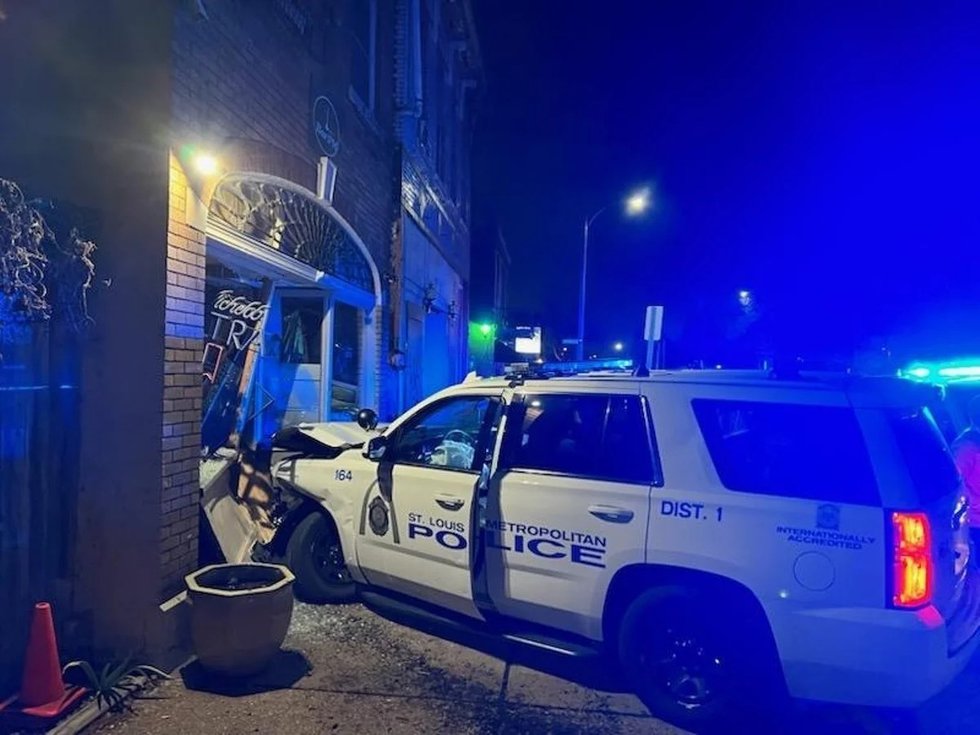
The Bar:PM incident—in which police crashed an SUV into a gay bar and then arrested its co-owner—has long been a headache for the St. Louis Metropolitan Police Department. But now lawyers for the bar’s co-owner are directing their ire at the prosecutor’s office.
Attorneys for bar co-owner Chad Morris, who faces misdemeanor charges of resisting arrest and assault from the incident last December, want a judge to sanction the office of St. Louis Circuit Attorney Gabe Gore. They allege that prosecutors failed to disclose the potentially damning information about the officer who arrested Morris, as the law requires.
Get a fresh take on the day’s top news
Subscribe to the St. Louis Daily newsletter for a smart, succinct guide to local news from award-winning journalists Sarah Fenske and Ryan Krull.
Jim Wyrsch, an attorney with St. Louis firm Khazaeli Wyrsch, filed the motion seeking the sanctions yesterday. He writes that prosecutors must provide any material or information that “tends to negate the guilt” of a defendant but that Gore’s office has failed to do that—even though, he writes, the office has information in its possession showing that a key witness in the matter lied in a previous case. Failing to provide such evidence to defense attorneys is known as a Brady violation (or, less commonly, a Giglio violation).
Wyrsch says Gore’s office has also made clear that it won’t ask the St. Louis Metropolitan Police Department for any mitigating information in its files. “Because the Circuit Attorney refuses to even make an inquiry into the existence of Brady/Giglio material with the SLMPD or look through its own files to identify Brady/Giglio material, these exceptional circumstances warrant the imposition of sanctions and dismissal of the charges against Defendant,” Wyrsch writes.
The St. Louis Metropolitan Police Department did not respond to requests for comment. The Circuit Attorney’s Office said only that it plans to file a motion in response.
The case against Morris drew intense public interest almost from its inception. A rookie St. Louis police officer crashed his department SUV into the bar owned by Morris and James Pence just after midnight on December 18, 2023. Rather than perform a field sobriety test on the driver, the officer responding to the crash, Ramelle Wallace, handcuffed Pence within 30 seconds of arriving. When Morris objected, he alleges that officers took him behind the bar, beat him, and arrested him, initially charging him with felony assault against a police officer.
Khazaeli Wyrsch is suing Wallace not only for the incident at Bar:PM, but, in a separate lawsuit, an attack that they allege took place the previous June at the City Justice Center. Their client, Richard E. Hopkins III, claims in the suit that Wallace attacked him “without justification,” body slamming and punching him while he waited to be booked into the jail.
The Circuit Attorney’s Office initially filed charges against Hopkins for assaulting Wallace but later dropped those charges. Wyrsch’s partner, Javad Khazaeli, suspects that is because prosecutors viewed security camera footage from the incident, which shows Wallace as the aggressor.
Wallace was involved in another instance of alleged misconduct in 2019. At a South Broadway apartment complex, police were on the scene arresting someone else when, according to police reports, bystander Charles Singleton said, “F—k the police!” According to a lawsuit later filed by Singleton, Wallace then threw him “to the concrete ground face first while [his] hands were secured behind his body.” Singleton suffered multiple broken bones. He settled his lawsuit against the city for $125,000 in June.
In the most recent filing in Morris’ criminal case, Wyrsch says that because of those incidents, Gore’s office has “direct knowledge of Officer Wallace’s penchant for using excessive force,” but still refuses to ask the St. Louis Metropolitan Police Department for information about Wallace that could be relevant to the case. The suit includes quotes from a text exchange with a prosecutor in Gore’s office. “I’ll produce anything that the police department provides me,” the prosecutor allegedly texted Wyrsch. “Please be aware that it will likely require a court order for the specific items you want and a potential hearing to oppose it.”
Wyrsch reacted with surprise, saying that prosecutors have an affirmative duty to search their own files and those of police. The prosecutor again replied that a court order might be necessary. Wyrsch responded again: “Just so I can be clear for our motion to compel/sanctions, is your position that a) you will not even ask the police department for the materials, or b) that you have asked and the police refuse to do the search and/or produce responsive materials?” Six weeks later, he writes, he has yet to receive a response.
Brady material was a big issue for Gore’s predecessor, Circuit Attorney Kim Gardner, who styled herself as a progressive reformer. Gardner had informed the police department of the existence of an “exclusion list,” which contained the names of officers she felt were not credible. At one point, the list grew to include 7 percent of the department. Some officers on the list later refused to testify in cases brought by Gardner.
Gore announced that he was scrapping the list, telling reporters that he’d look at officers on a “case-by-case basis.” He’s worked to build better relationships with St. Louis police officers. But Wyrsch, for one, is not impressed. “Given that the Circuit Attorney’s office refuses as a matter of policy to even ask the St. Louis Metropolitan Police Department about the existence of Brady/Giglio information or review its own files, this alleged ‘case-by-case’ review appears to be a complete sham and is actually a deliberate policy to protect police officers with problematic histories,” he wrote.
The request for sanctions will be decided by Circuit Court Judge David A. Roither. A status hearing is scheduled for July 25.