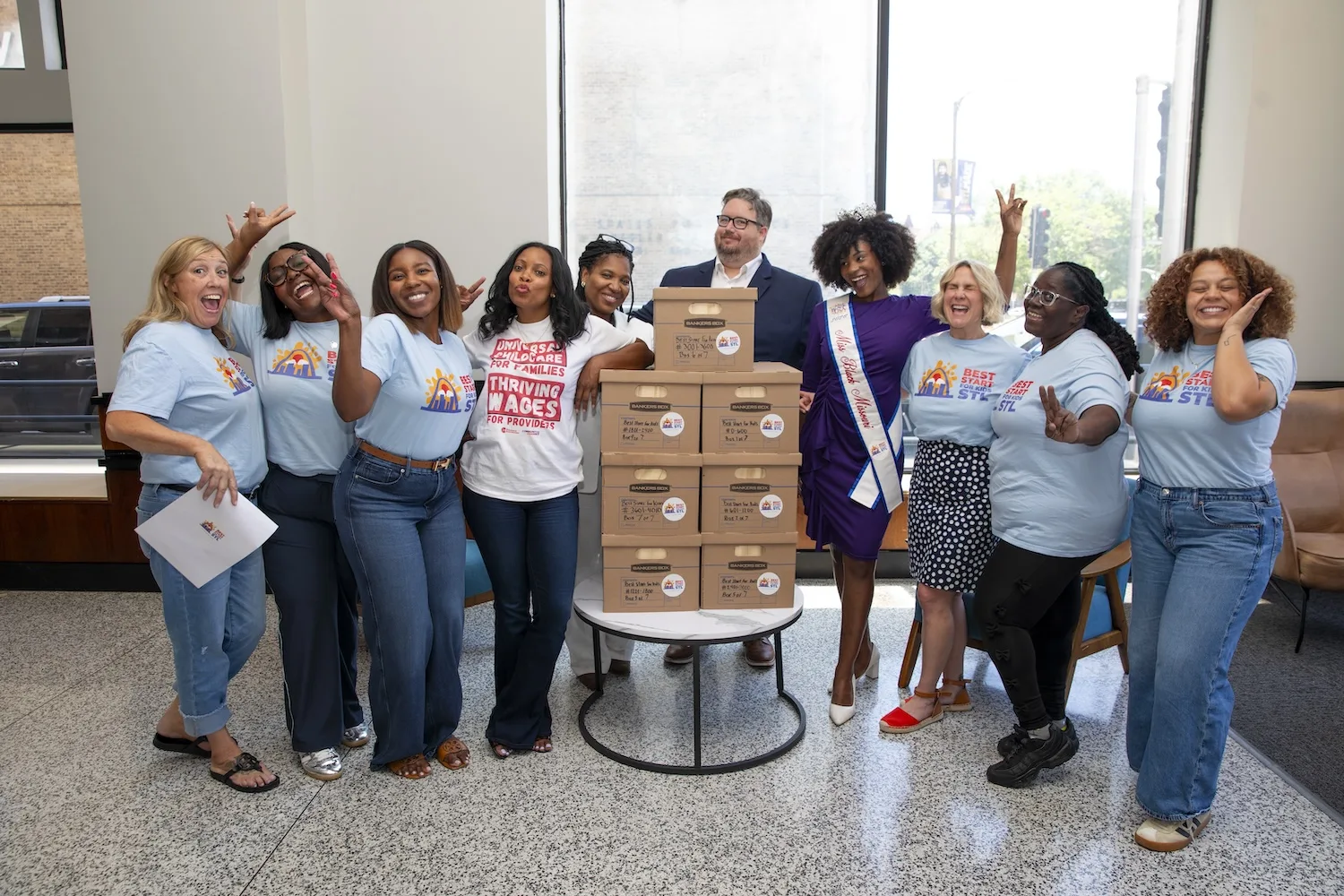
A half-cent sales tax increase to generate funding for early childhood education in the City of St. Louis will be on the ballot this November.
Proposition B, backed by the Best Start for Kids STL campaign, would generate $22.4 million annually for early childhood education. The revenue would be used in two ways: grants for providers to grow and stabilize the childcare workforce, and subsidies for families to make childcare more affordable.
Get a fresh take on the day’s top news
Subscribe to the St. Louis Daily newsletter for a smart, succinct guide to local news from award-winning journalists Sarah Fenske and Ryan Krull.
Currently, more than 6,000 St. Louis city children ages five and under who live in poverty lack access to childcare, which can cost as much as $31,000 per year for an infant, according to the campaign.
The grants for providers would be used to increase teacher pay, offer them benefits, and improve their learning spaces, according to campaign manager MacKenzie Grayson.
“Home childcare providers, childcare centers that are brick and mortar, public schools—all entities that care for children birth through five will be able to have access to these funds,” she says.
The subsidies would be awarded on a sliding scale, determined by family income and household size.
The campaign’s proposed subsidy scale would range from 100 percent of average tuition for the lowest-income families, allowing them to pay nothing, down to 10 percent for higher earners (families making more than five times the federal poverty level, or $178,433 for a family of four). A family of four making around $64,300 a year would get 90 percent of their tuition covered. That’s an average of $1,011 a month, making their monthly copay $112.
“That’s really significant,” especially for low-to-middle-income families, says Lindsey Baker, director of advocacy and operations at the SouthSide Early Childhood Center. A state subsidy that helps cover childcare costs for families earning no more than 1.5 times the poverty level has a waitlist of 5,896 applications, representing 10,921 children, according to the Department of Elementary and Secondary Education. Early Head Start and Head Start, meanwhile, generally serve families living at or below the poverty level, leaving many families earning too much to qualify, even while childcare remains financially out of reach.
The funds would be distributed through a newly created St. Louis Early Childhood Education Fund, overseen by a board appointed by the mayor and confirmed by the Board of Aldermen. The initiative takes the form of a charter amendment, which requires just over 60 percent approval to pass. The ballot measure creates the new fund through the city charter with a structure that allows public schools to participate.
Since the need is far greater than the funds that will come in each year, the campaign says the fund would prioritize the neediest families. Each year, the fund administrator would run an application process and assess demand, prioritizing eligible applicants with lower incomes. Over time, they say, demand may require a waitlist.
Unlike K–12 schools in the United States, there is little public infrastructure supporting childcare and early learning, and no state requires a child to attend school before kindergarten. That leaves the early childhood picture messy and fragmented. Without help from family members, some parents would be lost.
“Currently, the majority of the funding that goes into early childhood education is coming primarily out of the pockets of families and caregivers,” Baker says.
At the same time, the developmental science is clear: The first few years of life are the most active for brain development, with more than 1 million new neural connections being formed every second, and responsive, back-and-forth exchanges with caregivers are crucial. Researchers have also found that toxic stress from poverty and trauma can impair the development of neural connections in a child’s brain.
What’s more, access to early childhood education can boost a child’s long-term economic mobility. High-quality early childhood education is a high-return public investment shown to lift the economic prospects of disadvantaged children and, in the longest studies, their children too.
The ballot measure came about after a regional planning process throughout 2024 and 2025—co-chaired by Jason Purnell of the James S. McDonnell Foundation and Kelvin Adams of the St. Louis Community Foundation—that included more than a dozen meetings involving 59 community leaders and four national consulting groups.
“Making quality early childhood education accessible to more St. Louis families is critical to our children’s futures and to our workforce today,” says Purnell. “Too often, limited access prevents parents from pursuing quality jobs that build financial security for their families and prevents employers from filling the positions they need to grow.” (The James S. McDonnell Foundation is not taking a position on Prop B, a spokesman said.)
WEPOWER, a leader of the Prop B campaign, has been front and center in the effort to secure public funds for early childhood education in the St. Louis region for years. In 2020, it led the campaign to pass Prop R, which raised the property tax rate by six cents to generate $3.3 million annually. WEPOWER also advocated for a half-cent sales tax to fund early childhood education in St. Louis County the same year, but the proposal’s sponsor pulled it after losing a co-sponsor amid public concern about how the funds would be used.
Then, in 2024, WEPOWER sought support from the St. Louis Board of Aldermen to put a half-cent sales tax increase on city ballots for early childhood education. The bill sparked debate because public schools would not be eligible for the revenue unless a state law changed. Also fueling opposition from some city residents was WEPOWER’s past association with The Opportunity Trust, which is widely seen as supporting charter schools at the expense of traditional public schools. (WEPOWER says it ended its relationship with The Opportunity Trust in 2021.)
The Saint Louis Public Schools board unanimously opposed the 2024 bill, saying it “directs taxpayer dollars to non-public entities with no oversight or accountability measures in place.” The Board of Aldermen did not end up voting on the bill. (The SLPS board hasn’t taken a position on this November’s ballot initiative.)
The 2024 bill depended on a companion bill in the state Senate that would have let the revenue go to public schools. However, the Senate bill failed. As a result, Best Start for Kids STL restructured its proposal to what is now Prop B, which includes public schools without relying on state legislation. (A bill has been introduced in the past three legislative sessions, according to Cassandra Kaufman, executive director of the St. Louis Mental Health Board, and it advanced further in the most recent session than ever, but to no avail.)
It’s because that legislation is stalled that Best Start for Kids STL hasn’t pursued a similar measure in St. Louis County yet, according to the campaign. The county’s Children’s Service Fund can’t include public schools without the state legislation.
WEPOWER also previously pitched using some of the Rams settlement funds to create a $100 million endowment for upgrading daycares and boosting early childhood education, but the final plan Mayor Cara Spencer signed into law in July 2026 did not explicitly include funds for early childhood education.
This time around, the organization took a different route, gathering some 36,000 signatures to put the issue to voters directly.
Why a sales tax?
If passed, the proposal would increase the city’s sales tax rate by a half-cent; a $100 purchase would come with another 50 cents in taxes.
Sales taxes are considered regressive because they have a greater impact on low-income individuals than the wealthy, a criticism raised repeatedly during the 2024 effort. The combined sales tax rate in the city is currently 9.679 percent—the state’s rate of 4.225 percent plus the local 5.454 percent. That’s the highest among Missouri’s major cities.
Grayson says the campaign looked into multiple revenue streams and chose a sales tax because it would yield the most money and help close funding gaps. “This just seemed to be the most viable to make it sustainable and to make sure that it would be enough money to actually help make an impact for families and childcare providers,” she says.
Prop R
When Prop R passed in November 2020, it created a dedicated early childhood funding stream to be managed within the St. Louis Mental Health Board’s Community Children’s Services Fund.
The statute that governs the fund is focused on the mental health of young people, says Kaufman. As a result, the roughly $12 million committed through Prop R since 2022 has gone to more than 20 local organizations delivering mental health and social-emotional support to city children ages zero to five, from in-home therapy to emergency relief for childcare centers hit by the May 2025 tornado, according to a report provided by the board. The funds also go to professional development for educators as well as programs for parents and caregivers.
Kaufman says the funding stream was a start, but this fall’s Prop B could do much more.
“There’s a lot that can happen, but it’s just not as encompassing as being able to subsidize a child’s seat in a center,” she says. Also worth noting: Prop R funds have to go to nonprofits or government entities, but most early childhood providers are for-profit, according to Kaufman.
Baker, of SouthSide Early Childhood Center, says Prop R has “been a life saving situation for our center and families.” The center has used the funds to build a social-emotional program for the children it serves.
Prop B funds, however, could help families who can’t afford care. “It goes directly to the funding and access issue that we’re facing,” Baker says. “This is literally funds that can go directly to help bring down the cost of care.”