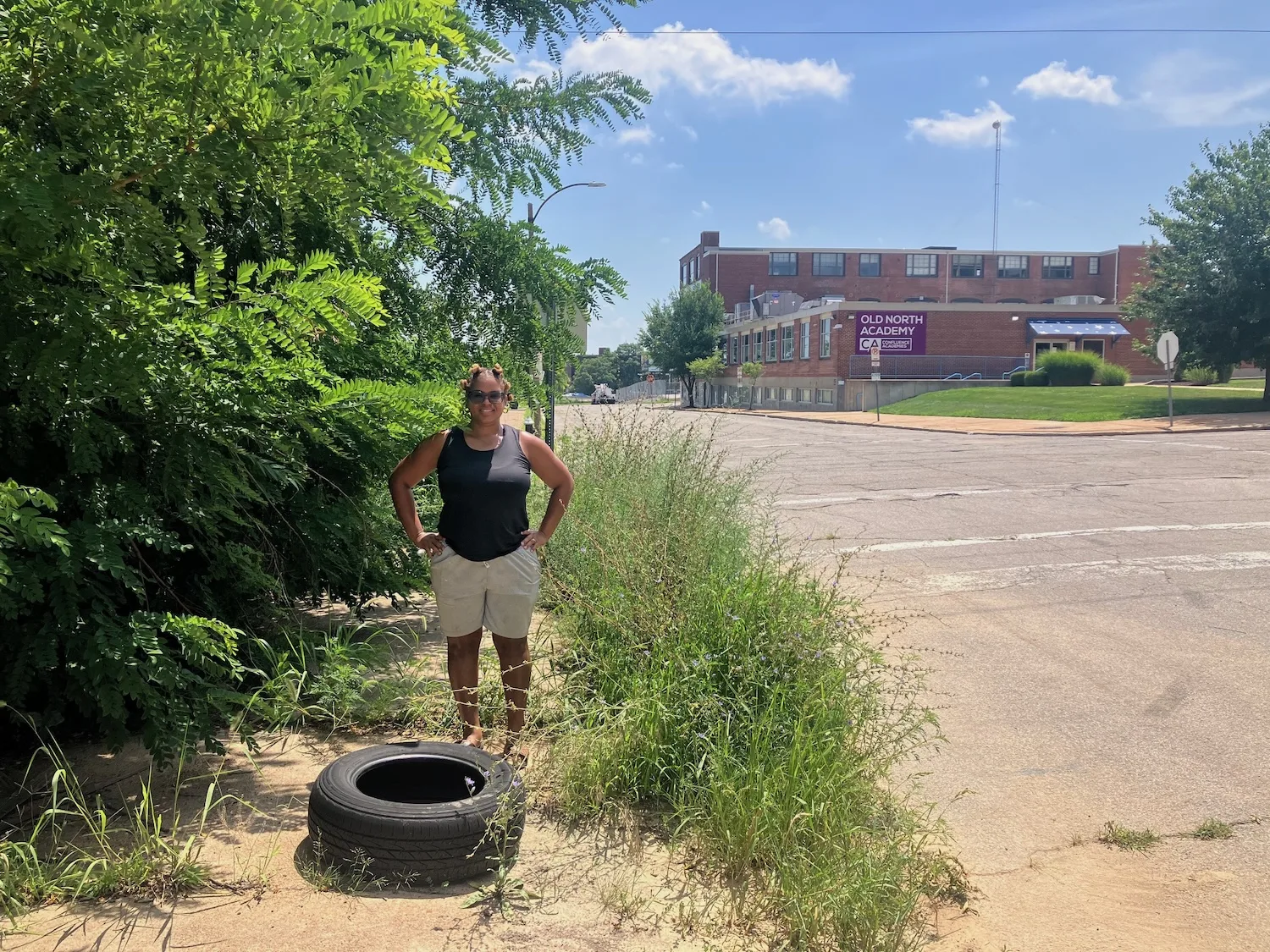
Sicelis Perry’s kids go back to school next week, and by late July she was already thinking about their path to get there. It’s been an ongoing problem since she and her family moved to the city’s Old North neighborhood from Atlanta.
The problem is not the distance. There are only two blocks between the two-family home Perry and her husband gut-rehabbed on Palm Street and her kids’ charter school. The problem is the sidewalks. In Old North—and indeed, throughout many swaths of North City—they are often overgrown with vegetation, sometimes high enough to make them impassable. But Perry has instructed her school-aged kids, ages 10 and 7, not to cross the street to the other side, under any circumstances. There, a hulking vacant building looks close to collapse. With both sidewalks impassable, she’s worried they have no choice but to walk in the street.
Get a fresh take on the day’s top news
Subscribe to the St. Louis Daily newsletter for a smart, succinct guide to local news from award-winning journalists Sarah Fenske and Ryan Krull.
The sidewalk conditions in Old North have recently become a focus of neighborhood leaders, including Perry. And what’s driving their ire isn’t just the neglect. That they could understand; they know the city is perpetually short of funds and that North City seldom seems to be a priority. What galls them is that the city is paying more than one contractor to mow lots in North City that have absentee owners, yet the contractors seem to be doing the bare minimum, if even that.
“If you get paid to do this, cut the bushes!” Perry says.
Neighbors say they have witnessed one city contractor pull up, mow a yard that’s barely overgrown, take a photo to document their work, and then move on—paying zero attention to the waist-high weeds in the adjacent yard that have grown up over the sidewalk. It feels to them as if the contractors are going for the easy job and ignoring the one in more desperate need that’s sitting right next door.
Barbara Manzara, who lives not far from Perry, says, “Once a weed tree reaches 18 inches high, it is carefully, almost lovingly, avoided by mowers for years while it erupts through concrete slabs and granite curbs, destroying our precious scraps of remaining street infrastructure.”
The result? Overgrown sidewalks like the ones that have plagued Perry’s kids’ path to school—and yards that neighbors say present a genuine public safety concern. In at least one case, neighbors say a sex worker was using the tall grass in a local vacant lot to conduct business.
And what’s really increased some locals’ ire: If a city contractor mows a privately owned lot, the owner gets billed. That would be a fine thing if the contractors were choosing the worst of the worst, but both Perry and Manzara tell of contractors choosing a relatively well-maintained yard to mow and billing the owner for that work, instead of tackling the overgrown lot next door.
Getting information about who is to blame—and determining what marching orders they’ve been given by the city—has proven difficult. When Manzara complained about a particular mowing job, she says a city staffer told her it was done by a company called Corner 2 Corner Building Management. She put in a Sunshine request, and sure enough, last week got confirmation that a company with that name currently has a five-year contract with the city, worth up to $200,000 each year. Under its terms, it should get $100 for each yard it mows.
But when SLM reached out to Corner 2 Corner’s owner with questions about its work, the owner said they are not currently doing any work in Old North or, in fact, the entire 14th Ward. “It’s possible we are being mistaken for another contractor,” she wrote. She did not respond to a follow-up question about whether they’d previously worked in the neighborhood. (Manzara is now seeking invoices to better pin down who’s working in Old North.)
Alan Jankowski, the city’s commissioner of forestry, says he can’t discuss the work of specific contractors, but says that the city has a contract compliance officer who monitors the handful of companies that are paid to mow overgrown lots. He says he feels confident they’re checking up on their work (although, interestingly, he says contractors are not assigned to specific wards, but rather rotate throughout them).
Jankowski also says he’s not surprised any of the city’s contractors would leave wildly overgrown lots alone: “If there is brush, like woody plant material, then they’re not contracted out to cut down brush and haul it away, OK? They’re just contracted out to cut grass.” (That is, however, contradicted by Corner 2 Corner’s contract that Manzara obtained from the city, which has an addendum that adds $75–$125 per yard for debris and brush removal.)
Overall, Jankowski notes, regularly cutting the number of North City lots that could use it would cost far more than what the city has allocated; with the rotation being what it is, most are lucky to get cut a handful of times each summer. Still, he adds, “If there are some areas that are being maintained by our contractor, and they’re not cutting the tree lawn, I’d love to know what those properties are, so we can correct that issue.”
Sure enough, not long after SLM’s conversation with Jankowski, neighbors report, someone showed up and clear-cut the specific blocks we’d offered as an example of overgrown sidewalks. (They just so happened to be the blocks that the Perry kids walk on their way to school.)
But to Manzara, that doesn’t solve the problem.
“We need systemic change,” she says. “This kind of soft corruption of, like, only going and doing something because the squeaky wheel gets the grease, because this person knows the alderman’s phone number, is not a solution that we’re looking for.” Among many other problems, she says, that penalizes neighborhoods in North City that don’t have the organization of Old North: “I’m not over here trying to hog a minimal amount of services away from my neighbors.”
Alderman Rasheen Aldridge, who represents the neighborhood, agrees. He believes Jankowski is doing a good job, but says systemic change is needed to how the city handles overgrown lots. “I’ll be honest, I think the system is broken, and I think it’s antiquated,” he says.
He says the city is in a Catch-22. It uses contractors because it’s short-staffed. But then it’s hard to properly supervise those contractors’ work because, again, it’s short-staffed. And he says the ongoing tornado cleanup cannot be allowed to become an excuse. “I think it’s one of the moments right now where we need to walk and chew gum,” he says. “A lot of resources do need to be put to the tornado area, but I don’t think we can stop working on daily city services.”
Sicelis Perry would heartily applaud that. Since moving to St. Louis, she has not only rehabbed the two-family she lives in, but also what she describes as a former crackhouse several blocks away, turning it into a stunning four-bedroom that’s finding big success as a short-term rental. She notes the tens of thousands of dollars she pays to the city in taxes and fees. “Where does that money go?!?” she demands. Perhaps unsurprisingly, she has not been able to get answers at City Hall.
Perry grew so frustrated by the condition of some yards on her street that, in June, she took matters into her own hands, clearcutting all the weeds with the help of her family. “I clear everything all the way with my kids,” she recalls. Three days later, she says, a contractor showed up, re-mowed the tree lawn, and took a photo of their work, which of course came right on top of her work. She didn’t get paid. She suspects they did.