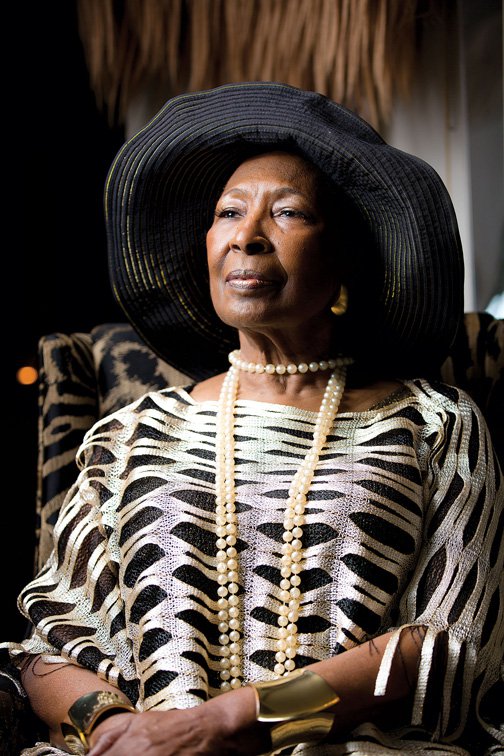
At the doorway of the tiny mustard-gold house, I hesitate. Could this be the same woman?
Jus Marianne Wagner swings open the door, smiling. Her hair—I remember it upswept—hides under a wide-brimmed hat. She waves me into a living room that could belong to a Surrealist French poet: She’s antiqued a neighbor’s castoff iron garden table into dark-gold Parisian Art Nouveau; covered the window with a dramatic crisscross of tobacco sheers she finagled from shower curtains…
Get a fresh take on the day’s top news
Subscribe to the St. Louis Daily newsletter for a smart, succinct guide to local news from award-winning journalists Sarah Fenske and Ryan Krull.
Definitely, I tell myself, this could be the same woman.
Two years ago, I watched a statuesque, elegant woman audition for a senior pageant by reciting, in a low, resonant voice, a poem. It ended on a powerfully ambiguous note, hinting that she’d been illiterate until she reached her sixties. Yet she carried herself like a queen, and she regaled the sequined tap dancers and thready sopranos with stories of her eccentric hand-sewn wardrobe. Fascinated, I asked to interview “the poet” for the finals. I was told she hadn’t made the cut.
Now I’m here to interview Wagner, who learned to read at age 65. Her clothes look vintage. And there’s a jacket on display, trimmed in lush fringes of human hair. “I’m a hair designer,” she points out cheerfully. “Why not use human hair?” She pauses. “Besides, I knew PETA would love me. And you have to remember, I’ve always been looking for love.”
Dare I ask? I let her tell me a bit of her life first. How her mother had her at 16 and her grandmother took care of her. How it took decades for her to understand the damage done by the neighbor boy who saw her as his sex toy, the white man who stuck his hand in her panties. “As I became older, it put a stigma in my mind—that I was ‘less than,’” she says softly, “and I cried all the time. My mother would come over to visit and bring clothes and candies, all the pacifiers. She was a domestic worker in Webster Groves, and everything those people in Webster bought for their children, my mother bought for me.” She shakes her head. “And here we were livin’ in Meacham Park!”
She nods to a painting of Miss Edith’s restaurant and Moe Johnson’s pool room, before developers razed them. “I’d see my father’s red truck parked there—Charles Johnson Contractors.They told me that was my daddy’s name. I remember wishing he’d rescue me.” She shakes her head. “Pain perpetuates in families. Had my mother known herself, she could have taught me who I was. I learned she’d been one of the most beautiful black girls in St. Louis County, but back then you couldn’t be high color—you had to be light—so she raised me to be insecure like her. But I had some Charles Johnson in me! God and Charles Johnson. And I stood tall.”
School bewildered her, though. “When you got all this stuff you are gathering in, your attention span is…” she gestures vaguely. She played hooky, had rheumatic fever, got moved ahead anyway, fell through that yawning crack, and hit the pavement hard. When she found herself pregnant at 16, it seemed a glorious escape. But her husband had a violent temper and slept with other women, so she left him.
At 31, Wagner went to work for the famous interior designer Jack Brandt. He and his brother supplied the camaraderie she’d hungered for. But she had to keep switching jobs to hide the fact that she couldn’t read more than an application. She married again, just as disastrously, for her kids’ sake. “You see people for the way you want them to be, for your needs,” she says with a sigh, “so it’s best not to be a needy woman.”
She left the second husband, too, and she drove to Chicago in her ’72 Grand Marquis, breaking all speed laws, elated to be free. She asked God who she was and heard “Wagner.” When people said, “Jus Wagner?” she tacked on “Jus,” deciding it would be an abbreviation of “justice.”
On a trip to New York, she glimpsed a beautiful woman in a mirror and kept going. “Then I did a moonwalk back, afraid to look. Was that really me?” She slept with a dictionary in her bed. She started signing letters “perdurable,” because it meant “everlasting,” and when a friend said gently, “Baby, you can’t be makin’ up words,” she showed him the entry.
“I would speak with such authority,” she says, “and then I’d get the dictionary and try to figure out how to spell the words I’d said.” Her smile is rueful. “I tell my grandkids, whatever your problem is, you gotta stop runnin’ from it.”
A grandchild was mentioned in that audition poem. Now I have to ask.
“Oh, yes,” she says warmly. “That was me.” She tilts her head back, her laugh easy and free of rancor. “They said my talent wasn’t what they were looking for.”
No matter. That talent was how she found herself.