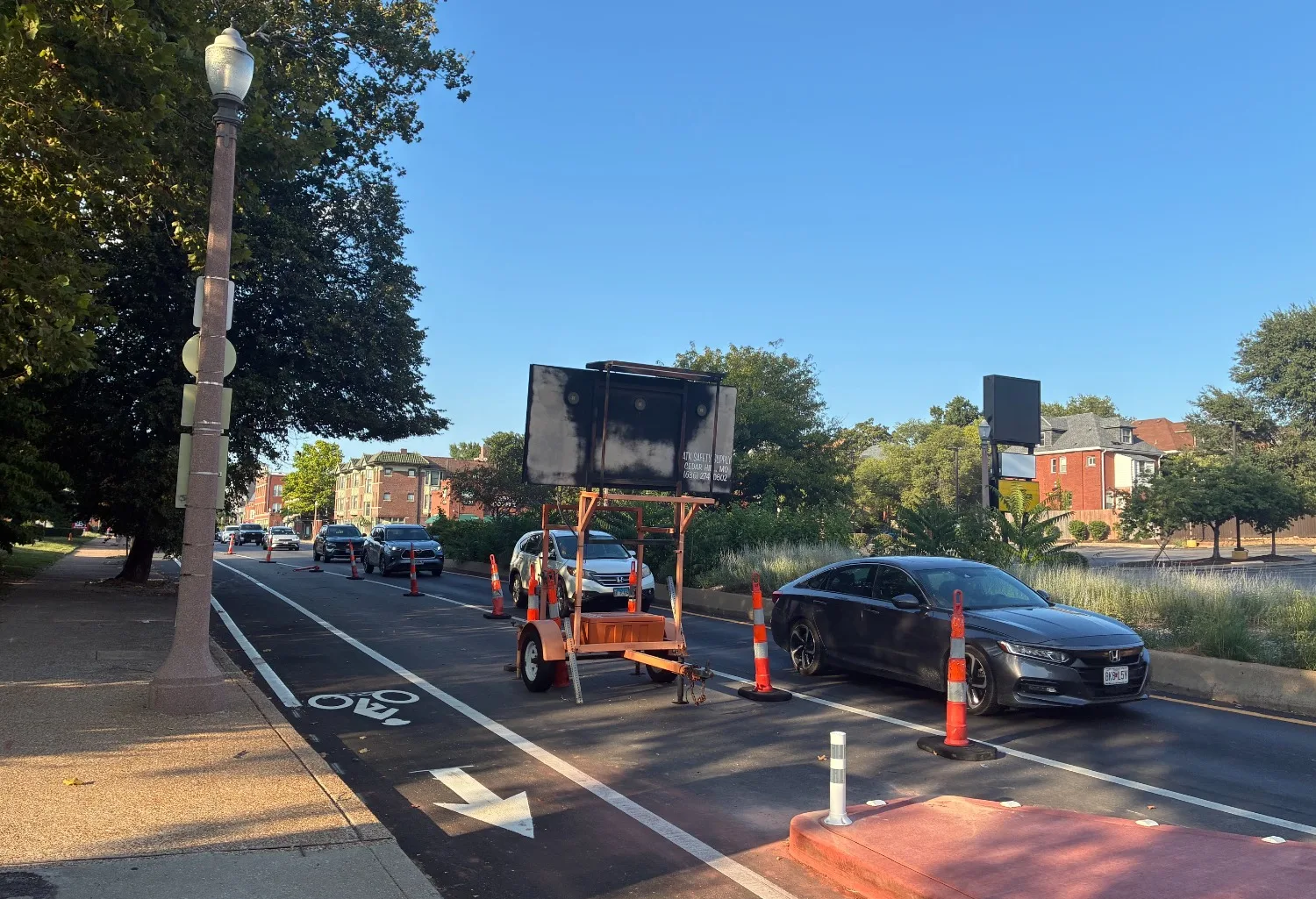
In the last year or so, the City of St. Louis has been resurfacing and, at points, reshaping six of its most popular corridors. Thanks to $40 million from the American Rescue Plan Act, what were once pothole-scarred arteries are now smooth. Many also have new traffic-calming features—concrete designed to narrow the street and force drivers to slow down.
But at one high-volume intersection, instead of feeling calmed, motorists are fuming. Scott Ogilvie, the city’s planning executive for transportation, acknowledges that South Grand’s intersection with Magnolia Street, where Shaw, Tower Grove East, and the northeast corner of Tower Grove Park meet, has generated significant complaints. As new ARPA-funded features funnel southbound drivers into a single lane, the striping feels confusing to many—and, perhaps due to St. Louis’ longstanding difficulties with zipper merges, traffic now backs up for blocks where it once flowed.
Get a fresh take on the day’s top news
Subscribe to the St. Louis Daily newsletter for a smart, succinct guide to local news from award-winning journalists Sarah Fenske and Ryan Krull.
Some of that slowdown is intentional. Cyclists and pedestrians begged for traffic calming near the park after some high-profile crashes. It also seems inevitable that traffic calming is popular in theory and irritating when you’re the one driving—and have somewhere to go.
But locals say the reality has been less that motorists are slowed and more that they’re incapable of navigating an intersection that no longer makes sense.
“The striping and bump outs they’ve laid down on that stretch of South Grand defies all logic. How on earth were drivers supposed to decipher their intent?” asks one Tower Grove South resident, adding, “What used to be a quick commute down Grand has now turned into a contest between those in that left-hand lane in preparation for the stupidity that is now the Magnolia approach, and the drivers trying to squeeze in at the last minute.”
Ogilvie says the city has heard those gripes (and, he implies, many more). He says the city is now actively monitoring the situation—but it’s not quite ready to retool the intersection yet.
And there’s a good reason for that: The project is not, in fact, finished. Work on South Grand might seem complete because the paving is done, but Ogilvie says the striping is a different story. The city is using different contractors to stripe center lanes, bike lane markings, crosswalks, and the crosshatches that now demarcate areas to avoid. Some are done; many are not.
Until they are, Ogilvie suggests, it’s hard to know what works and what doesn’t.
“I’ll say that it is pretty typical when projects are in construction that we hear concerns that basically resolve themselves as construction is complete, and as people become familiar with lane changes that have happened,” he says. “Now, that’s not to say that we’re dismissing what we’re hearing. We will continue to monitor it and continue to pay attention to resident feedback. But there’s sometimes some confusion that is resolved once construction finishes.”
If things still don’t work then, he says, changes are likely. And that’s not just an attempt to soothe angry locals.
“We have made some tweaks in some of the other corridors post-construction, based on stakeholder feedback,” he says. “When you’re designing a whole nine-mile corridor, there’s a lot of factors involved. … Once the project wraps up, if there’s really what we’ll call an excessive delay in that location, I think we’ll look at other design options.”
It’s a busy intersection, made more complicated by the fact that its signals are longer than usual to accommodate pedestrians living just one block away at the Missouri School for the Blind. But here’s one piece of good news for those demanding change: Unlike, say, the swath of Kingshighway along the southwest corner of the park, the Magnolia–South Grand traffic-calming measures involve more striping than concrete. “There is some hardscape that’s happened there, but not much,” Ogilvie says. “Magnolia is more flexible.”