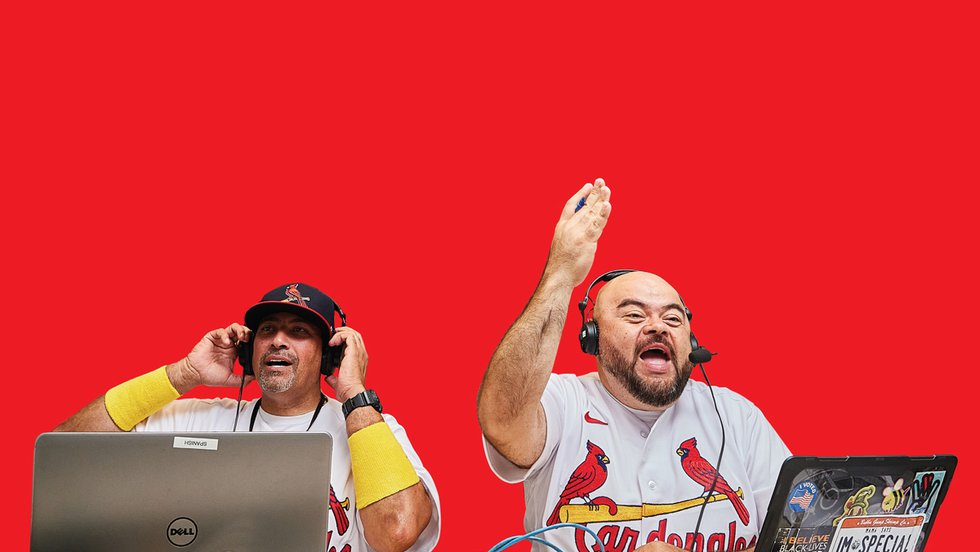
It’s three hours before the start of a Cardinals home game in July, and Spanish-language announcer Polo Ascencio is hosting a group of Latino children and their parents at batting practice. The outing at Busch Stadium is part of an event for LifeWise StL, a social services organization, and the kids, most between the ages of 6 and 12, all wear shirts featuring a giant microphone, the Cards logo, and the words “Los Pollitos de Polo”—“Polo’s little chickens” in Spanish. As they step out onto the field, their faces light up—and the parents are just as excited. They look around in awe at the size of the stadium and watch as the players warm up before the game against the Cincinnati Reds. Cardinals shortstop Edmundo Sosa (who has since been traded) walks over to meet the group. He plops his glove on top of his head and signs some balls. Pitcher Giovanny Gallegos follows, signing shirts and baseballs.
I mention to one set of parents, recent immigrants from Mexico, that Gallegos is from Mexico, too.
Get a fresh take on the day’s top news
Subscribe to the St. Louis Daily newsletter for a smart, succinct guide to local news from award-winning journalists Sarah Fenske and Ryan Krull.
“He is?” says the mom, surprised. “Where are you from?” she asks him.
“Sonora,” Gallegos says with a smile.
Ascencio and his co-announcer, Bengie Molina, have become community figures as they regularly meet with kids, particularly Latino children and their families. They host baseball clinics and invite kids to games to meet the team. As the Latino population grows in St. Louis, its representation is also expanding on the field. Today, according to Major League Baseball, Latinos make up nearly one-fourth of the league’s talent. And with manager Oliver Marmol—as well as players Albert Pujols, Yadier Molina, Nolan Arenado, Gallegos, José Quintana, JoJo Romero, Juan Yepez, and Génesis Cabrera—the Cardinals are no exception.
But it took until September 29, 2016, for the Cardinals to have a Spanish-language broadcast. It was part of the Cards’ annual two-day Hispanic Heritage Month “Fiesta Cardenales” and had been intended to serve that occasion only. At the mic was Ascencio, who provided the play-by-play, and Bengie Molina on color commentary. Bengie is one of Yadier Molina’s two older brothers who were also MLB catchers.
“The plan was just to do two games during Hispanic Heritage Month, but immediately we knew history was being made,” says Celina Allen, the Cardinals’ account services executive and Spanish broadcast coordinator. “Spanish voices needed to be heard at every game.” Now, Ascencio and Molina want to do just that, to broadcast every game—not just ones at home—in Spanish. Doing so, they say, would not only help them better connect with Latinos in St. Louis but also grow the Cardinals’ fan base worldwide.
Passion for baseball runs deep for Latinos. For many of them, the game was their survival.
“I think we see baseball as a way out. At least I did,” Bengie Molina says. “I thought it was my way out of Puerto Rico. I thought, I can help my mom and dad. I can help buy them a home and a new car. My motivation the whole time was my family. I thought about it all the time. I said, If my brothers don’t make it, I have to be the provider.”
“The plan was just to do two games, but immediately we knew history was being made.”
Ascencio, now known as “La Voz” of the Cardinals, was an avid listener of Dodgers games—both in English with Vin Scully and in Spanish with Jaime Jarrín—and wanted to get into broadcasting. While working as a custodian, he would call into a local Spanish sports-talk show in between cleaning jobs. The hosts loved his personality so much that he soon got a regular stint as a baseball commentator. Years later, the MLB gave him press credentials, and he began working for Univision and the Dodgers. A Padres Spanish broadcaster tipped off Ascencio that the Cardinals were looking for a new voice.
Bengie Molina’s inclusion as a Spanish-language broadcaster was a bit more of a shoo-in. The Cardinals saw the former pro catcher, World Series winner, and two-time Gold Glove recipient as a perfect addition to the broadcast. It also didn’t hurt that his younger brother, Yadi, was on the team.
Listen to Ascencio and Molina call a game, and you’ll hear a lot of Spanglish—the way many Latinos speak—coming from the press box. The announcers use English baseball terminology mixed with Spanish, such as “el splitfinger,” and creative metaphors. When a third baseman drops the ball, Ascencio says, “Se le salio la crema del taco,” which translates to “The cream fell out of the taco.” Later, when Marmol comes out of the dugout to make a pitching change, Ascencio says, “Ay viene la grua,” meaning, “Here comes the tow truck.” (The closest baseball idiom for this in English is “He’s getting the quick hook.”)
“I love when people come up to us and tell us, ‘Your call was great. I don’t understand what you’re saying, but it makes me happy,’” Molina says.
For him, the intimate way he connects with St. Louisans means the Spanish broadcast is more than simply calling a game. And the Cardenales fan base has expanded considerably: While all 81 home games air in Spanish locally on WIJR 880 AM, people worldwide can hear the broadcast streaming on Cardinals.com and the MLB app. Ascencio says that when he mentions various Latin American countries during a game, he’ll get bombarded with messages on WhatsApp from Spanish-speaking listeners letting him know their location.
Allen explains that the Cardinals want to cultivate fans across the nation. “But more importantly,” she says, “we want to make Busch Stadium and the St. Louis Cardinals more welcoming to the growing Latino population. Not just for fans—it’s also important for our Latino players’ families listening from Puerto Rico, Dominican Republic, Mexico, Cuba, and Panama, to hear Ascencio and Molina narrate the games in their native Spanish language.” Allen says the organization is working on inserting more Spanish-language voiceovers during the home games, imagery with the Cardenales branding throughout the stadium, and adding snippets of Ascencio and Molina’s voices for everyone to hear.
Ascencio is confident this increased visibility will lead to a bigger audience. “With Latinos, if they don’t feel invited and welcomed, they’re not going to come to the stadium, especially a place as intimidating as Busch,” he says. “For a lot of us, this is something new. This is something we only see on TV. We don’t realize how big it is until we get here.
“Imagine being a Latino family that’s never been here,” he continues. “All of a sudden, you hear the calls in Spanish. Then you walk in here, you maybe see a sign in Spanish, a T-shirt that says, ‘Cardenales’ instead of ‘Cardinals.’ You sit down, you hear an announcement or something, a highlight in Spanish, you feel like, ‘OK, this is a place for me.’ I think the more we do that, the more Latinos will come to Busch Stadium.”