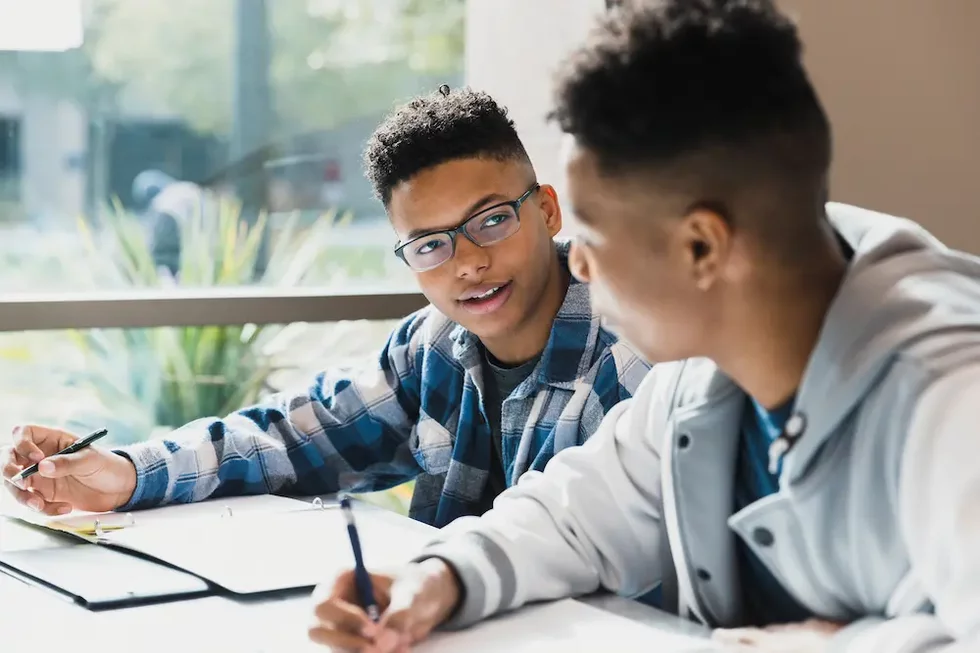
An African-American male in his 20s and living in St. Louis earns, on average, $15,000 a year, compared to an average $30,000 income for a white man in his 20s, regional economic data show, says Sean Joe, Ph.D., a professor of social development at Washington University. The disparity is just one of the societal challenges young Black men continue to face in disproportionate numbers. But a new program involving life coaches working with students and their families in St. Louis City and County aims to change that trajectory. It’s expected to start in April.
The program, for Black boys and men ages 12 to 29, will first focus on Black boys, says Joe, noting that plans call for the same coaches to remain with the participants—called members by the program—until the members turn 29. The life coaches program grew out of the Wash. U. Brown School’s Race and Opportunity Lab, which examines race, opportunity, social mobility, policies, and interventions, and the lab’s HomeGrown StL program. HomeGrownStL says it is “dedicated to improving the well-being of Black boys and young men, and reimagining the ways in which our communities support their health, academic attainment, employment, development opportunity, and transition into adulthood.” Providing community governance to HomeGrown StL is a regional steering committee composed of local community leaders experienced in such fields as career development, banking and finance, health, housing, and law and safety.
Get a fresh take on the day’s top news
Subscribe to the St. Louis Daily newsletter for a smart, succinct guide to local news from award-winning journalists Sarah Fenske and Ryan Krull.
Educators from city and county schools gathered this month at Wash. U. for what Joe called a town hall to hear about the life coaches program, ask questions, and discuss how their districts could support the initiative. There’s enough financial support to hire life coaches for 395 boys throughout St. Louis city and county, Joe says, with one life coach assigned to about 20 members and working year-round.
With the assistance of families, schools, health and social services, and other partners, life coaches, who’ll have special training from HomeGrown StL will help members deal with obstacles preventing them from doing their best in school—and begin thinking about future jobs of interest and preparing for post-high school education and training. “We are talking about jobs that pay living wages. An annual income of $15,000 is not enough to support oneself or a family,” Joe said while speaking to the town hall.
Obstacles to children’s academic success and future life successes as adults may start with unresolved traumas at home—the death of a parent or other loved one, substance abuse, and domestic violence, among them—as well as a lack of resources to adequately meet basic needs like food, nutrition, health, and safety, according to St. Louis licensed clinical social worker Candice Cox, CEO and executive director of the St. Louis nonprofit KHAOS (Keep Healing and Overcoming Struggles). The nonprofit serves children and families. “Life happens. Our babies need us. We can create a new normal by helping them overcome chaos, one day at a time,” Cox told the town hall audience.
As the members enter adulthood, further their education, start jobs, and have families of their own, they will experience new challenges and opportunities, with life coaches helping the members navigate them, Joe says.
About 60,000 Black boys and men live in the greater St. Louis area, according to Joe. Outreach to them via life coaches and other professionals will help them overcome challenges holding them back, he says, citing the goal of HomeGrownStL. That goal reads, “To disrupt dehumanizing or fragmented care coordination, using life coach interaction and intervention in neighborhoods, attaining a 100 percent increase in the upward mobility for a generation of Black boys and young men, ages 12–29, in the St. Louis region. HomeGrown StL defines a ‘100 percent increase’ as any positive outcome for a Black boy or young man—as well as their family—that had not previously existed. For example, if a boy is part of a family who has never had a member attend college, that boy attending college would be a 100 percent increase in upward mobility.”