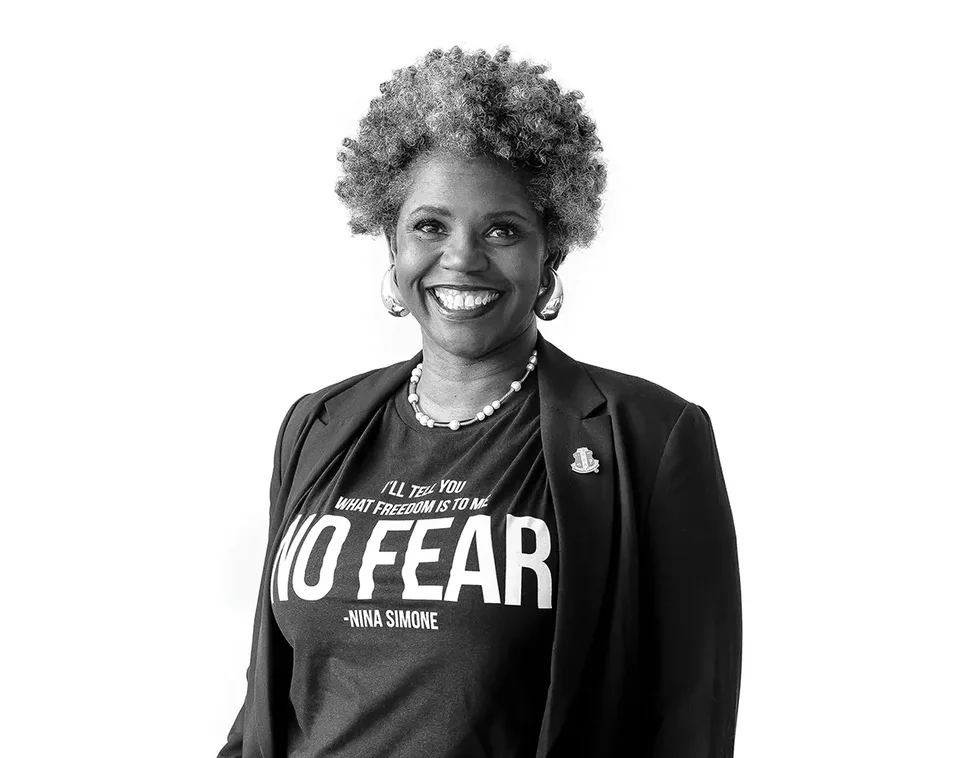
It’s been a decade since 18-year-old Michael Brown was shot and killed by police officer Darren Wilson, on August 9, 2014, turning Ferguson into a symbol of racial strife and inequality in the United States. The ensuing protests galvanized nationwide support around the rallying cry of Black Lives Matter and inspired hope that the St. Louis region was finally ready for a racial reckoning. The Ferguson Commission, an independent group appointed by then-governor Jay Nixon, recommended 189 calls to action, from policing reform and poverty reduction to educational outcomes and workforce development. In the wake of the commission’s report, Forward Through Ferguson was established as a nonprofit tasked with catalyzing the suggested changes. Executive director Annissa McCaskill says deaths at the hands of police are only a symptom of a problem that is “systemic, multigenerational, and still present.” While Forward Through Ferguson’s stated goal is to advance racially equitable systems and policies that ensure all people in the St. Louis region can thrive, 10 years weighed against “100, 200, 400 years of disenfranchisement of Black and poor people is nothing,” McCaskill says. “Work has been done, but the work is generational.”
Prison Reform
In the aftermath of the events of 2014, the Medium Security Institution—commonly known as “The Workhouse”—came to symbolize the alleged racial and economic bias in St. Louis’ criminal justice system. Poor people who could not pay bonds of a few hundred dollars filled the jail, where they allegedly languished in inhumane conditions while awaiting trial. A spirited push to address conditions at The Workhouse led to its closure in June 2022, a development that McCaskill characterizes as a significant win involving “not just a few people,” McCaskill adds, “It took studies, community decision-making, and pressing elected officials.” Still, she says, health services continue to deteriorate in the wider network of Missouri detention facilities, and activists stress that further prison reform is needed to stop the breakup of African American families and the disruption of impoverished communities.
Get a fresh take on the day’s top news
Subscribe to the St. Louis Daily newsletter for a smart, succinct guide to local news from award-winning journalists Sarah Fenske and Ryan Krull.
911
The region’s emergency dispatch system has long had a reputation for being outdated and ineffective. System stress lengthens police response times, and when officers do arrive, they’re sometimes responding to situations that could be better de-escalated by an unarmed social worker, McCaskill says. Through its Transforming911 initiative, Forward Through Ferguson is working to compare the reasons why St. Louisans call for emergency services to the responses police are capable of providing. McCaskill asks, “If someone calls 911 and cannot get to a first responder or the right responder, then how can a community respond?” Possible answers include EpiPens, community clinics, and a broader network of local resources. “When someone is having a psychological break,” McCaskill contends, “the police should not be the individuals responding.”
Surveillance
Even as federal and state budgets for social services have contracted, investment in policing equipment has grown. Gunshot detection microphones are one example, McCaskill says, and they can lead police to conduct frequent or warrantless searches. “We want everyone to feel safe in their neighborhood,” McCaskill says, “but people are being surveilled 24/7.” In the years after Brown’s death, Department of Justice investigators also found that the Ferguson Police Department sometimes used revenue-generating strategies that led to over-ticketing and criminalizing everyday behaviors for some nonwhite residents. “Why do people police the way they police? Why do people commit crimes?” says McCaskill, emphasizing that militarized law enforcement is not a remedy to systemic problems.
Housing & Transportation
For Black households and renters, the 2021 Affordable Housing Report Card came back with an “F” rating in St. Louis. “The issue that you see in St. Louis in terms of affordable housing is that it is geared toward veterans, people with disabilities, and the elderly,” McCaskill says, noting that she is the daughter of a veteran. “Where is the program for families? We have an old, beautiful, unique housing stock in St. Louis, but the means by which people can make it a home is not always easy.” Mobility in the city is also an issue, with fewer bus routes and much room for improvement in terms of accessibility. McCaskill notes that rather than broadening service, public transit services typically purchase security equipment, such as cameras, turnstiles, and fencing. In areas of St. Louis that are growing economically, McCaskill suggests that there should not be growth without also expanding public services. “How does that relate to people’s ability to get jobs, keep jobs, and go to school?” McCaskill asks.