It’s been 10 years since St. Louis police shot and killed 18-year-old Mansur Ball-Bey. Four months ago, a federal jury awarded his father, Dennis Ball-Bey, $18.75 million in a wrongful death lawsuit against the city. Along the way, the case exposed systemic flaws in how the department investigates police shootings—problems that went beyond this case alone.
But the legal drama didn’t end with the eye-popping judgment. In fact, it’s what happened since the trial wrapped on the last day of January that has gotten really strange.
Get a fresh take on the day’s top news
Subscribe to the St. Louis Daily newsletter for a smart, succinct guide to local news from award-winning journalists Sarah Fenske and Ryan Krull.
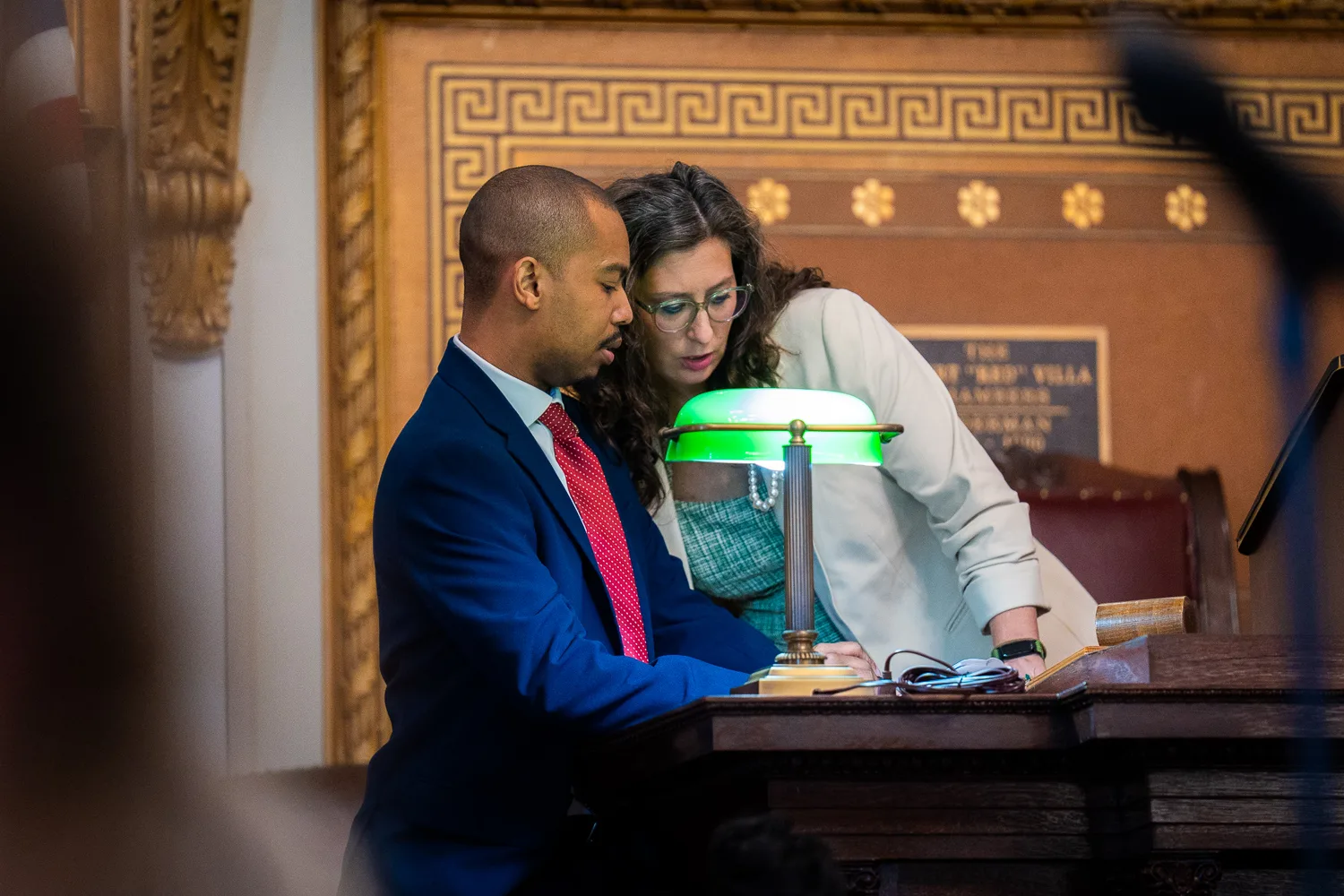
In a recent court filing, Assistant City Counselor Abby Duncan suggested that Ball-Bey’s attorney, Javad Khazaeli, somehow colluded with Aldermanic President Megan Green to derail debate over how to spend the city’s $290 million Rams settlement. By shutting down debate on a compromise spending plan for the funds, the legal filing alleges, Green was helping her own legal team in an unrelated case.
“It’s absurd,” said Green after an aldermanic board meeting on Wednesday. She added: “And I am stunned that anyone, much less a city employee, would fabricate such a story.”
The City Counselor’s office did not respond to a request for comment.
Khazaeli was named one of this publication’s under-the-radar power players last fall, but he balked at the idea he has the kind of pull implied in the assistant city counselor’s filings.
“In January, an all-white jury took less than two hours to determine that a St. Louis police officer shot and killed an unarmed Black teen,” he said, adding: “These false, baseless, and frankly bizarre allegations are a distraction.”
It’s indeed a strange theory, one that has come at the end of a volley of legal filings made by both sides in recent months. Khazaeli is seeking sanctions against the city counselor’s office over what he says are its false statements about Ball-Bey in the appeal for a new trial—specifically, suggesting that he was a cocaine user and a car thief, assertions Khazaeli says completely lack merit. Duncan asserted in court filings that Khazaeli has made false statements of his own about officers accused of shooting the teen.
“Throughout the many years of litigating this matter, barbs have been exchanged between attorneys on both sides,” Duncan wrote. “The very things that [Khazaeli] now grieves against Defendant, [Khazaeli] has done.”
Then, she posed the question of why Khazaeli is raising this issue now. Her answer: Because of what happened on the day of the verdict.
That day, January 31, the Board of Aldermen was debating how to allocate the Rams money when Green abruptly ended the debate and walked out. Duncan insinuates that Green’s exit, and subsequent halting of debate on the Rams money appropriation, may have somehow been orchestrated to benefit Khazaeli—perhaps by influencing the jury later that day during the trial’s punitive phase.
“Later that same day,” Duncan wrote, “after Green abruptly terminated the Board meeting about the Rams settlement funds at City Hall, her attorneys, Plaintiff’s counsel, were in this Court’s courtroom arguing at the close of the punitive portion of trial that the jury should award Plaintiff some portion of the Rams settlement money.”
The meltdown at the Board over the Rams money did come up just a few hours later at the trial, during what’s called the punitive phase. That’s when the jury assesses what is an appropriate amount of money to levy against the city so that, in Khazaeli’s words, the payout would be more than “a rounding error” and hopefully deter a shooting like it in the future. The fact that the Rams money remained unallocated came up, but it was hardly harped on. He told the jury at closing, “We’ve talked about these large amounts of money that they pay out for the Blues and they’ve got this Rams money.”
Otherwise, the only mention of the Rams money at the trial was when the city’s Budget Director Paul Payne took the stand to give the jury an idea of what the city’s books looked like. And he was a witness called by the city, in part to try to convey the notion that the judgment levied against the city would, as Duncan told the jury, harm city services and therefore city residents.
Khazaeli calls this an “unorthodox strategy of telling the jury that taxpayers would be responsible for the damages.” He hadn’t known the city was going to call Payne as a witness until shortly before the budget director took the stand.
John Ammann, a professor emeritus at Saint Louis University School of Law, agrees that it was an unusual move for the city to call the budget director to testify. “I have never seen that happen,” he says. “Juries don’t hear that the city or state will be paying damages when police or other officials are sued, just like they don’t hear how much an officer is worth to set damages. The jury sets damages irrespective of those facts.”
Two months later, in late March, Duncan deposed Green. During the deposition, she raised the idea that Green’s actions at the aldermanic meeting were linked to the Ball-Bey trial. Khazaeli objected.
“It’s way out of line,” he said, according to the transcript. “If your boss or whoever is trying to imply that we’re manipulating the president of the Board of Aldermen, who is your client, and you’re implying that she’s doing something unethical, we’re ending this right now.”
Despite saying that, Khazaeli let the deposition continue, until Duncan brought up the theory yet again. At that point, Khazaeli ended it.
Khazaeli’s motion for sanctions that led to Duncan unspooling her theory wasn’t the first of its kind in this case. Khazaeli previously sought sanctions against another assistant city counselor who had been working the case and allegedly hid documents related to the investigations of the Mansur shooting and dozens of other police shootings. A judge agreed that sanctions were warranted and levied $19,000 against the city.
If a judge agrees with Khazaeli’s current motion for sanctions, the city would have to pay attorneys’ fees for the time it has taken Khazaeli’s firm to correct what they say are the inaccuracies about Ball-Bey.
Khazaeli and Duncan have repeatedly exchanged barbs via court filings in the case in recent months. In April, Duncan wrote in a filing that Khazaeli’s firm merely “dabbled” in civil rights cases.
About a week later, Khazaeli, in his own filing, filled multiple paragraphs taking umbrage with that description and touting his firm’s track record in that area of law, writing that Duncan “is well aware of this history as they have been on the other end of much of this litigation.”