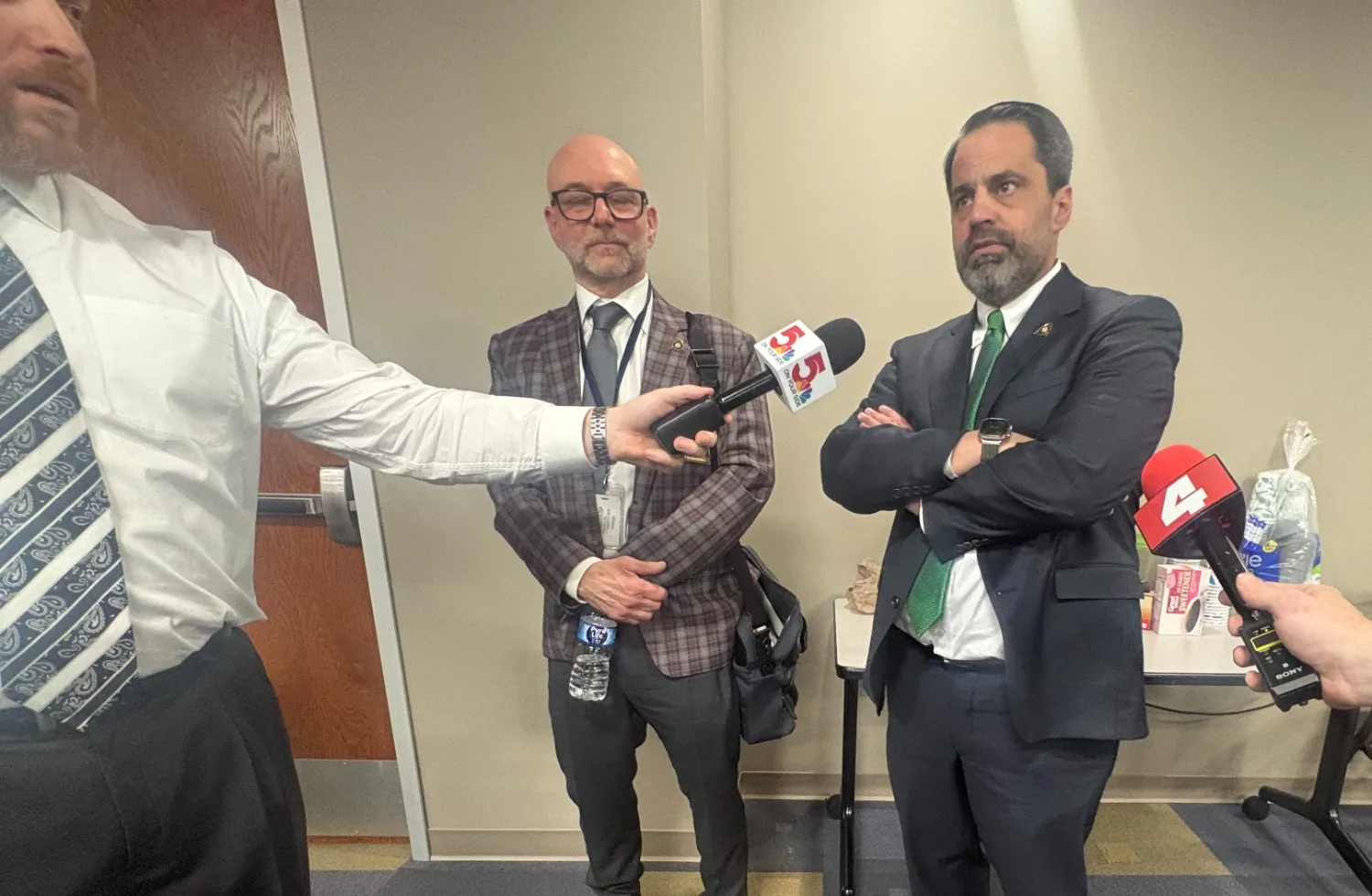
Chris Graville is the attorney advising the state-controlled board of police commissioners as they write the new rules for the St. Louis Metropolitan Police Department, a process that the board president often describes as “building the house as we’re living in it.”
But given Graville’s history, it’s fair to question if this new house represents a return to an old way of doing things in St. Louis—one that reformers pushed to change after Michael Brown’s 2014 death in Ferguson. Graville’s firm has cashed in by representing multiple municipalities, sometimes in roles that legal experts say are in conflict. In St. Louis, his firm has already generated a six-figure bill.
Get a fresh take on the day’s top news
Subscribe to the St. Louis Daily newsletter for a smart, succinct guide to local news from award-winning journalists Sarah Fenske and Ryan Krull.
Graville currently serves as the municipal judge in Glendale, Oakland, and Warson Woods, as well as the municipal prosecutor in Ballwin. He also represents the cities of Chesterfield and Des Peres as city attorney, all while holding down a private practice representing clients in civil proceedings and cases before local municipal courts.
His employment in those various roles is the kind of conflict of interest widely criticized by legal experts in the wake of Ferguson. Brendan Roediger, a professor of law at Saint Louis University, says, “The same lawyers serving as defense counsel, prosecutors, and judges in various municipalities in St. Louis County always creates the possibility for conflicts of interest.”
Graville initially responded to an email from SLM seeking an interview, only to go silent during multiple attempts to schedule one. He also did not reply to an emailed list of questions sent on Thursday.
Roediger’s concerns are shared by Kimberly Jade Norwood, who served on the Missouri Supreme Court’s Commission on Racial and Ethnic Fairness in the wake of Brown’s death. She describes a hypothetical where a defense attorney and prosecutor may oppose each other in one municipal court, only for that prosecutor to serve as a judge in a municipal court a few miles down the road.
“Fast-forward a day or two, or a week or month, and now that former prosecutor in the earlier case is sitting as a judge in another municipality, and he has the same defense lawyer appear before him,” she says.
The prosecutor holds an adversarial role against a defense attorney, whom they may later wield power over as a judge. The concern, says Norwood, is that tangle of relationships could lead a defense attorney to not “zealously” represent his client to avoid souring relationships with a prosecutor they may later be assigned as a judge.
Concerns about these apparent conflicts of interest drew significant attention in the wake of Brown’s killing. A 2015 report by the National Center for State Courts and State Justice Institute concluded that part-time employment across municipalities creates “an obvious appearance of impropriety,” which attorneys have a legal obligation to avoid per the Missouri Code of Judicial Conduct.
“It really can totally change the dynamics,” Norwood says, about part-time employment across courts.
Graville has another tie to the events in Ferguson that gripped the nation in 2014. As a municipal judge in Glendale, he performed officer Darren Wilson’s marriage ceremony, as CNN reported. Roediger notes, though, that Graville’s practice is not the most egregious example of part-time employment across municipal courts, though it is emblematic of it.
The potential for conflicts of interest comes alongside difficult financial questions for municipalities relying on courts for revenue.
According to Peter Joy, a professor of law at Washington University, “It became clear after Michael Brown was killed that the municipal court system in St. Louis had some municipalities using fines and fees as a way of bolstering the revenue that the city had.”
There have been some reforms since 2014. Among them, the state legislature instituted a cap on the percentage of revenue a municipality may acquire through court levied fines and fees. “That was a step in the right direction because it lessened the incentive that some municipal court judges had to layer on really crushing fines and fees on poor people,” Joy says.
ArchCity Defenders also filed numerous class-action suits against municipalities for operating what the nonprofit law firm charged were “debtors prisons.” Those suits resulted in settlements that put municipalities on notice and, says Roediger, led to real changes in how many municipal courts operate.
“The lawsuits that ArchCity, myself, and other people filed ultimately resulted in less people being incarcerated by municipal courts, by a lot,” he says. “But other things, the ethical problems, the people operating in multiple capacities, hasn’t improved in any way.”
A 2024 report by ArchCity Defenders maintains that “a subset of the legal community greatly profits from the current municipal system.” Lawyers holding positions across municipalities, the report says, “have a vested financial interest in keeping or increasing municipal court enforcement regardless of its impact on low-income communities.”
Attorneys like Graville, who hold positions across multiple municipalities, may gather hefty fees from part-time positions.
In March of 2022, in Glendale—where Graville serves as municipal judge—City Administrator Ben DeClue reported during a city meeting that “court revenue was up substantially this year,” saying it had already reached $6,000, compared to $800 at that point the prior year. Records show that from 2019 to 2021, the court generated approximately $46,000 annually, while by 2025, that had risen to $59,000, according to the town’s audited financial statement. That revenue translates to nearly $10 per resident, compared to around $1 in the City of St. Louis.
Per the 2022 meeting minutes, Graville and prosecutor Brian Malone stated that they “worked well together.” Malone also works as prosecutor in Warson Woods, where Graville is a judge. In 2024, Graville informed Glendale officials that they have great partners with Warson Woods and Oakland, both jurisdictions where Graville is municipal judge.
Des Peres, where Graville serves as city attorney, paid Hesse Graville LLC—where Graville was a partner—approximately $264,000 in 2024 and $114,000 in 2025, according to the municipality’s online records.
Roediger believes that extensive part-time employment across municipalities also creates potential for lawyers to essentially cash in favors with one another.
“It also leads us into an old ‘boys club’ where even if people aren’t specifically asking for favors, the temptation to engage in favors is always there,” says Roediger.
In 2024, Alex Graville was cited for driving under the influence in the municipality of Town and Country by prosecutor Keith Cheung. Cheung himself is affiliated with the private practice CHGO Law, whose attorneys hold a number of positions across St. Louis County municipalities, and previously came under scrutiny for trading favors through what the Post-Dispatch called “the ultimate good old boys club.”
As defense attorney for Alex Graville, Chris Graville negotiated a plea deal with Cheung. Alex Graville ultimately pled guilty to two parking violations and a single municipal charge of driving while intoxicated. Chris Graville did not respond to questions asking about the negotiation or his relationship to Alex Graville. (Editor’s note: This paragraph was amended after publication; see editor’s note at the story’s end.)
The Department of Justice’s probe in 2015 introduced several examples of citations being dropped or charges being downgraded due to the clubby nature of lawyers working in municipal courts.
Graville was also previously named in an active lawsuit in federal court. Najae Jordan and Deja Holland sued the City of Riverview, including then-Prosecutor Wesley Bell and then-City Attorney Chris Graville, over a police stop they said was unsubstantiated and racially motivated. (Jordan and Holland claim they then suffered police brutality by the Riverview Police Department.) Bell offered the pair a deferral agreement, which would dismiss their ordinance violations on the condition that they waive the right to pursue lawsuits against Riverview, including Bell and Graville. Some legal experts have criticized the practice of dismissing charges in exchange for liability waivers.
The lawsuit alleges that Graville’s actions constituted prosecutorial work extending beyond the scope of his role as city attorney. The complaint states that Graville made appearances in court and was included in communications about the case. Eventually, the suit states, he “ordered the prosecution to continue despite the lack of evidence of criminal conduct by Plaintiffs,” and further “conspired or directed” Bell to present the deferral agreement. The role of the city attorney, the lawsuit maintains, is to represent the municipality, not “serve the interests of justice” as the prosecutor does.
In court filings, Bell and Graville argued that prosecutors are granted absolute immunity in executing prosecutorial functions. Because Graville was also partaking in prosecutorial functions, they argued that immunity should extend to him. The judge agreed, dismissing the case against Graville.
Most recently, Graville has come under scrutiny for his role as lawyer of the St. Louis Board of Police Commissioners—only here, the fact that he’s billing the city for the work is the issue.
ArchCity Defenders is now suing the state of Missouri, seeking to block state takeover of police.
Maureen Hanlon, civil litigation attorney for ArchCity, says the lawsuit seeks to show that the takeover represents an unfunded mandate, which is illegal under Missouri law.
“This bill requires the City of St. Louis to pay for many things that it never had to do before there was a state board. For example, paying hundreds of thousands of dollars a year for the Board of Police Commissioners to have their own lawyer,” says Hanlon.
Per city records, the City of St. Louis has paid Graville Law Firm over $310,000 in the 2026 fiscal year.
“We think that is an unfunded mandate and the more time goes on, the higher those bills are,” says Hanlon about Graville’s role as lawyer for the Board of Police of Commissioners. “Instead of my tax dollars going to pick up recycling or affordable housing or snow removal, my money is going to pay hundreds of thousands of dollars for Chris Graville to go to many meetings and say many words.”
Editor’s note: A previous version of this story referred inaccurately to the plea agreement made by one of Chris Graville’s clients. Alex Graville did not see his charges reduced to a simple parking violation. Instead, he pled guilty to two parking violations and a municipal charge of driving under the influence. We regret the error.
Full disclosure: Sonal Churiwal interned on the housing and civil litigation teams at ArchCity Defenders from June to December 2023. In the fall of 2025, people she knew at the firm helped her request public records regarding municipality personnel employment.